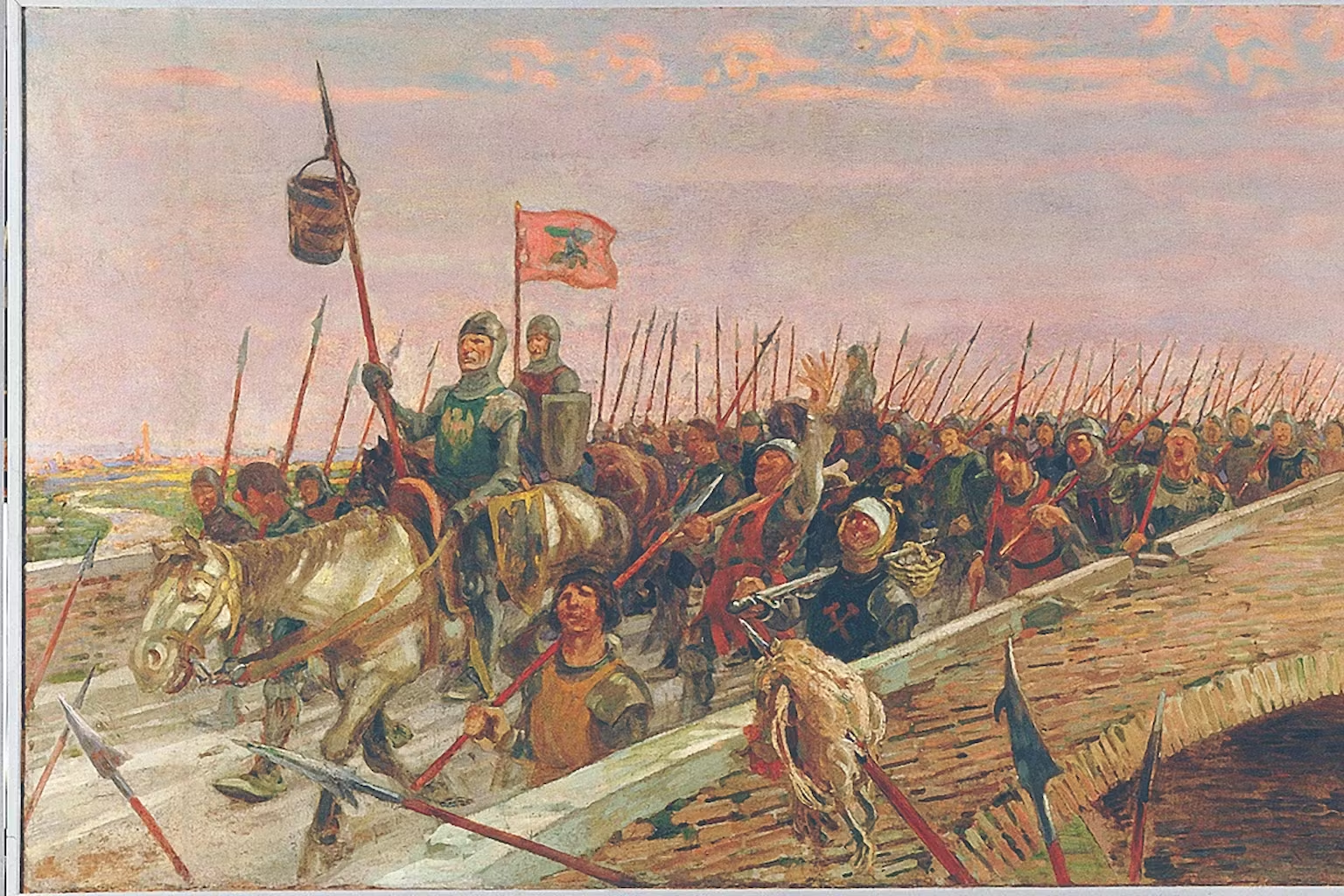
 In the year 1325, two proud Italian city-states went to war.
Not over territory.
Not over gold.
Not over dynastic succession.
Over a bucket.
At least, that’s how the story has been remembered.
The War of the Bucket — fought between Bologna and Modena — is one of medieval Italy’s most delightfully absurd conflicts. The image is irresistible: rival cities mobilizing armies, clashing in battle, and reshaping regional politics because someone stole a wooden water pail from a well.
The truth, as usual, is more complicated.
The bucket was real.
The war was real.
But the causes ran deeper — into factional rivalry, papal politics, and a divided Italy simmering with tension.
The bucket simply became the symbol.
Italy in the 14th Century: A Patchwork of Pride
To understand the War of the Bucket, you must first understand medieval Italy.
Italy in the 1300s was not a unified nation.
It was a mosaic of:
-
Independent city-states
-
Duchies
-
Republics
-
Papal territories
Cities like Florence, Venice, Milan, Bologna, and Modena were fiercely autonomous. They were wealthy, competitive, and deeply political.
At the heart of many conflicts were two rival factions:
-
The Guelphs, who supported the Pope
-
The Ghibellines, who supported the Holy Roman Emperor
These allegiances were not abstract.
They shaped alliances, trade relationships, and military campaigns.
And Bologna and Modena stood on opposite sides.
Bologna vs. Modena: A Long Rivalry
Bologna was a stronghold of the Guelph faction.
Modena leaned Ghibelline.
The two cities were geographically close — separated by less than 40 miles — and historically antagonistic.
Border disputes were common.
Skirmishes erupted periodically.
Raids were not unusual.
This was not peaceful coexistence.
It was simmering hostility.
The Bucket Incident
According to tradition, in 1325, soldiers from Modena raided Bologna and stole a wooden bucket from a public well.
The theft was meant as an insult.
In medieval culture, symbolic gestures mattered enormously. Stealing a communal bucket — a mundane but essential object — was an act of mockery.
It suggested dominance.
It suggested humiliation.
Bologna demanded its return.
Modena refused.
And so, the story goes, war followed.
The Reality Beneath the Story
While the bucket theft occurred — and the bucket still exists in Modena today — the war was not literally caused by a pail.
The bucket was the spark in a landscape already soaked in tension.
Border disputes between the two cities had intensified.
Political factions were entrenched.
Alliances were forming across northern Italy.
In 1325, conflict was inevitable.
The bucket provided a convenient rallying cry.
The Battle of Zappolino
The war culminated on November 15, 1325, at the Battle of Zappolino.
Bologna fielded a large army — reportedly around 30,000 men.
Modena and its allies mustered perhaps 7,000.
On paper, Bologna had the advantage.
In practice, it did not.
The Modenese forces were well-led and strategically disciplined. They engaged Bologna’s army near the village of Zappolino.
The result was decisive.
Bologna’s forces were routed.
Despite their smaller numbers, Modena achieved a stunning victory.
Aftermath of the Battle
Following the defeat, Modenese troops advanced toward Bologna itself.
They did not capture the city — its walls were too strong — but they conducted a symbolic gesture that would immortalize the conflict.
They reportedly seized another bucket from a Bolognese well and carried it back to Modena as a trophy.
The bucket became a relic.
It still hangs today in the Torre della Ghirlandina in Modena.
The Bucket as Trophy
The preserved bucket is not necessarily the original stolen one — historians debate its authenticity.
But its presence in Modena’s cathedral tower cements the legend.
It transformed a regional conflict into a story.
Instead of being remembered as a factional war between Guelphs and Ghibellines, it became the War of the Bucket.
Humor replaced complexity.
Why the Story Endured
History often compresses complicated conflicts into simple narratives.
The War of the Bucket endured because:
-
It’s absurd.
-
It’s relatable.
-
It’s human.
A stolen bucket is easier to grasp than papal-imperial factionalism.
It provides a face — or rather, a handle — for memory.
Italy’s Culture of Rivalry
The war also reflects the culture of intense municipal pride that defined medieval Italy.
City-states competed in:
-
Trade
-
Architecture
-
Scholarship
-
Military strength
Insults were not trivial.
They were existential.
A stolen bucket could symbolize weakness.
And weakness invited danger.
The Cost of Pride
Though remembered humorously, the War of the Bucket had real consequences.
Men died at Zappolino.
Families were shattered.
Resources were drained.
What began as political rivalry escalated into bloodshed.
The bucket may be funny in hindsight.
The battle was not.
The Broader Conflict
The war did not fundamentally reshape Italy’s political map.
But it reinforced the fragmentation that would define the peninsula for centuries.
Italy would not unify until the 19th century.
In the 14th century, loyalty lay with city, not nation.
And cities fought fiercely.
The Satirical Poem
In 1622, centuries after the war, Italian poet Alessandro Tassoni wrote a mock-epic poem titled La Secchia Rapita (“The Stolen Bucket”).
The poem exaggerated the absurdity of the conflict, portraying it as an epic saga worthy of Homer.
Tassoni cemented the bucket’s role in cultural memory.
The war became satire.
Memory Over Mechanics
The War of the Bucket reminds us that history is shaped as much by storytelling as by fact.
The deeper causes — factional rivalry, imperial politics — fade in public memory.
The bucket remains.
It is tangible.
It is visual.
It is oddly charming.
Final Reflections: When Pride Tips the Scale
The War of the Bucket was not truly about a bucket.
It was about pride.
It was about factional loyalty.
It was about two neighboring cities unwilling to yield even symbolic ground.
But symbols matter.
A wooden pail became a banner of rivalry.
An insult became a battlefield.
And centuries later, the bucket still hangs in Modena — silent, unassuming, and immortal.
History is often remembered not for its complexity, but for its symbols.
In 1325, in the rolling hills of northern Italy, that symbol had a handle.
And it was worth fighting for.