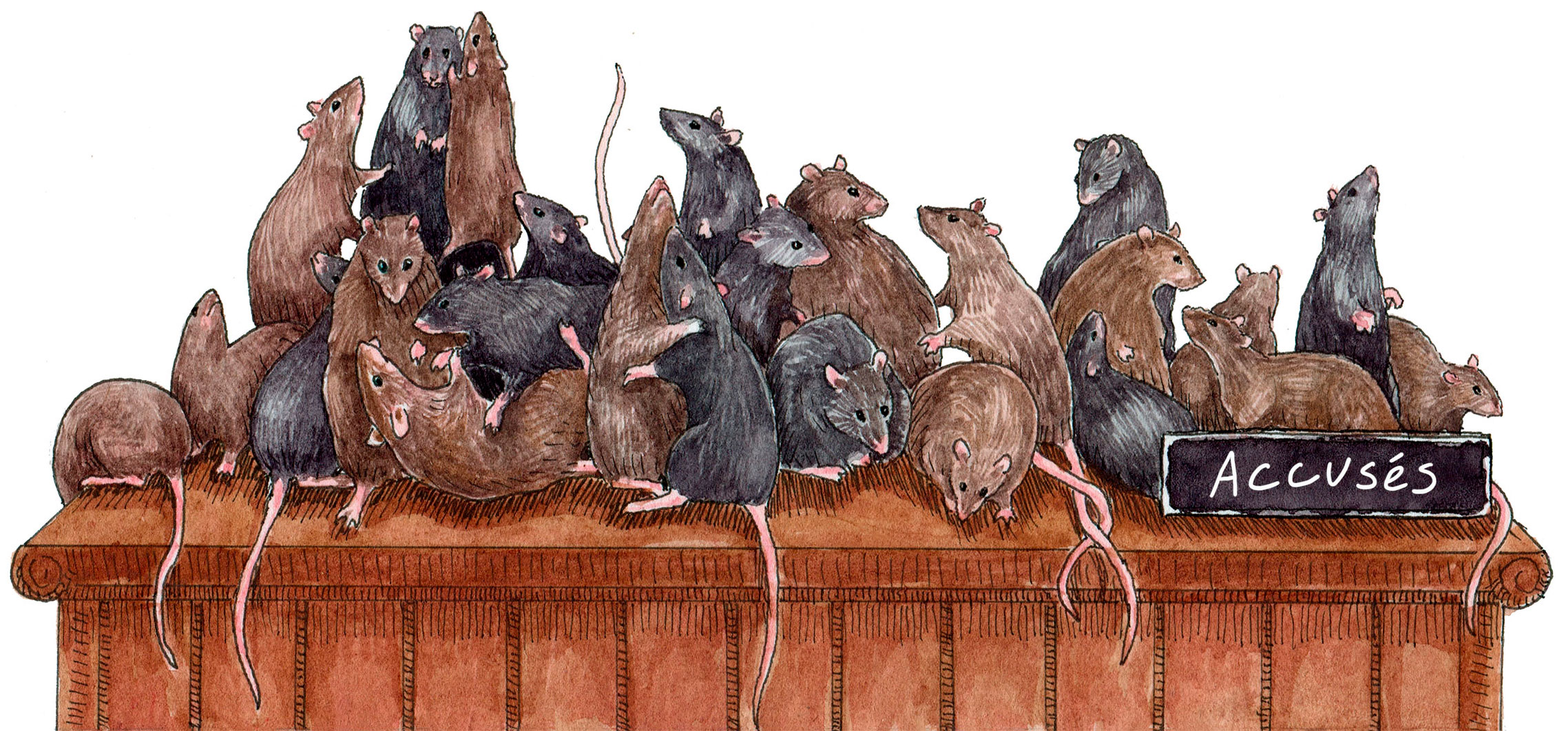
 In 1522, in the French town of Autun, something extraordinary happened.
The townspeople brought rats to court.
Not metaphorically.
Not as a joke.
They summoned them formally, accused them of criminal damage, and appointed them legal representation.
The charge?
Destroying the barley crop.
The accused?
Every rat in the district.
This was not satire. It was a real legal proceeding — one of several recorded cases in medieval and early modern Europe where animals were tried, prosecuted, and sometimes executed under human law.
The medieval trial of rats stands as one of history’s strangest intersections of faith, law, and pest control — a moment when the legal system attempted to reason with vermin.
And astonishingly, the rats almost won.
Animal Trials in the Middle Ages
To modern eyes, the idea of putting animals on trial feels absurd.
But in medieval Europe, it was not entirely uncommon.
Animals were tried for:
-
Murder (pigs killing children)
-
Property destruction
-
Blasphemy (insects devouring crops)
-
Disorderly behavior
There were two general categories of animal trials:
-
Domestic animal trials — where a specific animal (often a pig) was accused of harming a human. These were criminal trials.
-
Wild animal trials — where entire species were summoned to ecclesiastical courts for crop damage.
The trial of the rats at Autun fell into the second category.
The Crime: Destroying the Barley
In early 16th-century France, agriculture was survival.
If barley failed, bread failed.
If bread failed, hunger followed.
In Autun, rats were devastating the barley fields.
The damage was not minor.
It threatened food supply and economic stability.
The townspeople sought justice — not merely pest control.
Justice.
Summoning the Accused
The local ecclesiastical court issued a formal summons to the rats.
A public proclamation ordered them to appear in court on a specified date to answer charges.
This was not symbolic.
The summons was read aloud in multiple locations so that, legally speaking, the rats were “notified.”
When the court date arrived, the rats did not appear.
The prosecution moved for judgment in absentia.
But then something remarkable happened.
The Defense Attorney
The court appointed an advocate to represent the rats.
His name was Bartholomew Chassenée — a young lawyer who would later become a respected jurist.
Chassenée did not treat the case as a farce.
He mounted a serious defense.
First, he argued that the summons had not been properly served.
Rats were scattered across the countryside.
A general announcement in town did not guarantee that all rats had been notified.
Therefore, the summons was legally insufficient.
The court agreed.
A new summons was issued — this time to be read in every parish.
The Second Hearing
When the rats again failed to appear, Chassenée presented a new defense.
He argued that the journey to court was dangerous.
The roads between fields and the courthouse were filled with cats.
To compel the rats to appear would be to expose them to mortal peril.
Therefore, safe conduct must be guaranteed.
This was not sarcasm.
This was legal reasoning.
The court faced a dilemma.
Could it ensure safe passage for rats?
It could not.
The case stalled.
The Outcome
Ultimately, the trial faded.
The rats were never convicted.
No sentence was carried out.
The court could not practically enforce its authority over vermin.
In a technical sense, the rats escaped justice — thanks to procedural defenses.
Why Hold Such a Trial?
To modern readers, this episode feels absurd.
But it reveals much about medieval legal philosophy.
Medieval law was deeply intertwined with theology.
The world was viewed as a divinely ordered system.
If animals disrupted that order, they could be called to account.
Trials were not merely about punishment.
They were about restoring cosmic balance.
Theological Underpinnings
In medieval Christian thought, all creatures were part of God’s creation.
While animals lacked rational souls, they could still participate in moral order.
Ecclesiastical courts sometimes issued excommunications against swarms of insects or rats.
These spiritual penalties were believed to compel creatures to cease destructive behavior.
In a worldview where prayer could alter weather, it was not irrational to think law could influence animals.
The Role of Symbolism
The trial also served a symbolic function.
Publicly addressing the rat infestation through legal ritual may have reassured the population.
It demonstrated that authorities were taking action.
Even if practical pest control was limited, moral authority was asserted.
The ritual mattered.
Chassenée’s Brilliance
Bartholomew Chassenée’s defense became famous in legal history.
He treated the rats as clients deserving due process.
He insisted on:
-
Proper notification
-
Fair procedure
-
Protection from harm
His arguments were so well constructed that they elevated what could have been a mockery into a legitimate legal precedent about procedural fairness.
In defending rats, he demonstrated the strength of law.
Other Animal Trials
The trial of the rats was not unique.
In medieval Europe:
-
A pig was executed in 1386 for killing a child.
-
A rooster was burned at the stake for allegedly laying an egg (considered unnatural).
-
Insects were excommunicated for damaging vineyards.
Some trials resulted in public executions of animals dressed in human clothing.
The line between symbol and sincerity was thin.
Pest Control by Prayer
In cases involving insects or rodents, ecclesiastical courts sometimes issued spiritual commands.
If the creatures failed to comply, they could be formally cursed.
In an era without modern pest management, spiritual recourse felt tangible.
Communities needed to believe they had tools against uncontrollable forces.
The Rational Core
Though strange, these trials reflect a coherent medieval logic.
If law governed human society, and society was part of divine order, then disorder anywhere — even among animals — required response.
Justice was not merely secular.
It was cosmic.
The trial of the rats was an attempt to restore harmony.
Modern Interpretations
Today, historians view animal trials as windows into medieval mentality.
They reveal:
-
The seriousness of legal ritual
-
The blending of theology and governance
-
The human need to impose order on chaos
They are not evidence of stupidity.
They are evidence of worldview.
The Persistence of Legal Formalism
One striking element of the rat trial is the emphasis on procedure.
Chassenée’s insistence on proper summons and safe conduct reflects a legal system concerned with fairness.
Even in a case involving rodents, due process mattered.
In that sense, the trial demonstrates respect for law — not mockery.
Final Reflections: When Justice Has Whiskers
The medieval trial of rats stands as one of history’s most peculiar legal episodes.
But beneath the absurdity lies something profound.
It shows that law is not merely practical.
It is symbolic.
It reassures communities.
It structures fear.
It offers ritual in the face of uncertainty.
In 1522, the people of Autun faced a genuine threat — crop destruction and potential famine.
They turned to their most powerful institution: the court.
The rats did not appear.
The barley may still have suffered.
But for a moment, the community asserted that even vermin were subject to order.
And in that assertion, they found control.
The rats scurried on.
The court adjourned.
And history was left with a tale where whiskers met writ — and law, improbably, took the side of the accused.