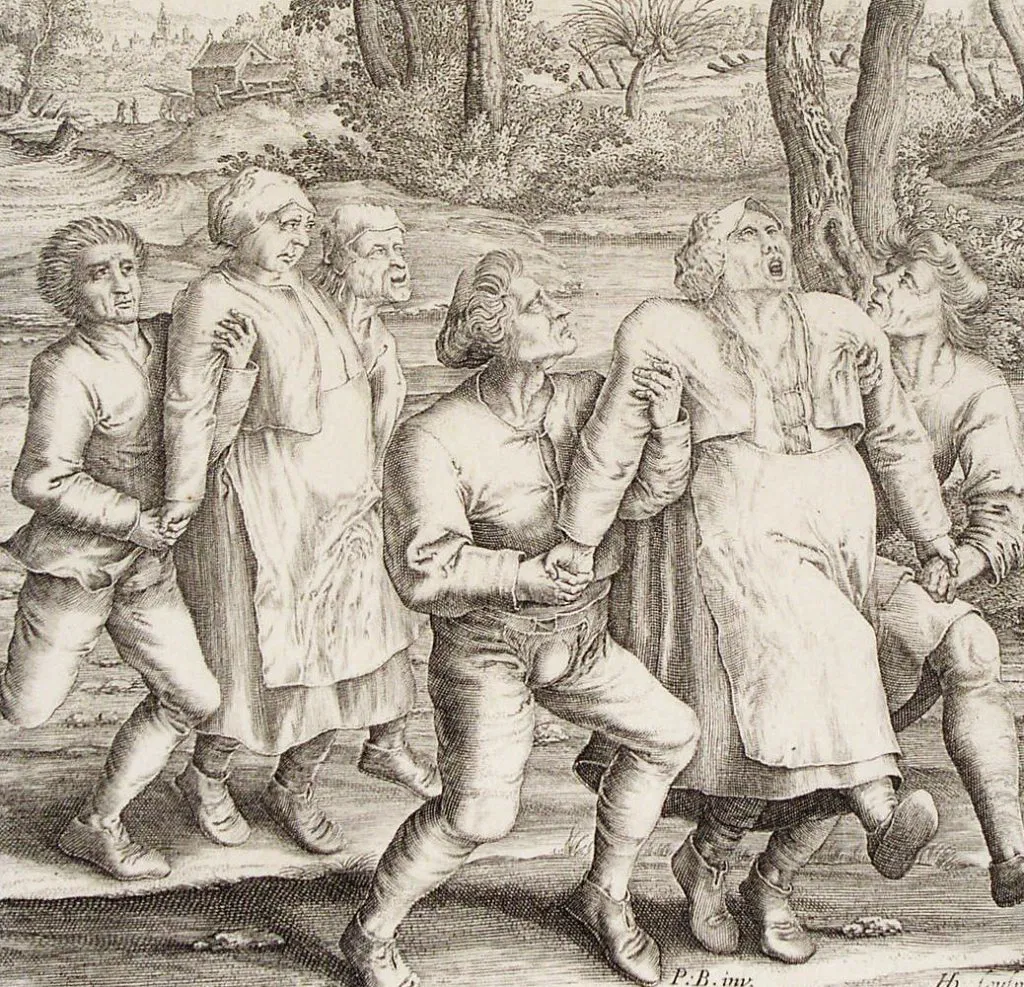
 In the summer of 1518, the city of Strasbourg—then part of the Holy Roman Empire—became the stage for one of the strangest mass events in recorded history. It began quietly, almost invisibly. A woman stepped into the street and started to dance. Not in celebration. Not to music. Just dancing. And she didn’t stop.
Within weeks, hundreds of people had joined her, writhing, leaping, and convulsing in public spaces, some dancing until they collapsed from exhaustion. Chroniclers claimed that dozens died from heart attacks, strokes, and sheer physical collapse. The authorities, utterly baffled, tried to treat the problem with music, platforms, and hired dancers—only to make it worse.
This was the Dancing Plague of 1518, an episode that still unsettles historians, psychologists, and medical experts alike. Was it mass hysteria? Poisoned bread? Religious mania? Or something darker—a psychological breaking point in a society stretched beyond endurance?
Whatever the cause, it remains one of the most haunting examples of collective human behavior ever recorded.
Strasbourg in 1518: A City on the Brink
Strasbourg in the early 16th century was not a happy place. The city was suffering through a convergence of disasters that created perfect conditions for psychological collapse.
The early 1500s brought:
-
Severe famine caused by crop failures
-
Rising food prices that left the poor desperate
-
Recurring outbreaks of disease, including smallpox and syphilis
-
Religious anxiety, fueled by apocalyptic preaching and fear of divine punishment
Life was brutal, short, and unpredictable. People believed deeply in divine judgment, curses, and saints who could bless—or punish—entire communities.
Stress was not an abstract concept. It was a daily, grinding reality.
Patient Zero: Frau Troffea
On or around July 14, 1518, a woman known as Frau Troffea stepped into a narrow Strasbourg street and began dancing.
There was no music.
No festival.
No explanation.
She danced for hours. When night came, she collapsed from exhaustion—only to rise the next day and continue. By the end of the week, her feet were bruised and bleeding. Her body shook uncontrollably. Yet she could not stop.
Neighbors watched in confusion and fear. Some laughed. Others prayed. Many whispered that she was cursed.
Then something far stranger happened.
Others began dancing too.
The Contagion Spreads
Within days, dozens of people had joined Frau Troffea. By August, estimates suggest as many as 400 dancers filled the streets, bridges, and marketplaces of Strasbourg.
The symptoms were horrifying:
-
Uncontrollable, frantic movement
-
Shaking and convulsions
-
Sweating and fever
-
Screaming and hallucinations
-
Collapse from exhaustion
Some dancers reportedly begged for help, insisting they wanted to stop but physically could not. Others seemed possessed, staring blankly while their bodies thrashed.
Chroniclers claimed that up to 15 people per day were dying at the height of the plague, though modern historians treat this number cautiously.
Still, deaths did occur.
And no one knew why.
The Authorities Make a Catastrophic Mistake
The city council of Strasbourg convened physicians, clergy, and civic leaders to determine the cause. Their conclusion now seems astonishing.
The doctors ruled out demonic possession.
They ruled out witchcraft.
They ruled out divine punishment.
Instead, they diagnosed the dancers with “hot blood”, a supposed imbalance of bodily humors that required release through movement.
Their solution?
Let them dance it out.
When Treatment Becomes Fuel
Believing that suppressing the dancers would worsen the condition, authorities made a decision that would define the event’s legacy.
They:
-
Built wooden dance platforms in public squares
-
Hired musicians to play lively tunes
-
Paid professional dancers to join in
The logic was simple: if dancing was the illness, dancing would also be the cure.
The result was catastrophic.
Music amplified the frenzy. Crowds gathered. The dancing intensified. More people joined, whether through psychological suggestion or fear that resisting would make them next.
What began as a medical crisis turned into a city-wide nightmare.
Collapse, Death, and Silence
As August wore on, dancers began collapsing in greater numbers. Some suffered heart attacks. Others died from strokes or sheer physical exhaustion. Feet rotted. Shoes filled with blood.
The city finally realized its error.
Music was banned.
Platforms were dismantled.
Dancers were forcibly removed from public spaces.
The afflicted were sent to shrines and sanctuaries, particularly to the Shrine of Saint Vitus, a figure long associated with dancing illnesses and nervous disorders.
Gradually—mercifully—the plague began to fade.
By early September, the dancing had stopped.
The Shadow of Saint Vitus
Saint Vitus looms large in this story. Medieval Europeans believed he had the power both to curse people with uncontrollable movement and to heal them.
Earlier outbreaks of “dancing mania” across Europe were often labeled St. Vitus’ Dance, a term later borrowed by medicine to describe certain neurological disorders.
Pilgrimages to Saint Vitus’ shrines were thought to calm afflicted bodies through prayer, fasting, and ritual—methods that, in hindsight, may have provided something crucial: rest, isolation, and relief from social pressure.
What Caused the Dancing Plague?
Five centuries later, no explanation fully satisfies. Several theories dominate the debate.
1. Ergot Poisoning
Ergot is a hallucinogenic fungus that grows on rye. Ingesting it can cause spasms, hallucinations, and convulsions.
While tempting, this theory struggles to explain:
-
Why symptoms lasted for weeks
-
Why movements appeared coordinated
-
Why only certain individuals were affected
2. Religious Mania
Medieval Europe was steeped in apocalyptic belief. Collective religious ecstasy could explain some behavior, but it doesn’t account for the intense physical suffering or pleas to stop dancing.
3. Neurological Illness
Some suggest epilepsy or chorea, but these conditions don’t spread socially or affect hundreds simultaneously.
4. Mass Psychogenic Illness
Most modern historians and psychologists favor this explanation.
Extreme stress.
Shared belief systems.
Visible suffering.
Social contagion.
The dancing plague may have been a collective psychological breakdown, manifesting physically in a society already pushed past its limits.
Why It Spread So Fast
The key wasn’t weakness—it was context.
The people of Strasbourg were:
-
Malnourished
-
Fearful of divine punishment
-
Surrounded by death and uncertainty
-
Living in tightly packed communities
When one person broke, others followed—not consciously, but neurologically and emotionally.
The mind found an outlet when words failed.
A City Haunted by Its Own Bodies
What makes the Dancing Plague so unsettling isn’t just its strangeness—it’s its familiarity.
Modern parallels exist:
-
Mass fainting episodes
-
Psychogenic illnesses in schools
-
Panic disorders spreading through communities
We like to believe we are immune to such things.
History says otherwise.
The Silence After the Music
After 1518, Strasbourg recorded no similar outbreak on that scale. The city quietly moved on. No monuments were built. No lessons were formally learned.
But the story survived.
It lingered in medical texts, folklore, and whispered curiosity—a reminder that human behavior can slip its leash under the right conditions.
Final Thoughts: When the Body Speaks
The Dancing Plague of 1518 wasn’t madness in the way we imagine it. It was despair given motion. Trauma given rhythm.
When language, politics, and religion failed to ease suffering, the body found another way to speak.
And it spoke through motion—relentless, exhausting, and ultimately deadly.
Sometimes history doesn’t scream.
Sometimes it dances.