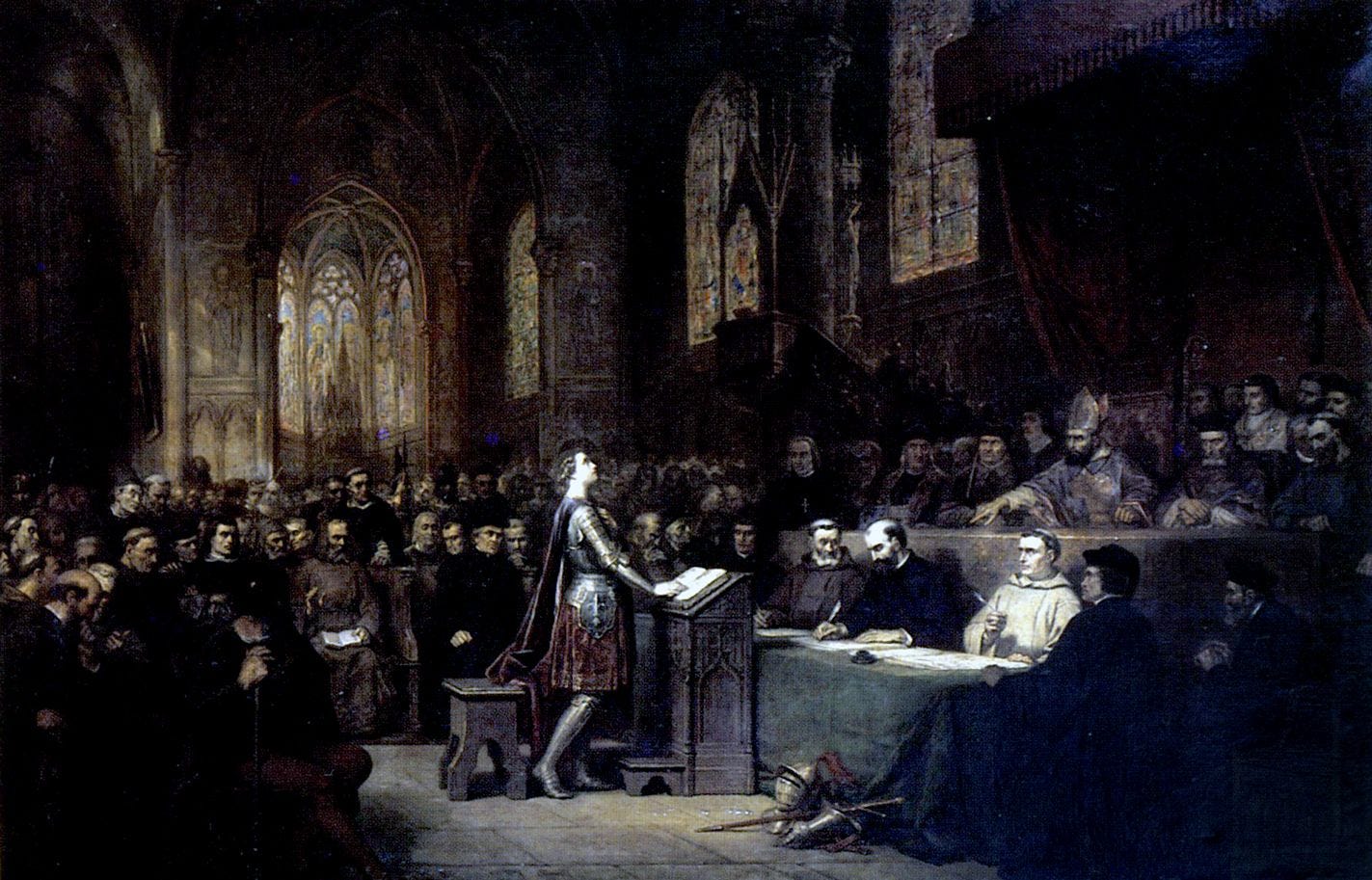
 On May 30, 1431, in the marketplace of Rouen, a nineteen-year-old peasant girl was tied to a stake and burned as a heretic. The English and their Burgundian allies had condemned her in a church court. The flames rose. Witnesses said her heart would not burn. When the fire died down, her executioners raked through the ashes to ensure nothing recognizable remained.
They cast the remains into the Seine River.
That should have been the end.
But centuries later, bones said to belong to Joan of Arc would resurface — sealed in a jar, revered as relics, and ultimately subjected to scientific scrutiny in what became, in effect, a posthumous trial.
Were they truly hers? Or were they part of a pious myth layered atop one of history’s most dramatic martyrdoms?
The trial of Joan of Arc’s bones reveals not only the endurance of faith and nationalism, but the collision between medieval devotion and modern forensic science.
Fire and Erasure
Joan’s execution was designed to erase her.
Captured in 1430 and sold to the English, she was tried for heresy by a church court sympathetic to English interests. The charges were theological and political: cross-dressing, claiming divine voices, defying ecclesiastical authority.
Her trial was irregular, biased, and later condemned as corrupt. But in 1431, the verdict stood. She was burned alive.
Executions by fire were meant to obliterate both body and memory. Her ashes were thrown into the Seine specifically to prevent the collection of relics. Medieval Europe was saturated with saintly bones and fragments. The English wanted no such cult forming around the Maid of Orléans.
Ironically, their efforts failed in the long term. In 1456, after the English were expelled from France, a retrial nullified her conviction. She was declared innocent. Centuries later, she became a national heroine and, in 1920, a canonized saint of the Catholic Church.
But the physical remains were thought lost forever.
Until they weren’t.
The Jar in the Pharmacy
In 1867, during renovations at a pharmacy in Paris, a jar was discovered bearing a label that claimed it contained the remains of Joan of Arc.
Inside were fragments of bone, charcoal, and what appeared to be bits of linen. The label asserted that these were salvaged from the pyre at Rouen in 1431.
The discovery electrified France.
By the 19th century, Joan had become more than a medieval curiosity. She was a symbol of French identity, especially after national humiliation in wars such as the Franco-Prussian War. To possess her relics would mean holding a tangible piece of sacred and national history.
The Church accepted the relics cautiously but reverently. They were displayed and venerated. Pilgrims came to see them.
For decades, few questioned their authenticity. Relics had long been part of Catholic devotional life. Skepticism existed, but faith often prevailed.
Yet modern science was advancing. And eventually, someone asked the obvious question:
Were these bones really hers?
A Saint Under the Microscope
In the early 2000s, the French Catholic Church authorized scientific testing of the remains. A multidisciplinary team of forensic experts, pathologists, and chemists was assembled.
It was an extraordinary moment — a medieval martyr subjected to 21st-century laboratory analysis.
Carbon dating, microscopic examination, chemical profiling — the works.
The results were startling.
The bones were not from a 15th-century European woman.
They were far older.
And they did not appear to be human.
What the Science Revealed
Radiocarbon dating placed the bones somewhere between the 3rd and 6th centuries BCE — more than a thousand years before Joan of Arc was born.
Even more surprising, chemical analysis suggested that some fragments belonged not to a human, but to a mummified Egyptian body.
Traces of bitumen and resin — substances used in ancient Egyptian embalming — were detected. The linen fibers resembled those associated with mummification practices.
In other words, the relics were likely a mix of animal bone and Egyptian mummy fragments.
How did Egyptian material end up in a jar labeled as Joan of Arc’s remains?
The most plausible explanation points to 19th-century relic trade and antiquarian curiosity. During that era, mummy fragments were widely available in Europe. They were sold as curiosities, ground into “mummy powder” for dubious medicinal uses, and collected as exotic artifacts.
At some point, perhaps intentionally or perhaps through confusion, these fragments were assembled and labeled as Joan’s remains.
The jar itself may have been created as a devotional object rather than a deliberate fraud. But the scientific verdict was clear:
They were not her bones.
A Different Kind of Trial
The testing of the relics felt, symbolically, like a new trial.
In 1431, Joan was judged by clerics hostile to her cause. In 2006, her supposed remains were judged by scientists armed with microscopes and spectrometers.
Both trials centered on truth.
But this time, the goal was not condemnation — it was clarity.
The Church accepted the findings. The relics were acknowledged as inauthentic. The myth of preserved bones was gently set aside.
Joan of Arc did not need physical remains to sustain her legacy.
Her story was stronger than any fragment of bone.
Why People Wanted to Believe
The persistence of the relics speaks to a deep human desire for tangible connection to history.
Joan of Arc is not merely a historical figure. She is a symbol — of faith, of patriotism, of courage in the face of overwhelming odds.
She claimed to hear divine voices instructing her to support the dauphin, the future Charles VII. She led troops to lift the siege of Orléans. She altered the course of the Hundred Years’ War. She was captured, tried, and executed before her twentieth birthday.
Her story reads like myth.
Relics offer physical grounding to mythic narratives. To stand before a bone fragment labeled as hers is to bridge centuries. It makes history intimate.
That longing can blur skepticism.
The discovery of the jar in 1867 occurred during a time when nationalism and Catholic revivalism intersected in France. Joan was being rediscovered as a unifying figure. Having her remains would have strengthened that symbolism immeasurably.
It is easy to see why few rushed to disprove the claim.
Relics and Reputation
The medieval world was saturated with relics — bones of saints, fragments of the True Cross, vials of holy blood. Authenticity was often secondary to devotion.
By the 19th century, however, attitudes were shifting. Enlightenment skepticism and scientific inquiry had reshaped intellectual life. Relics were increasingly subject to scrutiny.
The trial of Joan’s bones sits at the intersection of those worlds.
It reveals how modern science can challenge inherited narratives — but also how faith adapts.
When the relics were shown to be inauthentic, Joan’s sanctity did not diminish. Her canonization in 1920 had been based on historical testimony, not physical remains.
Her martyrdom did not require bone fragments.
The Enduring Power of the Story
Perhaps the most striking element of this episode is how little it ultimately changed.
The revelation that the bones were Egyptian mummy fragments did not tarnish Joan’s reputation. It did not reduce her symbolic power in France or within the Catholic Church.
If anything, the story added another layer to her legend.
The English burned her body to prevent relics from forming a cult. Centuries later, false relics emerged anyway. Science dismantled them — and her legend endured untouched.
It underscores a paradox: attempts to control memory often fail.
The English tried to erase her physically.
The jar tried to resurrect her materially.
Neither succeeded in defining her legacy.
Joan Beyond the Bones
Today, Joan of Arc remains one of the most iconic figures in French history.
She is commemorated in statues across France. Streets bear her name. Writers, filmmakers, and historians revisit her life endlessly. She occupies a unique space — saint and soldier, mystic and nationalist symbol.
Her physical body may be lost to the Seine, but her story is indestructible.
The trial of her bones reminds us that history is not merely about artifacts. It is about narrative.
And some narratives are too powerful to depend on relics.
Science vs. Myth — Or Science Alongside Myth?
It would be easy to frame the episode as science triumphing over superstition.
But the reality is subtler.
The Church authorized the testing. The findings were accepted. Faith and science did not clash violently. They coexisted.
The relics were not needed to sustain belief. Their exposure as inauthentic did not undermine Joan’s canonization or the Church’s position.
Instead, the episode demonstrates how institutions evolve.
The medieval world might have clung to the bones as sacred regardless of evidence. The modern Church allowed inquiry.
The result was not disillusionment, but clarification.
The Afterlife of a Martyr
There is something fitting about the absence of Joan’s remains.
She was a figure of fire and voice — ephemeral, intense, impossible to contain. Her power lay not in her body but in her conviction.
Her executioners feared that physical relics would fuel rebellion. In their absence, her story did.
Five centuries later, a jar of bones tried to fill that physical void.
Science opened it.
And found something else entirely.
Conclusion: Ashes and Identity
The trial of Joan of Arc’s bones was not a courtroom spectacle. There were no robed judges or heated testimony.
But it was a reckoning.
A jar discovered in a Parisian pharmacy carried the promise of tangible connection to one of history’s most dramatic lives. For decades, it was treated as sacred. Then microscopes and carbon dating quietly dismantled the claim.
The bones were ancient, yes.
But not hers.
And yet, her story remained untouched.
Joan of Arc’s true legacy was never in fragments of charred bone. It was in the idea of a young woman who believed so fiercely in her mission that she faced fire without recanting.
The English sought to scatter her into nothingness.
History gathered her anyway.
No relic required.