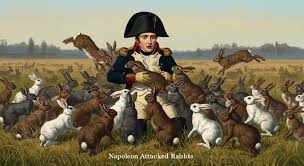
 Napoleon Bonaparte conquered most of Europe. He shattered empires, rewrote borders, and reshaped modern warfare. His enemies feared him. His soldiers worshiped him. His name became synonymous with domination, ambition, and military genius.
And yet.
In 1807, after defeating Prussia and Russia, the man who humbled kings and crushed armies was forced into retreat by an enemy he never saw coming.
Rabbits.
Not metaphorical rabbits. Not symbolic rabbits. Actual rabbits—small, fluffy, squeaking, relentlessly aggressive rabbits.
This is the true story of the day Napoleon Bonaparte was attacked by a swarm of bunnies, and how one of history’s greatest conquerors learned that nature does not respect reputations.
Setting the Scene: Napoleon at the Height of His Power
By 1807, Napoleon Bonaparte was untouchable.
He had:
-
Defeated Austria at Austerlitz
-
Crushed Prussia at Jena-Auerstedt
-
Humiliated Russia at Friedland
The Treaties of Tilsit made him the unquestioned master of continental Europe. France was at its apex. Napoleon was not merely winning wars—he was redefining them.
To celebrate these victories, Napoleon decided to do something refreshingly normal.
He went hunting.
A Victory Hunt Goes Horribly Wrong
Hunting was a common pastime for European elites, but for Napoleon, it was also symbolic—a ritual of dominance over nature itself. A hunt following a major military victory made sense.
Napoleon instructed his chief of staff, Louis-Alexandre Berthier, to organize a grand rabbit hunt near the Château de la Fère (or possibly near Tilsit; sources vary).
The plan was simple:
-
Release a large number of rabbits
-
Let Napoleon and his officers shoot them
-
Enjoy an afternoon of aristocratic sport
Berthier, eager to please, set about making it memorable.
He succeeded.
The Fatal Mistake: Domestic Rabbits
Here’s where everything went wrong.
Berthier didn’t source wild rabbits.
He sourced tame, domesticated rabbits, likely purchased from local farmers. These animals were accustomed to being fed by humans. They associated people with food, not danger.
And there were hundreds of them.
Some accounts say thousands. Regardless of the exact number, there were far more rabbits than anyone expected—or needed.
This was not a hunt.
It was a logistical error waiting to explode.
The Moment of Release
On the appointed day, Napoleon arrived with his officers, dressed for sport and victory. The rabbits were released from cages and pens, expected to scatter into the fields.
Instead, they charged.
Witnesses later described a surreal scene: a mass of rabbits hopping—not away—but toward Napoleon and his entourage.
At first, everyone laughed.
Then the rabbits kept coming.
When Bunnies Turn Hostile
The rabbits swarmed Napoleon’s boots, leaping against his legs, climbing over one another to reach him. These weren’t panicked animals fleeing for survival.
They were hungry.
Napoleon attempted to shoo them away with his riding crop. Officers tried to scatter them. Servants waved their arms and shouted.
Nothing worked.
The rabbits regrouped and charged again.
This was not a single wave. It was repeated assaults, as if the rabbits were coordinating.
Retreat of the Emperor
As the situation escalated, Napoleon did something he almost never did in battle.
He retreated.
The emperor and his officers fled toward their carriages, pursued by an advancing tide of rabbits. Even mounted guards struggled to clear a path through the writhing mass of fur.
Napoleon reportedly climbed into his carriage, but the rabbits followed, attempting to jump inside.
Eventually, the doors were shut, and the carriages pulled away—leaving behind a field still teeming with victorious rabbits.
The hunt was over.
The rabbits had won.
Why This Happened: Psychology of a Bunny Army
The incident wasn’t supernatural or coordinated intelligence. It was a perfect storm of misunderstanding.
Domestic rabbits:
-
Associate humans with feeding
-
Do not fear people instinctively
-
Will swarm a perceived food source
When hundreds of such animals are released simultaneously, they behave like a living tide.
Napoleon wasn’t being attacked in the predatory sense.
He was being overwhelmed by expectation.
Immediate Aftermath: Quiet Embarrassment
There were no official reports.
No military dispatches.
No medals awarded to the rabbits.
The incident was quietly absorbed into Napoleon’s growing mythos—but as an awkward footnote rather than a celebrated event.
Officers reportedly found it hilarious.
Napoleon, less so.
But even he reportedly laughed about it later—though one suspects the laughter was forced.
How We Know This Happened
The story survives through:
-
Memoirs of Napoleon’s contemporaries
-
Biographies written decades later
-
Oral retellings passed down through military history
Some historians debate details—location, number of rabbits, exact reactions—but few doubt the core event occurred.
Napoleon’s life was among the most documented in history. For a story this absurd to persist, it had to be at least mostly true.
Why This Story Endures
The rabbit incident has survived not because it changes history—but because it humanizes it.
Napoleon is often portrayed as:
-
A military machine
-
A genius without weakness
-
A man larger than life
The rabbits puncture that image.
They remind us that no amount of power protects you from the unexpected.
Symbolism: Empire vs. Chaos
In retrospect, the rabbit attack feels symbolic.
Napoleon believed:
-
Everything could be planned
-
Everything could be controlled
-
Logistics could conquer chaos
The rabbits proved otherwise.
They weren’t enemies.
They weren’t rebels.
They weren’t even wild.
They were a reminder that systems fail in strange ways.
Comparisons to Napoleon’s Downfall
Historians can’t resist the irony.
Just a few years later:
-
Napoleon underestimated Russia
-
Logistics failed in winter
-
Retreat became inevitable
Like the rabbits, the Russian winter wasn’t an enemy in the traditional sense.
It was indifference.
History has a sense of humor.
Not the Only Time Animals Defied Armies
Napoleon wasn’t alone in being humbled by animals.
History is full of similar moments:
-
Hannibal losing elephants in the Alps
-
Roman legions panicking over camels
-
Horses refusing battle conditions
Animals don’t care about rank.
They don’t read strategy.
They react.
The Rabbits’ Legacy
No monument marks the site of the Great Rabbit Rout.
No plaque commemorates their victory.
No children’s book properly does it justice.
But the story survives because it reveals something essential:
Power is fragile.
Control is temporary.
And sometimes, history trips over its own feet—or its own rabbits.
Final Thoughts: The Most Honest Battle
Napoleon’s rabbit encounter doesn’t diminish him.
It completes him.
It shows that even the greatest figures are subject to the ridiculous. That the universe occasionally reminds us not to take ourselves too seriously.
Napoleon conquered Europe.
But on one strange afternoon, Europe’s greatest conqueror was defeated by fluffy animals who just wanted dinner.
And honestly?
That might be history’s most perfect ending.