 On the morning of June 30, 1908, a fireball tore across the sky above a remote region of Siberia. Moments later, an explosion erupted with a force so immense it flattened forests, shattered windows hundreds of miles away, and sent shockwaves around the planet.
No crater was ever found.
No impactor was ever recovered.
No official explanation satisfied everyone.
This was the Tunguska explosion, the largest impact event in recorded human history—and one of the strangest. For more than a century, it has lived at the intersection of science, speculation, and cosmic dread.
Something from space detonated over Earth.
And we were lucky it happened where almost no one lived.
A Remote Corner of the World
The explosion occurred near the Podkamennaya Tunguska River, in what is now Krasnoyarsk Krai, Russia.
In 1908, this was deep wilderness:
-
Dense taiga forest
-
Sparse indigenous Evenki settlements
-
Virtually no infrastructure
Had the blast occurred over a major city, history would look very different.
Instead, it obliterated trees.
The Morning the Sky Burned
At approximately 7:17 AM local time, witnesses saw a brilliant object streak across the sky from southeast to northwest.
Eyewitness accounts describe:
-
A blinding white-blue light
-
A fireball brighter than the sun
-
A series of thunderous booms
Moments later, the shockwave hit.
People were thrown to the ground.
Windows shattered hundreds of miles away.
Heat scorched the landscape.
One witness said it felt like “the sky split in two.”
An Explosion Without a Crater
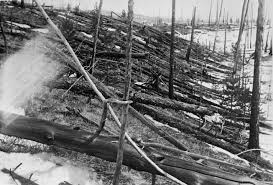
The blast flattened approximately 80 million trees across 830 square miles.
Trees near the center were scorched and stripped of branches, standing upright like telegraph poles. Further out, forests lay flattened in a radial pattern, pointing away from a central point.
And yet:
No crater.
No debris field.
No impact site.
This absence became the mystery’s heartbeat.
How Powerful Was It?
Modern estimates place the explosion’s energy between 10 and 15 megatons of TNT—roughly equivalent to a large thermonuclear weapon.
To put that in perspective:
-
Hiroshima: ~15 kilotons
-
Tunguska: ~1,000 times stronger
The explosion was heard 600 miles away.
Atmospheric pressure waves were detected worldwide.
Night skies glowed in Europe and Asia for days afterward.
The Shock Felt Around the World
In the days following the event, people reported:
-
Luminous night skies bright enough to read by
-
Unusual cloud formations
-
Atmospheric disturbances
Scientists later concluded that dust and aerosols from the explosion had entered the upper atmosphere, scattering sunlight globally.
The Earth had been struck.
Why No One Investigated Right Away
Given its scale, you might expect immediate scientific response.
But this was 1908 Russia.
The region was inaccessible.
The country was unstable.
Resources were limited.
It took nearly 20 years before a proper expedition arrived.
Enter Leonid Kulik
In the 1920s, Russian scientist Leonid Kulik led multiple expeditions into the Tunguska region.
What he found was astonishing.
Miles of flattened forest.
Trees burned and snapped like matchsticks.
No crater.
Kulik became convinced the cause was a meteorite—just one that exploded in midair.
He never found physical fragments.
But his documentation turned legend into science.
The Airburst Theory
The most widely accepted explanation today is that Tunguska was caused by an airburst—an object exploding in the atmosphere rather than hitting the ground.
Likely candidates:
-
A stony asteroid
-
A comet fragment
Traveling at tens of thousands of miles per hour, the object encountered Earth’s atmosphere, heated rapidly, and disintegrated violently at an altitude of 5–10 kilometers.
The resulting explosion flattened everything below.
No crater needed.
Asteroid or Comet?
Scientists still debate what the object actually was.
Asteroid Theory
-
Explains the explosive force
-
Matches known airburst physics
Comet Theory
-
Explains lack of debris
-
Accounts for atmospheric effects
Either way, the conclusion is chilling.
Earth was hit by something big.
Wild Theories and Fringe Ideas
Tunguska’s mystery has fueled speculation for decades.
Among the more infamous ideas:
-
A crashed alien spacecraft
-
Nikola Tesla’s death ray
-
A mini black hole
-
Antimatter collision
These theories persist because:
-
No impactor was found
-
The blast was unprecedented
-
The event happened in isolation
But none hold up to scientific scrutiny.
Still, the mystery invites imagination.
The Evenki Experience
Indigenous Evenki people living near the blast suffered greatly.
They described:
-
Reindeer killed by the shockwave
-
Forest spirits angry
-
A sky god punishing the land
Some survivors were thrown miles.
Others suffered burns and injuries.
Their oral histories preserve the terror science later quantified.
Could It Happen Again?
Yes.
And it already has—on a smaller scale.
In 2013, a meteor exploded over Chelyabinsk, Russia, injuring over 1,500 people.
That object was only about 20 meters wide.
The Tunguska object may have been 50–100 meters.
Earth is vulnerable.
A Cosmic Wake-Up Call
Tunguska reshaped how scientists think about planetary defense.
It showed that:
-
Space impacts don’t need craters to be devastating
-
Airbursts can cause massive destruction
-
Warning times may be zero
Modern asteroid tracking programs exist largely because of this realization.
Why We Were Lucky
If Tunguska had occurred:
-
Over London
-
Over New York
-
Over Tokyo
Casualties would have numbered in the millions.
Instead, it happened over forest.
Luck saved us.
The Silence After the Fire
Today, the Tunguska region has regrown.
Trees stand tall again.
The land appears normal.
But beneath the soil, the story remains.
A reminder that Earth is not isolated.
Legacy of Fear and Fascination
The Tunguska explosion occupies a unique space in human history.
It wasn’t war.
It wasn’t weather.
It wasn’t disease.
It was the universe reaching out and touching us—hard.
Final Thoughts: When the Sky Falls
The Tunguska explosion reminds us of our place in the cosmos.
We are small.
Our planet is fragile.
The universe is indifferent.
And sometimes, without warning, the sky itself becomes the enemy.
The fact that we’re still here isn’t proof of safety.
It’s proof of luck.