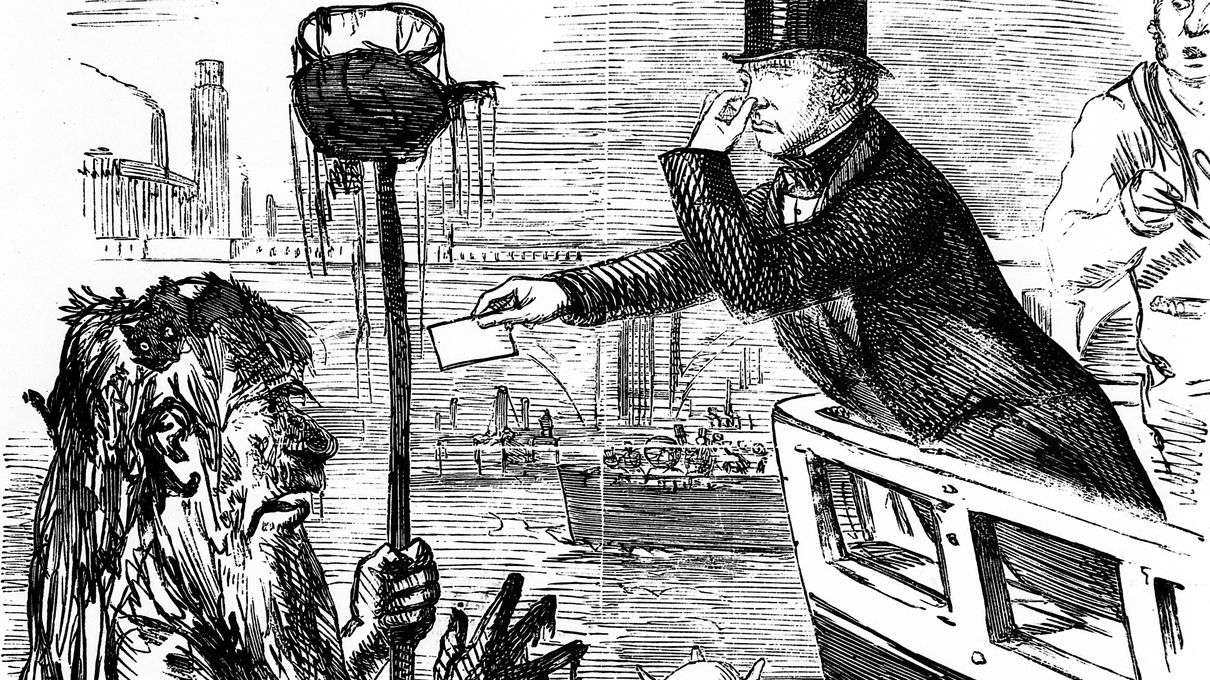
 In the summer of 1858, the most powerful city on Earth became almost uninhabitable.
London—the capital of an empire that ruled a quarter of the globe—was brought to its knees not by war, revolution, or plague, but by smell. A stench so overwhelming that it stopped government business, drove people from their homes, and forced Parliament to soak its curtains in chemicals just to remain open.
The River Thames, once the lifeblood of the city, had become an open sewer. Under a merciless heatwave, its contents began to rot in plain view. What followed was known simply, and with grim understatement, as The Great Stink.
It was disgusting. It was dangerous. And it changed modern cities forever.
London Before the Stink: A City Growing Faster Than Sense
By the mid-19th century, London was exploding.
The population had surged past 2.5 million, swollen by the Industrial Revolution. Factories belched smoke, tenements rose overnight, and people crowded into neighborhoods never designed to hold them.
Infrastructure did not keep up.
London’s medieval sewage system—if it could even be called that—was a patchwork of cesspits, open drains, and storm sewers designed to carry rainwater, not human waste. As indoor plumbing became more common, waste that once sat in cesspools was now flushed directly into the Thames.
The river became the city’s garbage chute.
The Thames: From River to Sewer
By the 1850s, the Thames was effectively dead.
-
Raw human sewage
-
Slaughterhouse waste
-
Industrial runoff
-
Decaying animal carcasses
All of it flowed directly into the water. Low tides revealed banks of black, bubbling sludge. Gas rose from the river in thick, choking clouds.
And yet, Londoners still drank from it.
Most believed disease spread through bad air—miasma, not contaminated water. The idea that invisible organisms could cause illness was radical and widely rejected.
The smell, however, was undeniable.
Heatwave of 1858: The Final Trigger
The summer of 1858 was unusually hot.
As temperatures climbed, the Thames slowed to a crawl. Sewage that might have been carried away instead stagnated. Organic matter fermented. Gases expanded.
The river didn’t just smell bad.
It became an assault.
Eyewitnesses described the stench as:
-
“A mephitic vapor”
-
“Indescribably offensive”
-
“Enough to knock a man senseless”
Boats stopped running. Windows along the river were sealed shut. Curtains were soaked in lime chloride in a desperate attempt to neutralize the odor.
Nothing worked.
Parliament Under Siege
Nowhere was the stink more politically significant than the Houses of Parliament.
Situated directly on the Thames, the building became almost unusable. Members of Parliament gagged during debates. Committees adjourned early. Some MPs reportedly fled the chamber mid-session.
The Speaker ordered drapes soaked in chemicals to be hung over windows.
Still, the smell penetrated everything.
For decades, reformers had warned about the Thames. Now, the stink had reached the noses of men who could actually do something about it.
And they were furious.
Cholera and Fear
The Great Stink wasn’t just offensive—it was terrifying.
London had already endured multiple cholera epidemics, killing tens of thousands. While doctors argued over causes, the public connected the smell with death.
They weren’t entirely wrong—just mistaken about the mechanism.
Cholera spreads through contaminated water, not air. But the Thames was both.
In trying to avoid bad smells, people often drank worse water.
The river was killing them twice.
John Snow Was Right — But Ignored
Years earlier, physician John Snow had demonstrated that cholera spread through contaminated water during the 1854 Broad Street outbreak. He removed a pump handle and stopped the epidemic.
His findings were dismissed.
The miasma theory remained dominant. Smell was blamed for disease. Clean water was a secondary concern.
Ironically, it was the smell—not the science—that finally forced reform.
A City at Breaking Point
The Great Stink was inescapable.
-
Businesses near the Thames closed
-
Property values collapsed
-
The poor suffered most, trapped in riverside slums
Newspapers mocked the situation mercilessly. Satirical cartoons depicted Father Thames strangling London with his fumes.
The empire that governed distant colonies could not manage its own waste.
Something had to change.
Enter Joseph Bazalgette
The unlikely hero of this crisis was an engineer named Joseph Bazalgette.
Bazalgette had been advocating for a modern sewer system for years. His plan was bold, expensive, and technically daunting.
It had also been repeatedly delayed.
Now, with Parliament gagging and the city furious, the money finally flowed.
Building a New London Underground
Bazalgette’s solution was revolutionary.
He proposed:
-
Over 1,300 miles of sewers
-
Massive underground intercepting tunnels
-
Pumping stations to move waste away from the city
-
Embankments that reshaped the Thames itself
Instead of dumping sewage into central London, waste would be carried downstream—away from drinking water intakes.
Construction began almost immediately.
Engineering Against Filth
The scale was staggering.
Millions of bricks were laid.
Steam engines powered pumps.
Entire neighborhoods were disrupted.
Bazalgette over-engineered everything—doubling pipe sizes beyond what calculations required.
He was mocked for it.
He would later be praised for it.
The Smell Begins to Fade
By the early 1860s, London began to change.
The Thames slowly cleared.
Cholera outbreaks declined.
The city became healthier.
The Great Stink was over.
But its legacy endured.
Why the Great Stink Matters
This wasn’t just a sanitation crisis.
It was a turning point in urban history.
The Great Stink:
-
Forced governments to invest in infrastructure
-
Advanced public health reform
-
Helped dismantle miasma theory
-
Set the model for modern sewer systems worldwide
Cities across Europe and America followed London’s lead.
Smell saved lives.
A Strange Irony
It’s deeply ironic that London didn’t act because people were dying.
It acted because powerful people were uncomfortable.
The poor had lived with the stink for decades.
It only mattered when Parliament couldn’t escape it.
The River That Remembered Everything
The Thames still flows through London today.
Cleaner now.
Safer.
Alive again.
But for one summer, it became a mirror—reflecting everything the city tried to ignore.
Industrial progress without planning.
Science without acceptance.
Power without responsibility.
Final Thoughts: When Filth Forces Change
The Great Stink of London reminds us that progress is often reactionary.
People can tolerate suffering.
They can ignore death.
But they cannot ignore what invades their senses.
Sometimes, history doesn’t turn on ideals or discoveries.
Sometimes, it turns on a smell so bad that an empire finally holds its nose—and builds something better.