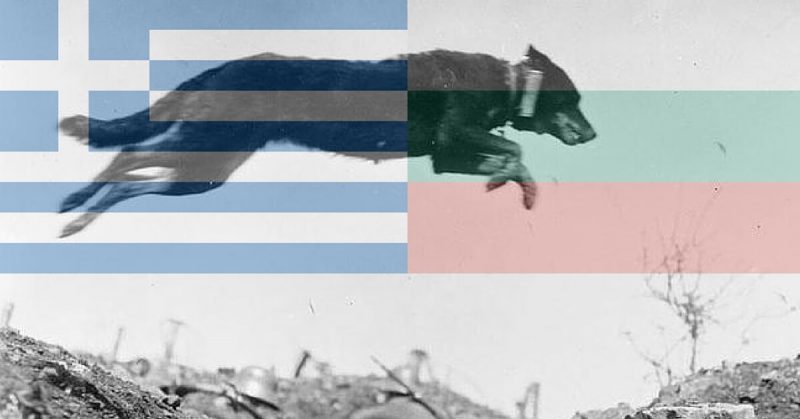
 On October 19, 1925, along a quiet stretch of the Greek–Bulgarian border near the town of Petrich, a dog ran across a line in the dirt.
It did not know the line was political.
It did not know it separated two nations still raw from war.
It did not know that Europe, less than a decade removed from the Great War, was a continent of nervous borders and brittle pride.
The dog simply ran.
Shots followed. Within hours, soldiers were mobilizing. Within days, artillery fired. Villages emptied. Men died.
The episode would become known—almost mockingly—as The War of the Stray Dog.
But behind the absurd name was a sobering reality: a world so tense that even a wounded animal could trigger bloodshed.
Europe After 1918: Peace in Name Only
The First World War had officially ended in 1918, but peace did not mean stability.
The Treaty of Versailles and subsequent agreements had redrawn borders across Europe. Old empires—the Ottoman, Austro-Hungarian, Russian—collapsed. New nations emerged. Minority populations found themselves stranded inside unfamiliar states.
The Balkans, in particular, remained volatile.
Greece had recently endured defeat in the Greco-Turkish War (1919–1922). Bulgaria, punished by postwar treaties, had lost territory and influence. Both countries harbored resentment. Both were economically strained. Both had large displaced populations nursing grievances.
The Greek-Bulgarian border was not merely a boundary—it was a scar.
The Incident at Petrich
The widely told version of events is deceptively simple.
A Greek soldier—often identified in later accounts as Private Antonios or Antoniou—was stationed near the border outpost at Demir Kapu, close to Petrich. A dog, either his or a stray, crossed into Bulgarian territory.
The soldier followed.
Bulgarian border guards confronted him. Words were exchanged. Shots rang out.
The Greek soldier was killed.
From that moment, the story diverges depending on who tells it. Greek sources emphasized Bulgarian aggression. Bulgarian accounts insisted the Greek soldier violated their territory and provoked the confrontation.
What is certain is this: within hours, what should have been a minor border incident escalated.
Because in 1925, no incident along a Balkan frontier was truly small.
Pride and Posture
Border tensions were common. Patrols were instructed to assert sovereignty firmly. Retreat could be interpreted as weakness. Weakness invited challenge.
The killing of a soldier—however accidental—became a matter of national honor.
Greece demanded an apology and punishment of those responsible. Bulgaria denied wrongdoing and called for arbitration.
The tone hardened quickly.
Within days, Greek forces advanced into Bulgarian territory near Petrich.
The War of the Stray Dog had begun.
Six Days of War
The conflict lasted from October 19 to October 25, 1925.
It was brief—but not bloodless.
Greek troops crossed the border in force, occupying several villages. Artillery exchanges followed. Civilians fled their homes. Panic spread along the frontier.
Though exact casualty numbers vary, estimates suggest dozens of soldiers and civilians were killed.
The name “War of the Stray Dog” makes it sound farcical.
The reality included:
-
Homes destroyed
-
Farmers displaced
-
Families grieving
Absurd beginnings do not prevent real consequences.
Petrich Under Fire
The town of Petrich became the focal point of the conflict.
Greek forces advanced toward it, seeking leverage. Bulgarian defenders mobilized quickly. Though Bulgaria’s army was restricted under postwar treaties, it still maintained capable defensive units.
Skirmishes intensified.
Civilians hid in basements. Livestock scattered. Fields were abandoned. For residents, the question was not who fired first—it was whether they would survive the week.
The border had become a battlefield.
The League of Nations Steps In
This was not 1914. The world now had an experiment in international diplomacy: the League of Nations.
Bulgaria appealed to the League almost immediately.
The League responded swiftly—remarkably swiftly for the era.
A ceasefire was ordered.
Both sides were instructed to withdraw.
An investigation began.
The Great Powers, wary of Balkan instability reigniting larger conflict, supported intervention.
Within days, hostilities ceased.
Judgment and Consequence
The League concluded that Greece had acted disproportionately by invading Bulgarian territory.
Greece was ordered to withdraw and pay compensation to Bulgaria—approximately £45,000.
Greece complied.
It was one of the League’s rare early successes.
Yet the resolution also revealed something deeper: the war had not erupted because of a dog.
It erupted because the region was primed for explosion.
Why a Dog Could Start a War
Blaming the dog makes the story easier to digest. It turns tragedy into anecdote.
But animals do not cause wars.
Humans do.
Several factors made escalation almost inevitable:
1. Fragile Borders
Post-WWI boundaries were contested and emotionally charged.
2. Militarized Frontiers
Armed patrols with strict orders increased the chance of deadly misunderstanding.
3. National Humiliation
Both Greece and Bulgaria felt wronged by recent history. Pride was brittle.
4. Communication Delays
In an era before instant diplomacy, local incidents escalated before leaders could de-escalate.
The dog was a trigger, not a cause.
The Psychology of Escalation
Modern analysts often cite the War of the Stray Dog in studies of crisis escalation.
Small incidents become symbolic.
Symbolic incidents demand response.
Response creates retaliation.
Retaliation demands honor.
It is a cycle.
The danger lies not in the initial event, but in how leaders interpret it.
In 1925, interpretation moved faster than caution.
A War in the Shadow of Something Larger
The Balkans had already ignited global war once before—in 1914, with the assassination of Archduke Franz Ferdinand.
The parallels were unsettling.
Another small event.
Another regional flashpoint.
Another risk of escalation.
This time, however, the fire was contained.
The League of Nations did what it was designed to do: stop a minor conflict from becoming a major one.
Civilian Memory
In Bulgaria, the incident is sometimes called the Petrich Incident.
In Greece, it is remembered as a regrettable border clash.
Among historians and popular writers, “War of the Stray Dog” stuck because it captures the absurdity.
But for villagers who fled artillery, the humor is thin.
To them, it was six days of terror.
The Fragility of Peace
The war lasted less than a week.
Yet it exposed how thin the veneer of peace truly was.
Europe in the 1920s was not healed.
It was stitched together.
Underneath lay resentment, poverty, and militarized pride.
The War of the Stray Dog was a tremor warning of future earthquakes.
Within 15 years, Europe would be engulfed in war again.
The Dog as Historical Metaphor
There is something haunting about the image:
A dog crossing an invisible border.
Borders are human inventions. Lines drawn on maps, enforced by rifles.
To a dog, they mean nothing.
To humans, they mean everything.
The tragedy lies in the contrast.
A Lesson in Overreaction
Historians often use the incident to illustrate disproportionate response.
One soldier dead.
An entire military mobilized.
One wounded animal.
Artillery deployed.
It reveals how pride, once engaged, can distort judgment.
International Law’s Early Test
The League of Nations rarely succeeded in its mission.
But here, it did.
Swift mediation.
Clear accountability.
Financial penalty.
Withdrawal of troops.
It was proof—briefly—that diplomacy could prevail.
The world would later forget that lesson.
The Power of Small Things
History often feels driven by grand forces: ideology, economics, empires.
But sometimes, the spark is small.
A wrong turn.
A misfired shot.
A frightened dog.
The War of the Stray Dog belongs in that category of moments where the mundane collides with geopolitics.
What If It Had Escalated?
Had the League failed, the consequences could have been severe.
Yugoslavia might have intervened.
Turkey might have weighed in.
Alliances could have activated.
The Balkans had a reputation for volatility for good reason.
Instead, the conflict remained contained.
It could have been worse.
Final Reflections: The Line in the Dirt
The War of the Stray Dog is remembered because it sounds ridiculous.
And it is.
But it is also deeply human.
It reveals how quickly anger can override reason.
How borders can turn accidents into affronts.
How pride can turn tragedy into escalation.
A dog ran across a line.
Men with rifles decided that line mattered more than restraint.
For six days, Europe held its breath.
The lesson endures: peace is fragile. And sometimes, the smallest movement across an invisible boundary is enough to remind us just how fragile it truly is.