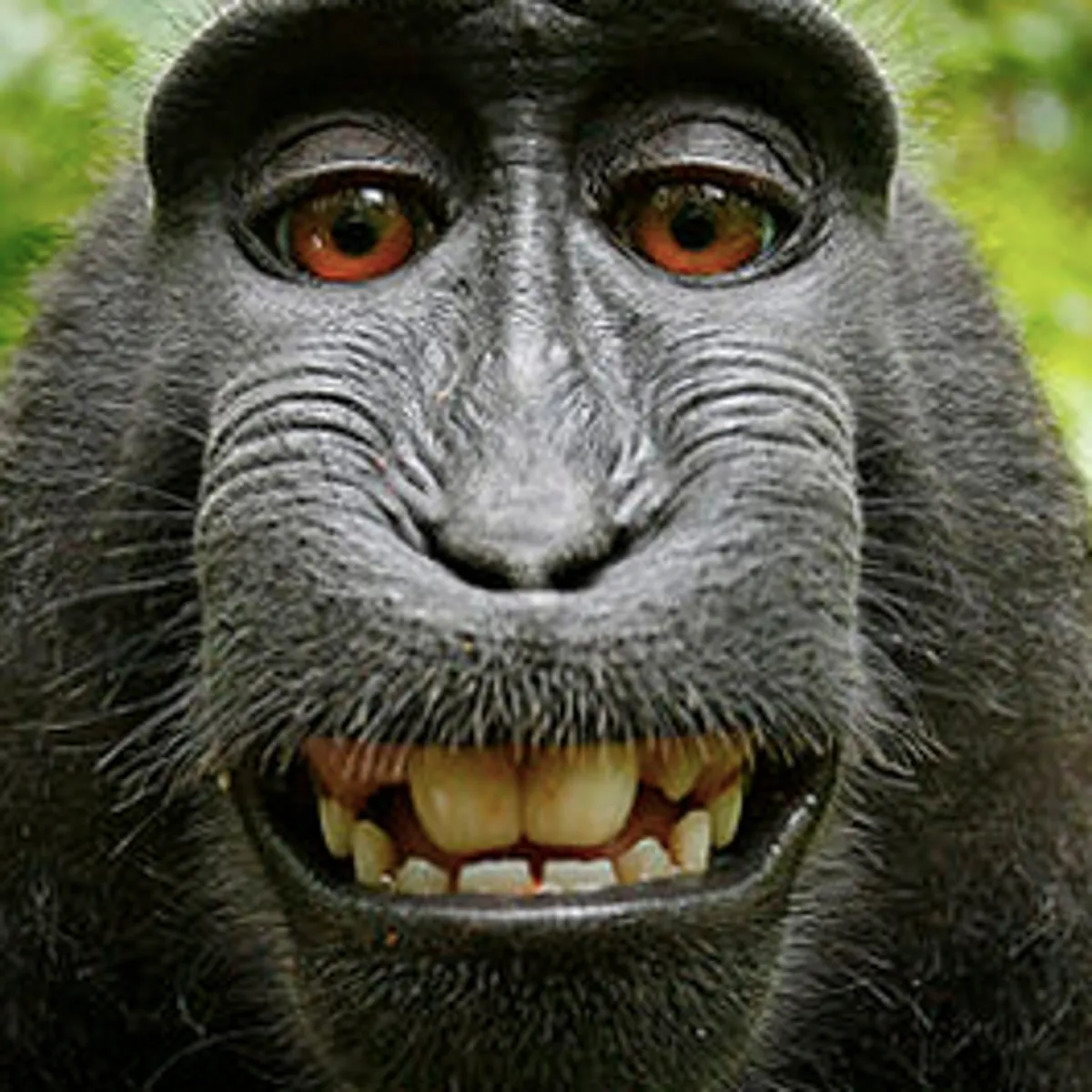
 In 2011, deep in the forests of Indonesia, a crested black macaque picked up a camera.
The shutter clicked.
The resulting image — a wide-eyed primate grinning directly into the lens — would become one of the most famous wildlife photographs of the 21st century.
It would also trigger a global legal debate.
Who owns a photograph taken by a monkey?
That question would travel from the jungles of Sulawesi to the pages of Wikipedia, into federal courtrooms in California, and ultimately into the evolving frontier of intellectual property law.
This is the story of the Monkey Selfie copyright case — a bizarre yet consequential legal battle that forced courts to answer a deceptively simple question:
Can a non-human own copyright?
The Photo That Went Viral
The macaque in question was a crested black macaque (Macaca nigra), a critically endangered species native to the island of Sulawesi.
The photographer nearby was British wildlife photographer David Slater.
According to Slater, he had spent days attempting to capture images of the macaques. To get closer and make them comfortable, he set up his camera on a tripod with a wide-angle lens and stepped back.
One of the macaques — later identified as a female named Naruto — began interacting with the camera.
She pressed the shutter.
Multiple times.
The resulting images were astonishing.
Sharp.
Expressive.
Unmistakably self-aware.
The photo spread across the internet like wildfire.
Wikipedia and the Public Domain
The legal controversy began not in a courtroom, but on Wikipedia.
The Wikimedia Foundation uploaded the image to its media repository, declaring it public domain.
Their reasoning was straightforward:
If a monkey took the photograph, then no human authored it.
And copyright law, under U.S. statute, protects works created by human authors.
No human author = no copyright.
Slater objected.
He argued that:
-
He set up the camera.
-
He chose the lens.
-
He adjusted the settings.
-
He created the opportunity for the image.
Therefore, he claimed, the photograph was his intellectual property.
Wikimedia refused to remove it.
The image remained freely accessible.
The dispute escalated.
Enter PETA
In 2015, the story took an even stranger turn.
The animal rights organization PETA (People for the Ethical Treatment of Animals) filed a lawsuit on behalf of the macaque — named Naruto — arguing that:
-
Naruto was the true author of the photograph.
-
Therefore, Naruto owned the copyright.
-
Slater had no rights to profit from it.
PETA sought to have the copyright assigned to Naruto, with proceeds managed for the benefit of the species.
The case was officially titled Naruto v. Slater.
A monkey had become a plaintiff in federal court.
The Legal Core: Who Can Own Copyright?
The case hinged on a foundational principle of copyright law.
Under U.S. law, copyright protects “original works of authorship.”
But courts have long interpreted “authorship” to require a human creator.
This interpretation has roots in centuries of legal tradition.
Corporations can own copyright.
Estates can manage it.
But authorship must originate with a human.
The monkey selfie forced courts to confront whether that assumption was explicit — or merely implied.
The District Court Ruling
In 2016, a federal district court dismissed PETA’s lawsuit.
The judge ruled that animals do not have standing under U.S. copyright law.
The Copyright Act did not explicitly grant rights to non-human entities.
Therefore, Naruto could not own the photograph.
The reasoning was blunt:
Congress had not extended copyright protections to animals.
If such a change were to occur, it would require legislative action — not judicial creativity.
PETA appealed.
The Ninth Circuit Weighs In
In 2018, the U.S. Court of Appeals for the Ninth Circuit issued its decision.
The panel upheld the lower court’s dismissal.
It ruled that:
-
The Copyright Act does not authorize animals to sue for infringement.
-
Authorship, as understood under the law, is limited to humans.
The court also criticized PETA’s representation of Naruto, noting concerns about whether the organization truly acted in the animal’s best interest.
The case was effectively over.
The monkey could not own copyright.
Slater’s Financial Struggles
While the legal drama unfolded, David Slater claimed the controversy severely damaged his livelihood.
Because the image was widely treated as public domain, media outlets and websites used it freely.
Slater argued that he had lost significant income.
The irony was stark.
A photograph that became globally famous brought its alleged creator little profit.
It became a symbol of internet culture — shared endlessly, monetized by platforms, but legally ambiguous.
A Question Larger Than Monkeys
The Monkey Selfie case was humorous on the surface.
But beneath the absurdity lay serious implications.
If a monkey cannot own copyright because it is not human, what about:
-
Artificial intelligence?
-
Autonomous creative systems?
-
Future non-human creators?
The case became an early reference point in discussions about AI-generated art.
Courts reaffirmed that authorship requires human creativity.
That principle would soon be tested again.
The Human Element
Slater’s argument rested on human involvement.
He:
-
Chose the location.
-
Engineered the setup.
-
Facilitated the interaction.
Was that sufficient creative input?
Courts did not need to answer definitively because the monkey’s claim failed first.
But the case left open the philosophical question of how much human involvement is required for authorship.
Is setting up a camera enough?
Is pressing the shutter essential?
Is intent required?
These questions would echo in later AI copyright debates.
PETA’s Strategy
PETA framed the lawsuit as a step toward recognizing animal rights.
If animals could own intellectual property, it would acknowledge them as legal entities with certain standing.
The court declined.
It emphasized that such recognition would represent a profound shift in law — one better suited for legislative action.
The judiciary would not redefine authorship unilaterally.
The Settlement Twist
After the Ninth Circuit’s decision, Slater and PETA reached a settlement.
Slater agreed to donate a portion of future revenue from the images to organizations protecting crested black macaques.
The agreement was voluntary — not legally mandated by a recognition of animal copyright.
It was a pragmatic conclusion to an eccentric legal battle.
Public Reaction
The Monkey Selfie case captivated the public because it was absurdly charming.
A grinning monkey in court.
Headlines about “monkey copyright.”
But it also reflected deeper tensions in intellectual property law:
-
Who owns creativity?
-
What defines authorship?
-
How does law adapt to technological and biological surprises?
The image itself — joyful and self-aware — made the debate feel oddly poetic.
The Role of Wikipedia
Wikimedia’s insistence that the image was public domain stemmed from its policy that copyright requires human authorship.
By maintaining that position, the organization reinforced the principle that:
No human author = no copyright.
The case solidified that interpretation in U.S. courts.
The Broader Legal Context
The U.S. Copyright Office has since clarified that works produced by animals or nature are not eligible for copyright.
This includes:
-
A monkey taking a photo.
-
A painting created by an elephant.
-
Natural formations shaped by erosion.
Human creativity remains the anchor of protection.
The Age of AI
In the 2020s, as AI-generated art surged, courts and copyright offices faced similar questions.
If a machine produces art autonomously, who owns it?
The Monkey Selfie case provided precedent:
Authorship requires human creative input.
The monkey, like the machine, lacked legal personhood under copyright law.
The line remained drawn at humanity.
Final Reflections: A Grin That Changed the Law
The Monkey Selfie case is one of those rare legal disputes that feels almost whimsical — and yet carries real weight.
A macaque pressed a button.
The image circled the globe.
And courts were forced to articulate something fundamental:
Creativity, in the eyes of the law, belongs to humans.
The monkey did not win copyright.
But the case clarified the boundaries of authorship in a changing world.
As technology evolves and new forms of creation emerge, the questions raised by that grin in the jungle will return.
Who creates?
Who owns?
Who decides?
For now, the answer remains human.
But the monkey, smiling into the lens, reminds us that authorship — like curiosity — is not always confined to our species.