 In medieval Europe, there were days when the world turned upside down.
Choirboys became bishops.
Priests brayed like livestock.
Processions wound through cathedrals with incense and mock reverence.
And in one of the strangest legends attached to this chaos, a donkey was crowned — sometimes said to have been crowned by the Pope himself.
Did a pope truly place a crown upon a donkey’s head?
No.
But for a time in medieval Christendom, that story felt possible — and in some places, something very close to it did happen.
This is the story of the Feast of Fools, the Feast of the Ass, and how satire crept into sacred spaces so boldly that it gave rise to one of history’s most persistent ecclesiastical myths.
The Medieval Love of Reversal
Medieval Europe was rigidly structured.
Society was ordered by rank: kings above nobles, nobles above peasants, clergy above laity.
The Church governed not only salvation but daily life.
Yet within that order, there existed sanctioned moments of reversal — days when hierarchy collapsed into ritual chaos.
These were festivals of inversion.
The low became high.
The foolish became wise.
The sacred flirted with parody.
The most famous of these was the Feast of Fools, celebrated primarily in France and parts of Central Europe between the 12th and 15th centuries.
The Feast of Fools
Typically held around the New Year or the Feast of the Circumcision (January 1), the Feast of Fools allowed lower-ranking clergy — deacons, subdeacons, choirboys — to temporarily assume high ecclesiastical roles.
A mock “Bishop of Fools” or “Lord of Misrule” was elected.
He wore vestments.
He carried symbols of office.
He presided over parody liturgies.
Cathedrals echoed with laughter.
Clergy brayed like animals.
Mock sermons were delivered.
Sacred chants were altered with comic refrains.
It was both irreverent and strangely devout.
The festival did not reject religion.
It bent it.
Enter the Donkey
Parallel to the Feast of Fools was another celebration known as the Feast of the Ass (Festum Asinorum).
This festival commemorated the biblical story of the Flight into Egypt — when Mary and Joseph fled with the infant Jesus riding on a donkey.
In some medieval towns, an actual donkey was led into the church during the service.
The congregation sang hymns honoring the humble animal that had carried the Holy Family.
Some versions of the liturgy ended with the congregation braying “Hee-haw” instead of “Amen.”
The donkey was garlanded.
It stood near the altar.
It was treated with theatrical reverence.
To modern ears, this sounds blasphemous.
To medieval participants, it was layered symbolism.
The Myth of the Crowned Donkey
Over time, stories grew.
In certain accounts, particularly from hostile chroniclers who despised the Feast of Fools, tales circulated that a donkey had been crowned inside a cathedral.
Some later retellings escalated further — claiming that even a pope had presided over such nonsense.
But no historical record supports the idea that any pope formally crowned a donkey.
The myth likely arose from exaggerated reports of the Feast of Fools’ excesses.
Critics of the festival painted it as grotesque chaos — clergy drinking, dancing, and mocking sacred ritual.
The donkey became the perfect symbol of ecclesiastical absurdity.
Why the Church Allowed It
The Feast of Fools presents a paradox.
How could a Church so concerned with doctrine tolerate such antics?
The answer lies in social pressure.
Medieval life was disciplined and hierarchical. Controlled release valves helped maintain order.
Carnival-like festivals allowed temporary disorder within defined limits.
The Church did not officially sanction blasphemy.
But in many regions, local clergy quietly permitted inversion rituals as a way of diffusing tension.
It was better to laugh once a year than rebel year-round.
Critics Push Back
Not everyone approved.
From the 13th century onward, reformers condemned the Feast of Fools as sacrilegious.
Church councils attempted to ban it.
Theologians described it as scandalous mockery of sacred rites.
By the 15th and 16th centuries, as the Church moved toward stricter discipline (and eventually into the era of the Reformation), such festivals declined sharply.
But by then, the stories had spread.
And stories grow teeth.
The Donkey as Symbol
Why a donkey?
In medieval symbolism, the donkey carried multiple meanings.
It represented:
-
Humility (as in Christ’s entry into Jerusalem).
-
Stubbornness.
-
Foolishness.
-
Earthiness.
Crowning a donkey — even symbolically — embodied inversion.
The lowliest animal elevated.
The foolish exalted.
It mirrored biblical themes of the last becoming first.
But it also carried a dangerous edge.
When satire enters sacred space, interpretation becomes volatile.
The Power of Satire
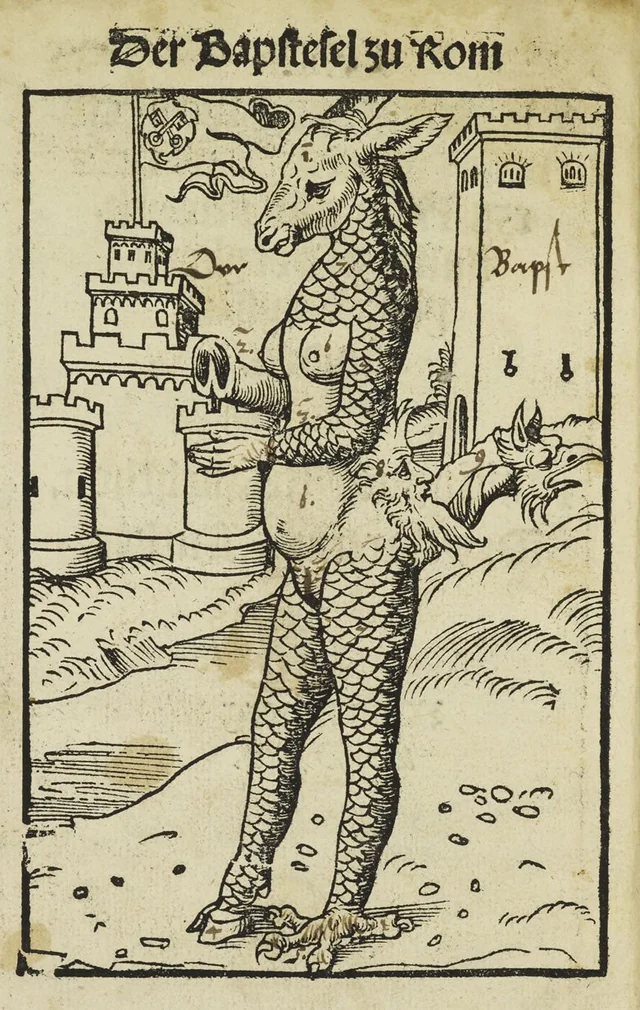
The myth of the Pope crowning a donkey likely flourished during periods of anti-clerical sentiment.
Critics of Church corruption seized on stories of ritual absurdity to mock authority.
In pamphlets and later Protestant polemics, exaggerated tales of medieval folly reinforced narratives of decadence.
The donkey became shorthand for ecclesiastical foolishness.
A crowned donkey was easier to ridicule than complex theological disputes.
Reversal as Safety Valve
Anthropologists and historians view festivals like the Feast of Fools as ritualized inversions — temporary chaos to reinforce long-term order.
By allowing the world to flip briefly, society affirmed its structure the rest of the year.
The mock bishop reminded participants who the real bishop was.
The braying donkey emphasized sacred humility.
But satire is unpredictable.
Once laughter enters, reverence can thin.
The Disappearance of the Feast
By the late medieval period, Church authorities increasingly suppressed inversion festivals.
The Council of Basel (1431–1449) criticized such practices.
Local bishops banned donkey processions and mock liturgies.
As Europe moved toward religious reform and heightened doctrinal seriousness, tolerance for playful ritual shrank.
The donkey left the cathedral.
But the myth remained.
Did a Pope Ever Attend?
No credible evidence suggests that any pope formally participated in crowning a donkey.
Popes in Rome were often far removed from regional folk practices in northern France and Germany.
The association likely arose from the tendency to attribute local excesses to centralized authority.
When critics wanted to dramatize decline, they escalated stories.
If priests brayed, perhaps bishops encouraged it.
If bishops allowed it, perhaps the pope blessed it.
Legend filled the gaps.
Why the Story Endures
The tale of a Pope crowning a donkey survives because it’s irresistible.
It captures tension between:
-
Sacred and profane
-
Authority and absurdity
-
Order and chaos
It feels like satire written by history itself.
But like many such stories, it simplifies a more nuanced truth.
The medieval Church was neither uniformly solemn nor perpetually ridiculous.
It was human.
And humans have always blended reverence with laughter.
Final Reflections: The Braying in the Cathedral
The Pope never crowned a donkey.
But in medieval Europe, a donkey once stood near altars, adorned and celebrated, while congregations brayed in ritual chorus.
For a few hours each year, hierarchy dissolved.
The foolish wore miters.
The humble animal became central.
The world inverted.
And then it returned to order.
The myth of the crowned donkey endures because it speaks to a timeless question:
How much laughter can power endure before it becomes vulnerability?
In the Middle Ages, the Church allowed a little.
But not forever.
The donkey stepped down.
The crown vanished.
The cathedral grew quiet again.
Yet somewhere in the echo of stone vaults, if you listen closely enough, you can almost hear the faintest bray — a reminder that even the most solemn institutions once flirted with folly.