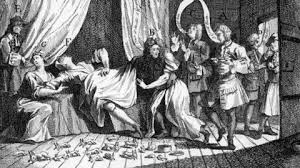
 In 1726, England was gripped by a medical sensation so bizarre it bordered on the surreal: a woman claimed she had given birth to rabbits.
Not metaphorical rabbits.
Not malformed infants mistaken for animals.
Actual rabbits.
Doctors examined her. Surgeons debated the case. Even members of the royal court took interest. Pamphlets spread the news across London. Learned men argued over anatomy, divine intervention, and maternal imagination.
For a brief, astonishing moment, much of Britain entertained the possibility that a human woman could produce animal offspring.
Her name was Mary Toft.
And the story that followed would become one of the most humiliating episodes in the history of British medicine.
A Servant in Surrey
Mary Toft was born in 1701 in Godalming, Surrey. She was a poor, illiterate servant woman who had already borne children before the events of 1726. By all accounts, her life was unremarkable — defined by labor, rural hardship, and limited opportunity.
In the summer of 1726, she claimed to have experienced a miscarriage after being startled by a rabbit while working in the fields.
Soon after, she began reporting intense pains and passing what appeared to be animal parts.
Local surgeon John Howard was summoned. According to his testimony, he witnessed Toft deliver pieces of rabbits — lungs, legs, and fragments that appeared to belong to small animals.
Howard, unsure what to make of it, contacted more prominent physicians in London.
The case was about to escalate far beyond rural curiosity.
London Takes Notice
News of Toft’s “births” traveled quickly.
In early 18th-century England, medicine was a blend of emerging scientific inquiry and lingering medieval theory. Anatomy was advancing, but superstition and outdated concepts still held sway.
One such idea was maternal impression — the belief that a pregnant woman’s intense emotions or experiences could physically mark or alter her unborn child.
If a woman fixated on rabbits, some believed, perhaps her offspring might resemble one.
Absurd by modern standards — but in 1726, not universally dismissed.
The case drew the attention of respected physicians, including Nathanael St. André, a Swiss-born surgeon who served as anatomist to King George I.
St. André examined Toft and declared the phenomenon genuine.
He publicly supported the claim.
That endorsement transformed the story from rural oddity into national sensation.
The Royal Investigation
As reports spread, King George I ordered an official inquiry.
Surgeon Cyriacus Ahlers was dispatched to examine Toft. He was skeptical from the start.
Ahlers noticed inconsistencies. The rabbit parts did not appear fresh. Some showed signs of having been cut with instruments. Others contained straw and grain — suggesting they had lived independently, not grown within a human womb.
Still, Toft continued producing animal fragments under observation.
In one documented instance, she allegedly “gave birth” to the torso of a rabbit.
Crowds gathered outside her lodging in Guildford and later London. Pamphlets circulated. Debates flared in coffeehouses.
Was this a miracle? A medical anomaly? Or an elaborate deception?
The Anatomy Problem
Even by 18th-century standards, there were biological red flags.
Rabbits are mammals, but their gestation, anatomy, and reproductive systems are fundamentally incompatible with human physiology. The idea of cross-species pregnancy — while sometimes speculated upon in folklore — had no scientific foundation.
Moreover, dissections of the rabbit parts revealed evidence of normal animal digestion.
In one case, pellets found within the rabbit fragments suggested the animals had eaten grass prior to death.
That detail was devastating.
It implied the rabbits had lived and digested food — impossible if they had developed inside a human womb.
Skepticism intensified.
The Confession
Under mounting scrutiny, Mary Toft’s story began to unravel.
Investigators placed her under close watch to prevent outside interference. Guards monitored her room.
Eventually, she confessed.
The rabbit parts had been smuggled into her chamber — reportedly by accomplices, possibly including her husband and mother-in-law.
She had inserted animal fragments into her body to simulate birth.
It was a grotesque and painful deception.
Her motive remains debated. Some historians suggest financial gain — curiosity seekers and physicians paid for access. Others believe she sought attention or was pressured by family members hoping for profit.
Whatever the reason, the hoax collapsed spectacularly.
Public Humiliation
The fallout was swift and brutal.
Nathanael St. André, who had publicly endorsed the authenticity of the births, was ridiculed mercilessly. Satirical prints mocked him. His medical credibility suffered irreparable damage.
Pamphleteers had a field day.
Caricatures depicted doctors with rabbit ears. Poems and broadsides mocked the gullibility of learned men.
The scandal became a cautionary tale — not about maternal imagination, but about professional pride and premature conclusions.
Mary Toft herself was charged with fraud but ultimately released without severe punishment. The legal system struggled to classify her crime.
After her confession, she faded into obscurity.
Why So Many Believed
The rabbit births may seem laughable today, but they occurred during a transitional moment in medical history.
The Scientific Revolution had advanced anatomy and experimentation, but standardized peer review and rigorous clinical protocols were still evolving.
Physicians often relied on observation and reputation rather than controlled experimentation.
The case also exploited contemporary beliefs about maternal impression. While not universally accepted, the theory provided a conceptual framework that made Toft’s claims seem less impossible.
Furthermore, the involvement of respected doctors created a feedback loop of validation. If a royal anatomist vouched for it, who was a layperson to disagree?
The episode reveals how authority can amplify error.
Media and Sensation in the 18th Century
The Toft affair was also an early example of media frenzy.
London in the 1720s was teeming with pamphlets, newspapers, and public lectures. Sensational stories spread rapidly. The printing press — already centuries old — had created a vibrant culture of public debate.
The rabbit births became a spectacle.
People paid to view the alleged evidence. Reports traveled across Europe.
The hoax demonstrates that viral misinformation is not unique to the digital age.
It thrived in Georgian England.
Gender, Class, and Credibility
Mary Toft’s social status played a complex role in the scandal.
As a poor, rural woman, she occupied a low position in the social hierarchy. Yet her body became the center of national fascination.
Male physicians debated her anatomy. Royal officials investigated her womb.
The episode reflects both the vulnerability of women’s bodies to public scrutiny and the limited agency of lower-class individuals.
Some historians argue that Toft may have been manipulated by those around her — pressured into continuing the deception once it gained attention.
Others portray her as a cunning opportunist exploiting elite curiosity.
The truth likely lies somewhere in between.
The Aftermath in Medicine
The rabbit hoax had lasting consequences for British medicine.
It embarrassed prominent physicians and underscored the need for stricter standards of evidence.
Skepticism gained ground.
The case became a textbook example of why extraordinary claims require rigorous proof.
In that sense, the scandal contributed — indirectly — to the strengthening of scientific methodology.
Humiliation can be a powerful teacher.
Cultural Legacy
The phrase “rabbit birth” entered satire and folklore.
For years, the story was referenced as shorthand for gullibility.
Artists and writers used it to lampoon medical arrogance and public credulity.
Mary Toft’s name became synonymous with deception.
Yet over time, the story also took on a more sympathetic tone. Some modern historians see her not just as a trickster, but as a product of economic desperation and social exploitation.
The hoax endures because it combines the absurd with the revealing.
Lessons from the Rabbit Womb
At its core, the story of Mary Toft is not about rabbits.
It is about belief.
It shows how authority figures can convince themselves of unlikely phenomena when evidence appears to align — even if that evidence is manipulated.
It shows how public appetite for the sensational can override caution.
It shows how scientific progress is uneven, shaped by error as much as discovery.
And it shows how quickly reputations can collapse when truth surfaces.
Conclusion: When Medicine Was Humbled
In 1726, a poor woman from Surrey convinced some of England’s most respected doctors that she was giving birth to rabbits.
For weeks, the country debated anatomy and miracle. The king sent investigators. Surgeons examined animal parts with grave seriousness.
Then it unraveled.
The rabbits had been planted.
The births had been staged.
The learned men had been fooled.
The woman who gave birth to rabbits left behind more than scandal. She left a cautionary tale about the limits of authority and the necessity of skepticism.
In the end, no human had produced animal offspring.
But the episode produced something else — a moment of reckoning for medicine, a reminder that even experts can be led astray when spectacle overtakes scrutiny.
And nearly three centuries later, the image remains unforgettable:
A room full of distinguished physicians, staring at rabbit parts, convinced they had witnessed the impossible.
Until they hadn’t.