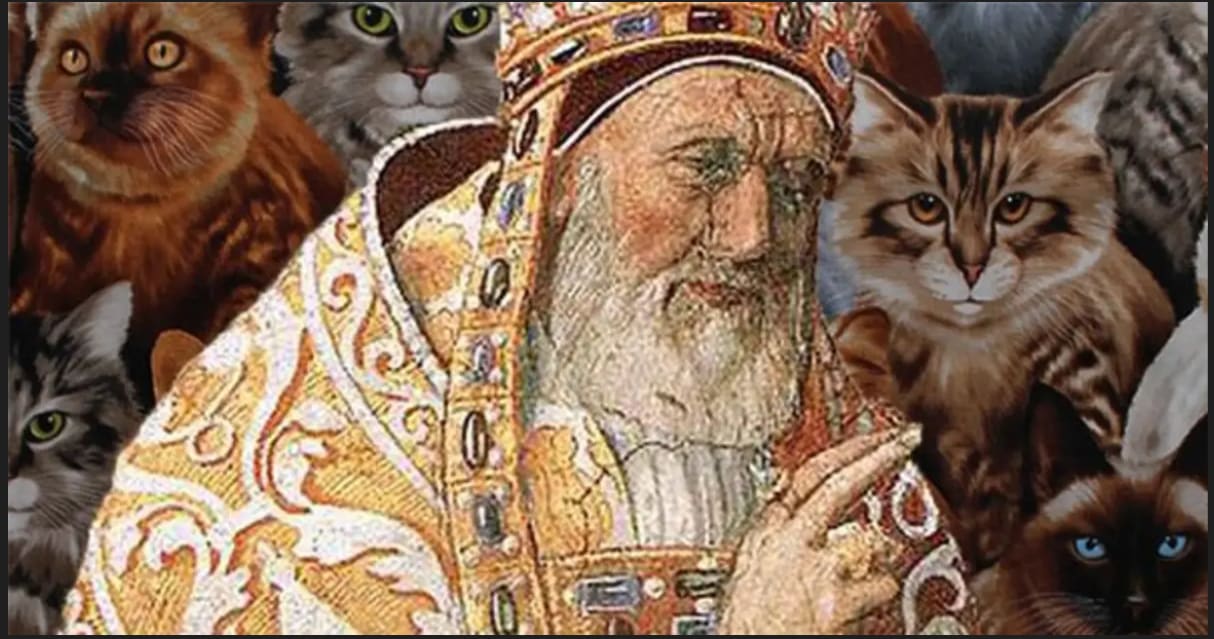
 In the Middle Ages, cats did not just chase mice.
They were accused of consorting with the devil.
They were associated with witches.
They were symbols of darkness, heresy, and hidden sin.
And in 1233, under the authority of Pope Gregory IX, the Catholic Church issued a document that would forever tangle religion, superstition, and one of history’s deadliest pandemics.
It wasn’t a formal declaration of war, not in the military sense. There were no armies marching against tabbies and tomcats. But in effect, cats—particularly black cats—were condemned. Persecuted. Killed.
And what followed, according to many historians, may have made Europe far more vulnerable to the catastrophe of the Black Death.
This is the story of how fear turned an animal into an enemy—and how unintended consequences can echo across centuries.
Europe in the 1200s: A World of Fear and Faith
The 13th century was an age of deep religious intensity.
The Catholic Church stood as the dominant spiritual and political authority in Europe. Heresy was not merely a theological error—it was a threat to social order. Groups like the Cathars and other sects challenged Church authority. Witchcraft accusations simmered. Demonic imagery infused sermons and folklore.
Life was uncertain. Disease was poorly understood. Famine was frequent. The supernatural felt close.
In that environment, symbolism mattered.
And cats—especially black cats—were ripe for suspicion.
The Papal Bull Vox in Rama
In 1233, Pope Gregory IX issued a papal bull known as Vox in Rama.
The document did not explicitly say “kill all cats.” That’s where modern retellings sometimes exaggerate.
But it did describe alleged heretical rituals in Germany involving devil worship. One of the most striking details was the description of a black cat appearing in these ceremonies, representing Satan himself.
The imagery was vivid and damning:
-
A black cat descending backward
-
Worshippers kissing the animal
-
Demonic manifestations
The implication was clear.
Cats—particularly black ones—were linked to diabolical activity.
In a society where papal words carried enormous weight, that was enough.
From Suspicion to Slaughter
Once associated with Satanic ritual, cats became targets.
Black cats, especially, were viewed with suspicion. They were believed to be:
-
Familiars of witches
-
Shape-shifting demons
-
Omens of bad luck
In various parts of Europe, cats were persecuted, driven from towns, or killed during festivals.
It was not a single coordinated campaign across all of Europe. But fear, once unleashed, spreads quickly.
And cats, long valued for their ability to control rodents, found themselves rebranded as spiritual threats.
Why Cats Were Vulnerable to Superstition
Cats have always occupied a peculiar place in human imagination.
Unlike dogs, they:
-
Move silently
-
Hunt at night
-
Stare without blinking
-
Appear indifferent to authority
In pagan traditions, cats were sometimes sacred. In Norse mythology, they pulled the chariot of the goddess Freyja. In ancient Egypt, they were revered.
But in medieval Christian Europe, pagan symbolism was suspect.
Animals associated with mystery, independence, or femininity were often viewed as spiritually dangerous.
Cats fit that profile perfectly.
The Unintended Consequence: Rats Rejoice
Here is where the story takes its darkest turn.
Cats are natural predators of rodents. And rodents—particularly black rats—were carriers of fleas infected with Yersinia pestis, the bacterium responsible for the plague.
By the mid-1300s, Europe would face the Black Death, which killed an estimated 25 to 50 million people.
While the connection between cat persecution and plague mortality is debated among historians, the logic is chillingly straightforward:
-
Fewer cats
-
More rats
-
More fleas
-
More plague
Whether papal condemnation directly caused a continent-wide reduction in cat populations is complex. But the broader cultural hostility toward cats certainly did not help rodent control.
Superstition weakened a natural defense system.
The Black Death Arrives
In 1347, ships carrying infected rats docked in Mediterranean ports.
Within years, plague swept across Europe.
Villages emptied.
Cities collapsed.
Mass graves filled.
Doctors wore beaked masks filled with herbs, believing smell carried disease. The miasma theory—like earlier superstition about cats—misunderstood the true cause.
Ironically, in some regions, cats were killed during plague outbreaks because they were blamed for spreading disease.
The animal that could have helped contain the rodent population became a scapegoat.
Did the Pope Cause the Plague?
It would be simplistic to say Pope Gregory IX caused the Black Death.
The plague’s arrival depended on:
-
Trade routes from Asia
-
Climatic conditions
-
Urban density
-
Lack of medical knowledge
However, the Church’s demonization of cats contributed to a cultural atmosphere where eliminating them was acceptable.
It is one of history’s classic cases of unintended consequences.
Fear misdirected energy away from the real threat.
Witch Hunts and the Cat’s Dark Reputation
The association between cats and witchcraft deepened in the centuries following Vox in Rama.
During the witch hunts of the 15th–17th centuries, cats were often implicated as:
-
Demonic companions
-
Transformations of witches
-
Agents of the devil
Black cats became symbols of bad luck—a superstition that persists today.
The animal’s reputation never fully recovered in medieval Europe.
The Psychology of Blame
Why blame cats?
Because fear demands a target.
When societies face:
-
Disease
-
Famine
-
Uncertainty
They look for visible enemies.
Rats were everywhere, but they were also mundane. Cats, with their nocturnal habits and perceived independence, felt mysterious.
It is easier to accuse something symbolic than something ordinary.
The Church’s Broader Context
It’s important to note that medieval Christianity was not universally anti-cat. Monasteries often kept cats to protect manuscripts from rodents. Many clergy valued their practical use.
The papal bull targeted heretical ritual, not domestic pet ownership.
But symbolism has power.
And once cats were tied to Satanic imagery, the cultural damage was done.
A Lesson in Fear and Ecology
The story of the “war on cats” illustrates a larger pattern:
Human superstition can disrupt ecological balance.
Predator populations matter.
Rodent control matters.
Disease vectors matter.
Ignoring biology in favor of myth has consequences.
The Cat’s Survival
Despite persecution, cats endured.
Their utility was undeniable. Even in fearful times, farmers and sailors recognized their importance.
Over centuries, cats regained acceptance. By the Renaissance, their image softened. In some regions, they were again seen as companions rather than omens.
But the shadow lingered.
Black cats remain symbols of bad luck in many Western cultures—a superstition born in medieval fear.
Modern Reassessment
Today, historians debate the extent of cat persecution and its direct link to plague mortality. Some argue the impact has been exaggerated in popular retellings.
What is certain is this:
-
The Church’s rhetoric contributed to suspicion.
-
Superstition influenced behavior.
-
Ecological imbalance can amplify disaster.
The story survives because it captures a powerful truth about unintended consequences.
Final Reflections: When Fear Targets the Wrong Enemy
The so-called “war on cats” was not a war in the conventional sense. It was a cultural shift born of fear and reinforced by authority.
It reminds us that:
-
Symbols matter.
-
Authority shapes perception.
-
Blame can be misplaced.
Cats did not summon demons.
They did not cause plague.
They did not conspire against humanity.
They hunted rats.
And sometimes, that was exactly what humanity needed.
History often teaches that the real danger isn’t the creature in the shadows.
It’s the fear that makes us chase it there.