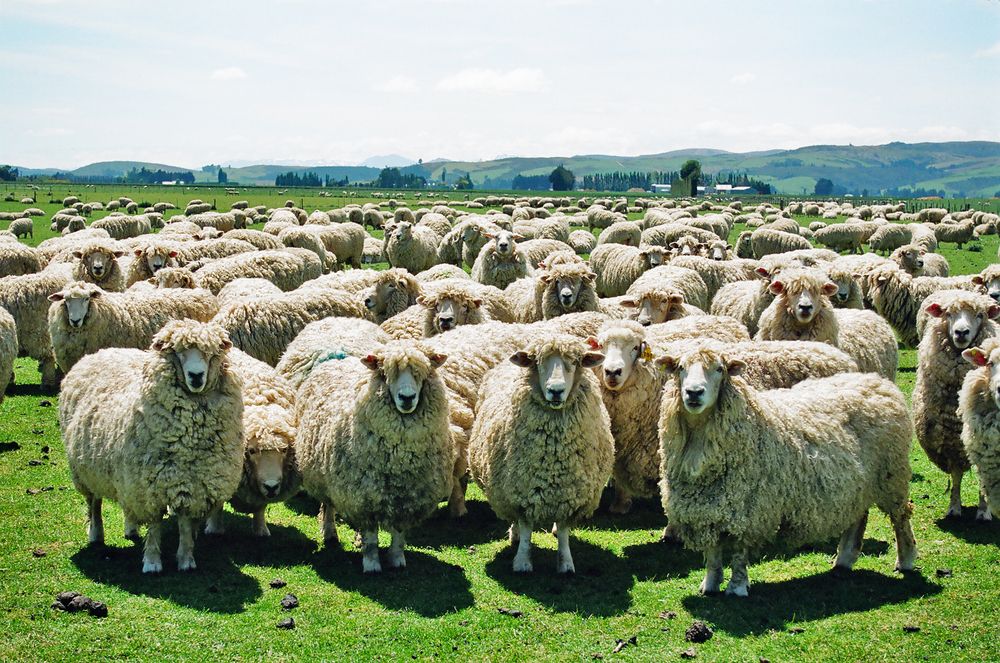
 It began, as so many strange chapters in history do, with something small and easily dismissed. A few restless animals. A farmer muttering about odd behavior. A fence trampled in the middle of the night. Then, suddenly, whole hillsides were alive with motion — thousands of sheep bolting in blind terror, smashing through barriers, plunging into ravines, suffocating one another in heaving, woolly tides of panic.
The Great Sheep Panic was not a single, neatly documented event with a clear beginning and end. Rather, it describes several waves of mass hysteria among flocks in the 19th century, most notably in Britain and parts of Australia. In these incidents, sheep stampeded seemingly without cause, sometimes for miles, injuring themselves, killing one another, and leaving bewildered farmers to sift through the aftermath.
In an age when rural life depended heavily on livestock, these episodes were more than curiosities. They were economic disasters. They were mysteries that inspired superstition, speculation, and scientific inquiry. And they were stark reminders that even the most domesticated animals can be overtaken by primal instinct.
A Night of Chaos
One of the most infamous episodes occurred in southern England in the 1880s. Reports spread of sheep across multiple counties suddenly breaking into frenzied runs during the night. Farmers were jolted awake by the thunder of hooves and the splintering of wooden fences. Entire flocks poured across fields, crashing into stone walls and hedgerows. Some animals collapsed from exhaustion. Others were trampled in dense clusters at gates or narrow passages.
What made the event so unsettling was the absence of an obvious cause. There were no wolves. No visible predators. No fires or storms to drive the animals forward. The panic seemed spontaneous — contagious in a way that felt almost supernatural.
Newspapers at the time described the scene in dramatic terms: “a rolling sea of wool,” “the earth trembling beneath the stampede,” “an inexplicable terror sweeping the countryside.” For rural communities already steeped in folklore, the temptation to see something otherworldly in the event was strong.
The Nature of Sheep
To understand the phenomenon, one must first understand sheep themselves. Sheep are intensely social, herd-bound animals. Their survival strategy for millennia has been collective flight. When one sheep bolts, others follow. When the group runs, the individual runs — often without knowing why.
This trait, evolutionarily advantageous in the presence of predators, becomes dangerous in confined spaces. Domestic flocks kept in fenced pastures lack the wide-open plains their ancestors once roamed. When panic strikes, there is nowhere to dissipate the momentum.
Even a minor trigger — a sudden noise, a dog barking, a gust of wind snapping a branch — can set off a chain reaction. In large numbers, that reaction can become catastrophic.
But during the Great Sheep Panic, many farmers insisted that the usual explanations fell short.
Superstitions and Speculation
In rural 19th-century Britain, unexplained livestock behavior often invited supernatural interpretations. Some whispered of spirits roaming the countryside. Others suggested earthquakes or underground disturbances too subtle for humans to detect. A few blamed atmospheric phenomena — perhaps unusual electrical activity in the air.
One popular theory centered on dogs. Even the distant scent or bark of a stray dog can trigger a sheep’s flight response. It was suggested that feral or wandering dogs might have moved through the countryside at night, unseen but deeply felt by the flocks.
Yet in many reported cases, no canine culprit was found.
The lack of visible cause only deepened the mystery. If a wolf attacks, the blood tells the story. But when sheep stampede into injury without a predator in sight, the explanation feels incomplete.
Economic Toll
The financial impact of these events was significant. Sheep were not ornamental animals; they were investments. Wool, meat, and breeding stock formed the backbone of many rural economies. A single night’s panic could result in dozens — sometimes hundreds — of dead or injured animals.
Beyond the immediate loss was the lingering unease. Farmers feared recurrence. They reinforced fences, hired additional shepherds, and kept dogs closer at hand. Some even adjusted grazing patterns to reduce flock density.
In Australia, where sheep farming was — and remains — a massive industry, similar episodes were reported in the late 19th and early 20th centuries. There, vast flocks numbering in the tens of thousands could be swept into motion by a single disturbance. The scale magnified the destruction.
Scientific Inquiry Emerges
By the late 19th century, scientific thinking was beginning to replace folklore in explaining animal behavior. Early studies of herd psychology suggested that sheep possess highly sensitive auditory and olfactory systems. Sounds imperceptible to humans — distant thunder, subtle shifts in wind, faint vibrations — could register as threats.
Some researchers proposed that minor seismic activity might have triggered the panic. Animals have long been observed behaving erratically before earthquakes. Perhaps the sheep were responding to tremors too subtle for human detection.
Others suggested mass startle reflexes amplified by density. In tightly packed flocks, one startled animal can create a cascade effect. Each sheep, reacting to the movement of the one beside it, compounds the urgency.
In this view, the Great Sheep Panic was not mysterious at all. It was a predictable outcome of evolutionary wiring colliding with agricultural confinement.
The Psychology of Panic
The phenomenon also offers a window into collective behavior more broadly. Panic spreads rapidly in groups when individuals rely heavily on social cues. Sheep, by nature, defer to the movement of the herd. When one runs, the safest option — from a survival standpoint — is to run too.
Humans are not immune to similar dynamics. Crowd panics in stadiums or theaters often follow comparable patterns: a sudden stimulus, an overreaction, and a chain reaction fueled by limited information.
In that sense, the Great Sheep Panic was less about sheep than about the universal mechanics of fear.
Media Amplification
As with many strange events, media coverage played a role in shaping the narrative. Victorian newspapers were eager for dramatic rural tales. The image of entire hillsides in motion, fences splintering in moonlight, and farmers chasing woolly avalanches made compelling copy.
Some reports likely exaggerated the scale or frequency of incidents. A localized stampede could, through repetition and embellishment, become a nationwide phenomenon in public imagination.
This amplification may have contributed to further anxiety. Farmers reading about distant flocks in frenzy might interpret minor disturbances in their own fields as part of a larger pattern.
In this way, panic about panic can spread — not only among sheep, but among people.
Lessons from the Hills
By the early 20th century, improvements in fencing design, flock management, and understanding of animal behavior reduced the frequency of catastrophic stampedes. Shepherds learned to avoid overcrowding and to monitor environmental stressors more closely.
Yet the memory of those nights lingered. Oral histories in rural communities preserved stories of “the night the sheep ran” — a phrase that needed no elaboration among those who had witnessed it.
The events became part cautionary tale, part rural legend.
A Metaphor in Wool
Today, the Great Sheep Panic occupies a curious space between documented agricultural mishap and folkloric oddity. It reminds us how thin the line can be between order and chaos, especially in systems built on instinct.
Sheep are often used metaphorically to describe unthinking conformity. The panic episodes underscore the double-edged nature of that instinct. Following the herd can be lifesaving — until it isn’t.
There is something haunting about the image of thousands of animals running in darkness, driven by a threat that may not even exist. It speaks to primal fear, to ancient survival codes still embedded in modern life.
The Quiet Aftermath
In the morning light after such events, the countryside must have looked eerily still. Broken fences. Scattered wool caught on thorns. Exhausted sheep huddled in corners of fields. Farmers tallying losses and shaking their heads.
The mystery rarely yielded a clear culprit. No wolf tracks. No storm damage. Just the aftermath of a fear that had rippled through a herd like lightning.
In the end, the Great Sheep Panic was not a single event, nor a supernatural curse. It was a convergence of biology, environment, and human interpretation. It was a reminder that domestication does not erase instinct, and that beneath the calm surface of pastoral life lies a pulse of ancient vigilance.
History often celebrates battles and kings, revolutions and discoveries. But sometimes, it’s the quieter, stranger episodes — a hillside erupting in wool and hooves under a moonlit sky — that reveal the fragile choreography of life.
The sheep ran. The fences fell. The mystery lingered.
And somewhere in the echo of those hoofbeats is a lesson about fear, about community, and about how quickly the ordinary can turn extraordinary when instinct takes the reins.