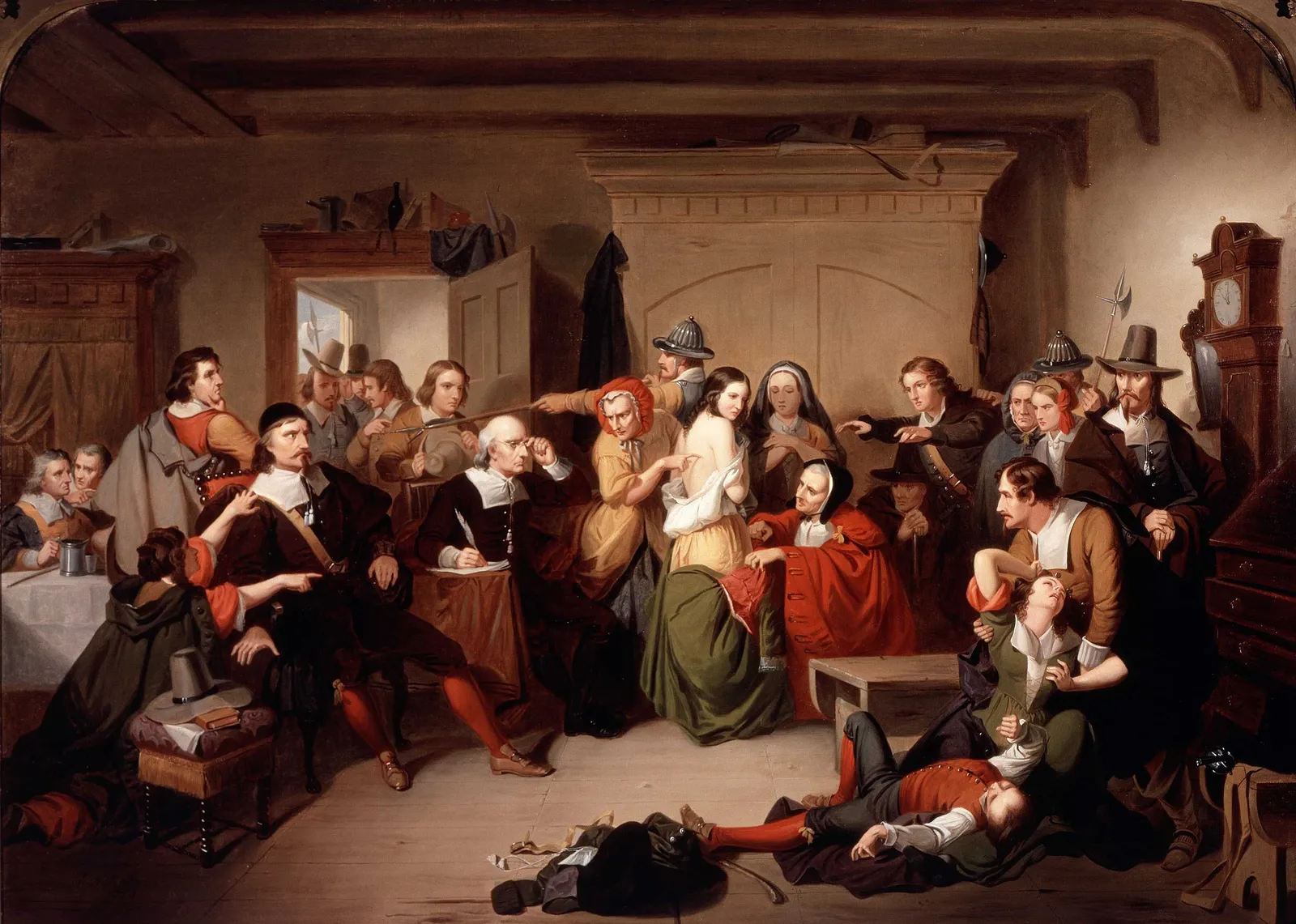
 In the winter of 1692, in a small Puritan settlement in colonial Massachusetts, something invisible took hold.
It was not a plague.
It was not a foreign army.
It was not famine.
It was fear.
By the time the panic ended, twenty people were dead, hundreds had been accused, and an entire community had torn itself apart over invisible crimes and spectral evidence. The events would become known as The Salem Witch Trials, one of the most infamous episodes of mass hysteria in American history.
But Salem was not simply a story of superstition. It was a collision of religion, politics, gender, frontier war, personal grudges, and a legal system unequipped to deal with invisible threats.
It was a tragedy born not from magic—but from belief.
A Community Under Strain
To understand Salem, you must understand the world it inhabited.
Late 17th-century New England was rigidly Puritan. Religion shaped law, family life, and social order. The devil was not metaphorical; he was real, active, and believed to be constantly at work corrupting souls.
At the same time, the Massachusetts Bay Colony was unstable.
-
The colonial charter had recently been revoked and replaced.
-
Political authority was in flux.
-
There were ongoing frontier wars with Native American tribes.
-
Refugees from violent border conflicts had flooded towns like Salem.
-
Smallpox outbreaks and crop failures had frayed nerves.
Salem Village itself was divided internally—economically and socially—between those aligned with the more prosperous Salem Town and those seeking independence.
The community was primed for fracture.
The First Afflictions
In January 1692, two young girls began behaving strangely:
-
Betty Parris, age 9
-
Abigail Williams, age 11
They screamed.
They convulsed.
They crawled under furniture.
They claimed to see specters.
Their father, Reverend Samuel Parris, was Salem Village’s minister—a controversial figure already disliked by many parishioners.
Doctors were called.
Unable to find a physical cause, they reached a chilling conclusion:
Witchcraft.
Once that word entered the air, it refused to leave.
The First Accused
Under pressure to identify the source of their torment, the girls named three women:
-
Tituba, an enslaved woman in the Parris household
-
Sarah Good, a homeless beggar
-
Sarah Osborne, an elderly woman who defied social norms
These were not powerful women. They were marginalized.
Accusation followed status.
Tituba, under interrogation, confessed—describing elaborate visions of black dogs, red cats, and a “man from Boston” who signed the devil’s book.
Her confession electrified the community.
The devil was in Salem.
The Court of Oyer and Terminer
As accusations multiplied, colonial authorities established a special court: the Court of Oyer and Terminer.
It was tasked specifically with hearing witchcraft cases.
The court accepted a controversial form of testimony known as spectral evidence—claims that the accused’s spirit had appeared in visions to torment victims.
The logic was flawed but powerful:
If a person’s specter attacked someone, they must be guilty.
The devil could not assume the form of an innocent person.
That assumption would prove catastrophic.
The Executions Begin
On June 10, 1692, Bridget Bishop was hanged—the first execution.
More followed.
By September:
-
19 people were hanged.
-
One man, Giles Corey, was pressed to death under heavy stones after refusing to enter a plea.
-
Several others died in prison.
The condemned included farmers, housewives, church members—even a former minister.
The hysteria spared no one.
The Pattern of Accusation
Accusations spread like wildfire.
Neighbors accused neighbors.
Children accused adults.
Servants accused masters.
The accused were often:
-
Social outsiders
-
Women with property disputes
-
Individuals critical of church leadership
-
People involved in longstanding feuds
Witchcraft became a weapon.
Personal grudges dressed themselves in religious language.
Gender and Power
Of the twenty executed, fourteen were women.
In Puritan society, women were expected to be submissive, obedient, and silent.
Women who:
-
Owned property
-
Spoke bluntly
-
Defied authority
-
Lived alone
Were more vulnerable to suspicion.
Witchcraft accusations reinforced patriarchal control.
The trials were not just about theology.
They were about power.
The Frontier Factor
Many of the accusers came from families displaced by frontier wars with Native American tribes.
They had witnessed violence.
Lost homes.
Buried relatives.
Trauma does not vanish.
It transforms.
Some historians argue that unresolved fear and grief found expression in witchcraft accusations—a way to externalize chaos.
Instead of acknowledging political or military failure, communities blamed invisible evil.
The Turning Point
The hysteria reached its breaking point when accusations began targeting the elite.
When the wife of Governor William Phips was named, the political calculus changed.
Prominent ministers, including Increase Mather, began publicly questioning the use of spectral evidence.
The governor dissolved the Court of Oyer and Terminer in October 1692.
Executions stopped.
The panic ebbed.
Aftermath and Regret
In 1697, a day of fasting and reflection was declared to atone for the tragedy.
Several judges admitted error.
In 1702, the trials were declared unlawful.
In 1711, financial compensation was provided to families of the accused.
But apology does not resurrect the dead.
Salem would forever be marked.
What Caused the Hysteria?
Historians have proposed numerous theories:
-
Ergot poisoning (a fungus that can cause hallucinations)
-
Mass psychogenic illness
-
Political instability
-
Religious extremism
-
Economic rivalry
No single explanation suffices.
The trials were a perfect storm:
Fear + theology + social tension + flawed law.
The Danger of Spectral Evidence
Perhaps the most enduring lesson of Salem is legal.
Evidence must be tangible.
When courts accept invisible harm as proof of guilt, justice collapses.
Salem became a cautionary tale in American legal history—invoked during later moral panics.
A Community Divided
Salem Village was already fractured before 1692.
The trials amplified existing divisions.
Land disputes.
Church politics.
Economic inequality.
Witchcraft accusations often aligned with these fault lines.
Fear simply gave them moral cover.
Salem’s Place in American Memory
The Salem Witch Trials became symbolic of:
-
Mass hysteria
-
Religious extremism
-
Miscarriages of justice
In the 20th century, playwright Arthur Miller used Salem as allegory in The Crucible, drawing parallels to McCarthy-era anti-communist witch hunts.
The phrase “witch hunt” entered political vocabulary.
Salem became shorthand for collective paranoia.
The Psychology of Panic
Why did it spiral so quickly?
Because belief systems shape perception.
When people believe:
-
The devil is active
-
Witches are real
-
Confession saves souls
Accusations feel righteous.
Fear becomes contagious.
And once the machinery of accusation begins, stopping it requires courage few possess.
The Silence of Doubt
Many likely doubted.
But speaking out risked suspicion.
Silence becomes survival.
In that environment, hysteria feeds itself.
Modern Reflection
Today, Salem is a tourist destination.
Museums display artifacts.
Tours recount tragedies.
Souvenirs are sold.
The spectacle is sanitized.
But beneath the commercialization lies something deeply human:
A reminder of how quickly reason can collapse under fear.
Final Thoughts: The Fire That Burns Without Flame
The Salem Witch Trials were not caused by witches.
They were caused by:
-
Certainty without evidence
-
Authority without restraint
-
Fear without skepticism
They remind us that societies are fragile.
That belief can override reason.
That justice must be grounded in proof, not panic.
In 1692, Salem believed it was fighting the devil.
In reality, it was fighting itself.
And for twenty people, that battle was fatal.