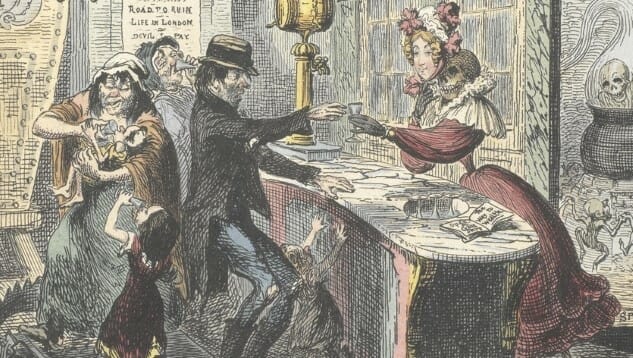
 In early 18th-century London, you could get drunk for a penny.
You could get blind drunk for two.
And if you had nothing left to give but your dignity, there was always a filthy pile of straw in the corner where you could sleep it off.
Gin was not merely popular in England during the first half of the 1700s — it was omnipresent. It soaked into the mortar of London’s brickwork. It lingered in alleyways and markets. It burned in the bellies of laborers before sunrise and clouded the minds of mothers before noon. The capital of a rising global empire had, in many districts, become a city permanently under the influence.
And then — almost as dramatically as it had arrived — the flood receded.
England did not wake up one morning to find literal empty barrels. But in a political, cultural, and economic sense, the country did something just as extraordinary: it sobered itself. Through riots, moral panic, failed legislation, and finally strategic regulation, England effectively “ran out” of the gin-drenched chaos that had defined an era.
This is the story of how a nation drank too much, panicked, and forced itself to stop.
How a Foreign Spirit Conquered England
Gin did not begin as English. It began in the Netherlands as jenever, a juniper-flavored medicinal spirit. English soldiers encountered it during continental wars in the 1600s and returned home with a taste for what they called “Dutch Courage.”
The turning point came in 1688, when the Dutch-born William III took the English throne during the Glorious Revolution. England soon found itself locked in conflict with France, and French brandy — once fashionable among the English elite — became politically undesirable.
To weaken France economically and strengthen domestic agriculture, the government encouraged the distillation of spirits from English grain. Laws were relaxed. Licensing requirements were minimal. Distillation was easy and profitable.
The unintended consequence was an explosion of cheap gin.
Unlike beer, which required brewing time and infrastructure, gin could be distilled quickly, cheaply, and almost anywhere. By the early 1700s, small-scale distillers were producing massive quantities. London, swelling with migrants seeking work, became the epicenter.
By the 1730s, gin was no longer a novelty. It was a tidal wave.
The Gin Craze
Between roughly 1720 and 1751, England entered what historians now call the Gin Craze.
London’s population hovered around 600,000. Estimates suggest the city consumed millions of gallons annually — an astonishing figure for the time. Gin was sold in market stalls, in homes, in makeshift shops. It was dispensed through windows into the street. Some establishments displayed grimly humorous signs promising intoxication and a place to collapse.
The drink was brutally strong. Quality control barely existed. Some distillers added turpentine or other chemicals to mimic flavor or boost potency. What mattered was cost — and gin was cheaper than beer.
In overcrowded slums, gin dulled hunger and softened the misery of urban life. Industrialization was still emerging, but economic instability was already severe. Work was irregular. Housing was cramped. Sanitation was poor.
Gin was not simply a drink.
It was escape.
Women drank it in large numbers, which shocked moral reformers. Mothers were accused — sometimes accurately, sometimes not — of neglecting children under its influence. Reports circulated of infants sedated with gin. Crime was blamed on it. Poverty was blamed on it. Idleness was blamed on it.
Whether all accusations were fair is still debated by historians. But perception mattered.
And the perception was that London was collapsing under juniper fumes.
Hogarth’s Nightmare
No single image captured the panic more powerfully than Gin Lane, the 1751 engraving by William Hogarth.
The scene is grotesque. A skeletal woman, oblivious in drunken stupor, allows her baby to tumble from her arms. Around her, emaciated citizens stagger, starve, pawn tools, and collapse. Buildings decay. A man impales himself on a railing. A sign for a gin shop dominates the background like a shrine to ruin.
Hogarth’s companion print, Beer Street, shows healthy, prosperous citizens enjoying modest ale. The contrast is moral theater. Beer builds society. Gin destroys it.
Hogarth was not neutral. His work was propaganda in the service of reform. But it struck a nerve. Gin Lane did not invent concern — it crystallized it.
The middle and upper classes began to fear that England’s working population was dissolving into drunkenness. A nation that aspired to naval dominance and colonial expansion could not afford to be perpetually intoxicated.
The panic moved from pamphlets to Parliament.
Parliament’s First Strike — And Failure
The first legislative attempt to curb gin came in 1729. It imposed modest taxes on retailers. The effect was negligible. Gin remained cheap and plentiful.
So in 1736, the government tried something far more aggressive.
The Gin Act of 1736 — passed by the Parliament of Great Britain — imposed a massive £50 annual license fee on retailers, along with steep duties. For small sellers, £50 was astronomical. The law aimed to crush the trade outright.
Instead, it detonated social unrest.
Gin did not disappear. It went underground.
Illegal distilling exploded. Sellers operated secretly, often under coded names. Informers who reported unlicensed dealers were assaulted. Riots broke out. Crowds attacked enforcement officers. The act became deeply unpopular among the working class, who saw it as an attack on their way of life.
Consumption did not meaningfully decline. In some areas, it increased.
The government had tried prohibition by economic strangulation.
It had failed.
When a Nation Cannot Enforce Its Own Law
The failure of the 1736 Act revealed something uncomfortable: the state did not have the practical ability to police widespread behavior that large segments of the population supported.
London was too big. The trade was too decentralized. Enforcement was inconsistent and dangerous.
More importantly, gin was not simply a vice imposed from above. It had become woven into daily life. Removing it overnight was like trying to remove oxygen.
For nearly fifteen years, the government struggled. Consumption fluctuated but remained high. The social consequences continued. Courts complained of drunken defendants. Hospitals and poorhouses overflowed.
But something else began to shift.
Grain prices rose in the late 1740s due to poor harvests. Distilling became more expensive. Gin slowly grew less affordable. The economic winds that had once fueled the craze began to turn against it.
When Parliament tried again in 1751, it did so differently.
The Gin Act That Worked
The Gin Act of 1751 was more measured. Rather than imposing absurd license fees, it focused on tightening distribution. Sales were restricted to licensed retailers. Magistrates were empowered to supervise enforcement locally. Wholesale suppliers faced stricter oversight.
The approach was strategic rather than theatrical.
Combined with rising grain costs, the act succeeded where the earlier one had failed. Production dropped. Consumption declined. Public drunkenness visibly decreased.
Between the early 1740s and early 1750s, gin output fell sharply.
London did not empty its last barrel.
But the era of chaotic, penny-a-dram intoxication ended.
England had not run out of gin physically — it had run out of tolerance.
Was It Really That Bad?
Modern historians debate the severity of the Gin Craze. Some argue that reformers exaggerated horror stories to push legislation. Infant mortality, for example, had multiple causes beyond alcohol. Urban poverty was complex and longstanding.
But even allowing for exaggeration, the numbers were extraordinary. Consumption was undeniably high. The political anxiety was genuine. Riots were real.
The Gin Craze revealed how quickly a cheap intoxicant could reshape society when regulation lagged behind demand.
It also exposed deep class tension.
The wealthy drank wine and imported spirits in private clubs without interference. The poor drank gin in public and were told they were destroying civilization. Crackdowns felt hypocritical to many working Londoners.
Gin was never just about alcohol.
It was about control.
The Empire and the Aftermath
By the late 18th and early 19th centuries, gin reemerged in a new form.
Distillation improved. Quality rose. London Dry Gin developed as a cleaner, more refined style. What had once been associated with squalor gradually gained respectability.
Ironically, gin would later become an emblem of British imperial culture. In tropical colonies, officers mixed gin with tonic water — whose quinine helped prevent malaria. The bitterness of tonic was softened by juniper spirit.
The drink that had once symbolized urban decay became a colonial staple.
But it never again achieved the unregulated chaos of the Gin Craze.
The state had learned.
Why England “Ran Out” of Gin
England did not literally drain its barrels dry. Instead, it exhausted a social experiment.
Cheap, lightly regulated spirits flooded an expanding urban population. Consumption soared. Reformers panicked. The government overreached and failed. Social unrest followed. Then, slowly and strategically, regulation combined with economic pressure curbed the excess.
In effect, England ran out of the conditions that made runaway gin consumption possible.
The country discovered something enduring: outright bans often fail, but targeted regulation and shifting market forces can succeed.
The juniper fog lifted not because gin vanished — but because access narrowed, prices rose, and oversight tightened.
A Mirror to Future Panics
The Gin Craze feels strangely modern.
Substitute gin with another substance — opium in 19th-century China, alcohol in 1920s America, opioids in the 21st century — and the pattern echoes: rapid expansion, moral panic, harsh crackdown, black market surge, eventual recalibration.
England’s near-infatuation with gin offers a case study in how societies react to sudden shifts in consumption.
Panic. Overreaction. Adjustment.
Sobriety — eventually.
The Morning After
By the 1760s, London was different. Not sober in the strict sense — alcohol remained central to British life — but more stable. Gin shops no longer dominated slum corners. Public intoxication declined. The sense of crisis faded.
The country that had feared it was drinking itself into oblivion had regained its footing.
And yet the memory lingered.
“Mother’s Ruin” became a nickname for gin, a lingering reminder of the era when it was blamed for familial collapse. Hogarth’s Gin Lane remained a warning etched in copper and paper.
England had stared at itself in the mirror — hollow-eyed, unsteady, and staggering — and decided it did not like what it saw.
Conclusion: When the Barrels Didn’t Empty, But the Patience Did
The time England “ran out” of gin was not a dramatic moment of sudden scarcity. It was slower, more complex, and more revealing.
A foreign spirit became a national obsession. Cheap supply met urban despair. The drink flooded streets and households. The government tried to crush it and failed. Then it tried again — smarter this time — and succeeded.
What ran out was not gin.
It was indulgence.
It was tolerance for chaos.
It was the illusion that a nation could thrive while permanently intoxicated.
When the juniper haze finally cleared, England remained standing — chastened, regulated, and forever marked by the decades when a small glass of clear spirit nearly unbalanced an empire.