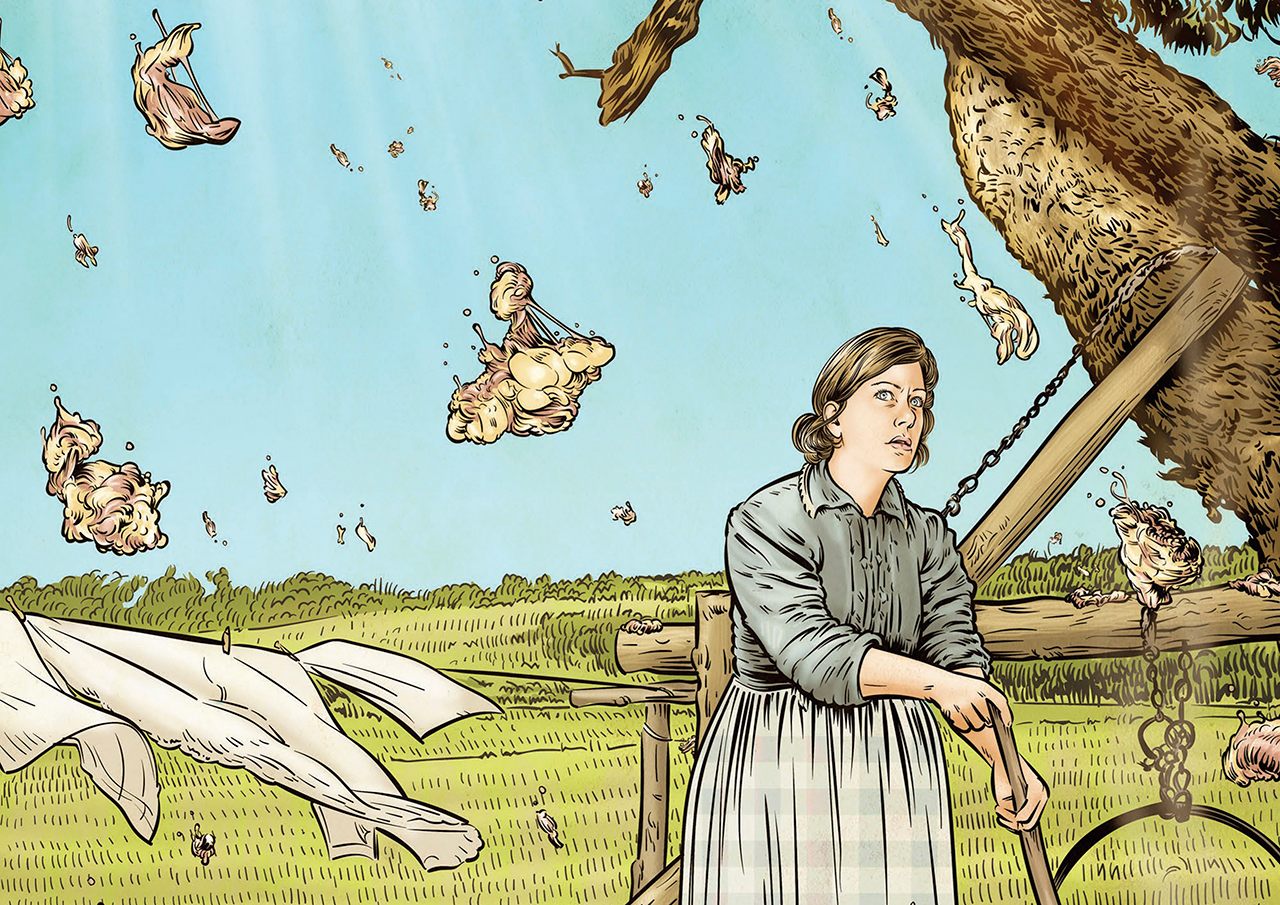
 On the afternoon of March 3, 1876, in rural Bath County, Kentucky, a woman stepped outside to make soap.
Her name was Mrs. Crouch. The air was clear. The sky was blue. Nothing about the day suggested the extraordinary.
Then something began falling from above.
At first it was just specks. Then chunks. Then what witnesses described as flakes and strips of red meat, drifting down from an empty sky and landing across a field roughly the size of a football field.
They did not come from a passing wagon.
There was no explosion.
No storm cloud.
No visible source.
For several minutes, it rained flesh.
The incident would later be known as the Kentucky Meat Shower, one of the strangest and most perplexing events in American folklore — a case where science, superstition, and appetite collided in ways that still baffle explanation.
A Clear Day in Olympia Springs
Bath County in 1876 was rural and quiet. Farms dotted the landscape. News traveled by word of mouth. Unusual events were memorable because they broke the monotony of agricultural life.
Mrs. Crouch reportedly saw the material falling slowly — almost gently — from a cloudless sky.
Witnesses described pieces roughly two to four inches across.
The meat landed on fences, fields, and rooftops.
Some said it covered an area approximately 100 yards wide.
This was not a single object dropping.
It was a sustained shower.
The First Reactions
The immediate response was confusion.
Was it:
-
A sign from God?
-
A curse?
-
A bizarre accident?
In 19th-century America, religious interpretation often preceded scientific analysis.
Some locals reportedly saw it as divine intervention — perhaps a modern echo of manna from heaven.
Others were simply bewildered.
And then came the detail that elevates the story from strange to unforgettable.
Some people tasted it.
Tasting the Sky
Two men, described in newspaper accounts as “gentlemen of unquestioned veracity,” reportedly fried samples of the fallen meat and ate it.
Their verdict?
One thought it tasted like venison.
The other suggested mutton.
The casual confidence with which they sampled unexplained sky-meat says something about frontier pragmatism — and about 19th-century standards of risk assessment.
Today, such behavior would be unthinkable.
In 1876, curiosity won.
News Spreads
Local newspapers quickly reported the phenomenon.
Within days, the story reached national circulation.
Headlines described “Flesh Falling from the Sky” and “A Shower of Meat.”
Scientific societies requested samples.
Specimens were preserved in jars and sent for analysis.
The Kentucky Meat Shower had become a national mystery.
Early Scientific Analysis
In 1876, the American scientific establishment was smaller but active.
Microscopic examination of preserved samples suggested that the material was not divine manna, nor human flesh, nor extraterrestrial matter.
Some early analysts proposed it was:
-
Lung tissue
-
Muscle fibers
-
Cartilage
One physician, Dr. Leopold Brandeis of Louisville, concluded the samples resembled lung tissue from either a horse or a human infant — a grim and dramatic claim that newspapers eagerly repeated.
Later analysis revised that assessment.
Competing Theories
Several explanations emerged over time.
1. Vulture Regurgitation
This is the most widely accepted modern theory.
Turkey vultures, when threatened or overburdened, will vomit partially digested meat to lighten themselves for flight.
If a flock had been feeding on a carcass and was startled, it could theoretically expel a quantity of meat while airborne.
The pieces could then fall across a concentrated area.
This explanation accounts for:
-
The size and irregularity of the meat.
-
The lack of visible source (vultures at high altitude).
-
The organic nature of the tissue.
It also matches known vulture behavior.
2. Atmospheric Phenomenon
Some speculated that a waterspout or whirlwind could have lifted material from a distant slaughter site and deposited it over Bath County.
However, there were no reports of storms or violent winds that day.
3. Hoax
Could the entire event have been staged?
Given the number of witnesses and preserved samples examined by scientists, this seems unlikely.
There was no clear motive for fabrication.
The Vulture Hypothesis Gains Strength
Modern researchers tend to favor the vulture explanation.
Turkey vultures have:
-
A wingspan of up to six feet.
-
The ability to soar silently at high altitudes.
-
A well-documented reflex of projectile vomiting when disturbed.
If a flock feeding on a carcass was suddenly startled — perhaps by gunfire or another predator — they could simultaneously expel their stomach contents.
The resulting rain of partially digested tissue might resemble a “meat shower.”
While grotesque, it is biologically plausible.
The Limits of 19th-Century Science
In 1876, forensic biology was in its infancy.
Microscopes were limited.
Tissue identification was imprecise.
Conflicting reports about whether the meat resembled lung, muscle, or cartilage likely reflect methodological limits rather than deliberate confusion.
The scientific community could identify it as animal tissue.
They could not definitively determine its origin.
Cultural Reaction
The Kentucky Meat Shower became part of American folklore almost immediately.
It entered collections of strange phenomena.
It was cited in discussions of unexplained natural events.
It became shorthand for rural oddity.
In an era fascinated by spiritualism and mysterious occurrences, it fit neatly alongside stories of falling frogs, raining fish, and other “sky anomalies.”
The Broader Phenomenon of Animal Rain
The Kentucky incident was not unique in one sense.
Throughout history, reports have surfaced of:
-
Fish raining from the sky.
-
Frogs falling during storms.
-
Worms scattered after heavy winds.
In many cases, waterspouts and whirlwinds are responsible — lifting small animals and depositing them elsewhere.
The Kentucky case differs because:
-
It involved mammalian tissue.
-
There was no storm.
-
The area of impact was localized.
That combination gives it enduring mystery.
The Appetite of Curiosity
Perhaps the strangest element of the story remains the tasting.
In a modern context of health awareness, the idea of sampling unidentified sky-flesh seems absurd.
But frontier life was pragmatic.
People were accustomed to slaughtering animals, handling raw meat, and assessing quality by taste.
The curiosity of the two tasters — and their willingness to publicly report flavor notes — adds an oddly human layer to the event.
Why It Endures
The Kentucky Meat Shower persists in popular memory because it sits at the intersection of:
-
Natural mystery
-
Rural Americana
-
Scientific uncertainty
-
Dark humor
It is grotesque but harmless.
Absurd but documented.
It resists neat categorization.
A Mystery Mostly Solved?
If the vulture hypothesis is correct, the event is less supernatural and more biological accident.
But complete certainty is impossible.
No preserved samples remain for modern DNA testing.
Accounts are filtered through newspapers of the time.
Witness descriptions vary.
The Kentucky Meat Shower remains “likely explained,” not conclusively solved.
Final Reflections: When the Sky Feeds You
On that March afternoon in 1876, Mrs. Crouch stepped outside expecting routine chores.
Instead, she witnessed one of the strangest meteorological anomalies in American history.
Meat fell from a clear sky.
Neighbors gathered.
Some tasted.
Scientists speculated.
Whether it was startled vultures or something more exotic, the event reminds us of a simple truth:
Nature is capable of absurd spectacle.
And human beings are equally capable of meeting the bizarre with curiosity — sometimes even with a frying pan.
The sky opened.
Flesh descended.
And for a few unforgettable minutes, Kentucky became the only place on Earth where dinner arrived unannounced from above.