 High above mainland Europe, tucked deep inside the Arctic Circle, sits a town where the sun disappears for months at a time, polar bears outnumber people, and—according to one of the most persistent stories in modern folklore—it is illegal to die.
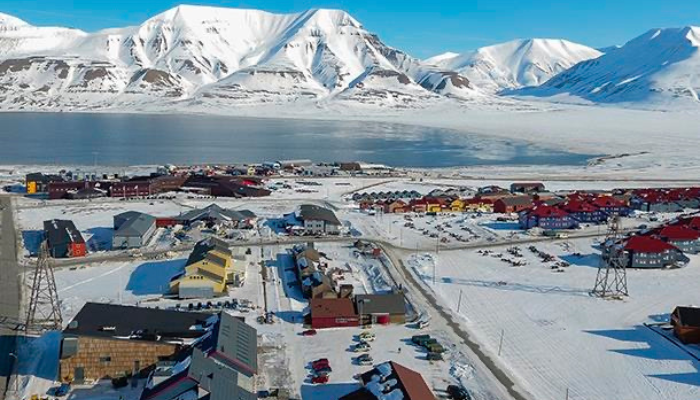
The town is Longyearbyen, the largest settlement in the Norwegian archipelago of Svalbard. With a population hovering around 2,000, it is one of the northernmost permanently inhabited places on Earth.
And while death is not technically outlawed there, something stranger is true:
You cannot be buried.
This isn’t a philosophical statement.
It’s geological.
In Longyearbyen, the ground is frozen solid year-round. The permafrost is so deep and so persistent that bodies buried in the town cemetery decades ago never decomposed.
Death, in this place, doesn’t behave the way it does elsewhere.
A Town at the Top of the World
Longyearbyen was founded in 1906 as a coal mining settlement by American industrialist John Munro Longyear. The town carries his name.
For decades, coal defined life there.
Miners worked in darkness.
Families braved Arctic winters.
Ships docked in ice-choked fjords.
Isolation was constant.
So was cold.
Svalbard’s location—between mainland Norway and the North Pole—means that from October to February, the sun never rises. The polar night blankets the town in darkness. In summer, the opposite occurs: the midnight sun shines for months without setting.
It is a place of extremes.
And the ground beneath it reflects that extremity.
The Cemetery That Wouldn’t Change
In the early 20th century, Longyearbyen maintained a small cemetery.
Miners died in accidents.
Children succumbed to illness.
The dead were buried in the frozen earth.
But something unusual became apparent over time.
Bodies weren’t decomposing.
In temperate climates, bacteria and soil organisms break down organic material naturally. But in permafrost, the soil remains frozen year-round. Microbial activity is nearly nonexistent.
Coffins remained intact.
Tissue remained preserved.
Even pathogens remained viable.
The Spanish Flu Discovery
The most unsettling discovery came decades later.
In 1918, during the global influenza pandemic, several residents of Longyearbyen died of the Spanish flu and were buried locally.
In the 1990s, scientists exhumed some of those graves for research.
To their astonishment, the bodies were remarkably preserved.
More disturbingly, samples of the influenza virus were recovered.
The virus had remained intact in the frozen soil for over 70 years.
Permafrost had become a biological time capsule.
The Practical Ban on Burial
The implications were clear.
If bodies did not decompose and dangerous pathogens could survive indefinitely, burial posed a public health risk.
Local authorities eventually stopped allowing burials in Longyearbyen.
Today, if someone is terminally ill or near death, they are flown to mainland Norway.
If a resident dies unexpectedly, the body is transported south for burial or cremation.
The cemetery remains, but it is effectively closed.
Hence the myth:
“You can’t die in Longyearbyen.”
It isn’t that death is illegal.
It’s that burial is.
Living with the Reality
In practical terms, this means Longyearbyen operates differently from most communities.
-
There are no nursing homes.
-
There are no long-term elderly care facilities.
-
Residents who become too frail must relocate.
The town skews younger.
People come for work—research, tourism, mining, administration.
Few stay for life.
Longyearbyen is not designed for dying.
The Science of Permafrost
Permafrost is ground that remains frozen for at least two consecutive years.
In Svalbard, it has remained frozen for thousands.
Temperatures can plunge below -30°C (-22°F) in winter. Even in summer, the thaw penetrates only a shallow surface layer.
Below that, the earth is hard as stone.
Digging graves requires heavy machinery.
But even if dug, the cold halts decomposition.
Permafrost preserves:
-
Woolly mammoths
-
Ancient plant matter
-
Microbial life
-
And, in Longyearbyen’s case, human remains
It is nature’s freezer.
A Town Built on Ice
Longyearbyen itself rests atop permafrost.
Buildings are constructed on stilts or pilings to prevent heat from melting the ground and destabilizing foundations.
Pipes run above ground.
Infrastructure adapts to the frozen earth.
Life here depends on respecting the cold.
And death does too.
The Myth Grows
The idea of outlawed death captured global imagination.
Headlines declared:
“The Town Where It’s Illegal to Die.”
Tourists arrived intrigued.
Documentaries featured it.
Writers leaned into the surreal image.
But the truth is less whimsical and more practical.
The town has not banned death.
It has adapted to climate.
Climate Change Complicates Things
Ironically, climate change is now altering the conditions that made Longyearbyen unique.
Svalbard is warming faster than most places on Earth.
Permafrost is beginning to thaw.
In 2016, melting ground destabilized a cemetery in another Svalbard settlement, exposing coffins.
The frozen barrier that once preserved bodies indefinitely is no longer guaranteed.
The town that once feared undying viruses now fears unstable soil.
The Psychological Effect
Living in Longyearbyen changes perspective.
You are:
-
800 miles from the North Pole.
-
Surrounded by glaciers.
-
Accompanied by mandatory rifle carry outside town limits (because of polar bears).
Life feels provisional.
The knowledge that you cannot be buried here reinforces that sense.
Longyearbyen is a place for living intensely—not settling permanently.
Community in Isolation
Despite its harsh conditions, Longyearbyen has a vibrant community.
There is:
-
A school
-
A university center (UNIS)
-
A cultural center
-
Restaurants and bars
Residents celebrate polar night with festivals.
They mark the sun’s return with ceremony.
But the absence of burial underscores an underlying truth:
This is not a place where generations accumulate.
It is a place of transience.
Death Without Resting Place
In most societies, burial grounds anchor community memory.
Gravestones connect past to present.
In Longyearbyen, that continuity is broken.
The old cemetery stands, but it is frozen in time.
No new graves.
No evolving landscape of remembrance.
Memory here is portable.
A Mirror of Extremes
Longyearbyen’s burial policy reflects the broader Arctic reality:
Nature dictates terms.
Humans adjust.
In most of the world, soil reclaims the dead.
Here, soil refuses.
Final Reflections: Where Even Death Must Travel
The phrase “the town that outlawed death” persists because it feels paradoxical.
How can a community ban the inevitable?
It cannot.
But Longyearbyen demonstrates that even death is shaped by environment.
In a place where the sun disappears for months and the ground never softens, life itself feels different.
The dead cannot remain.
The sick must leave.
The ground remembers everything.
Longyearbyen is not a town without death.
It is a town where death does not linger.
And in that frozen, silent soil, where even viruses can sleep for decades, the boundary between past and present feels thinner than anywhere else on Earth.