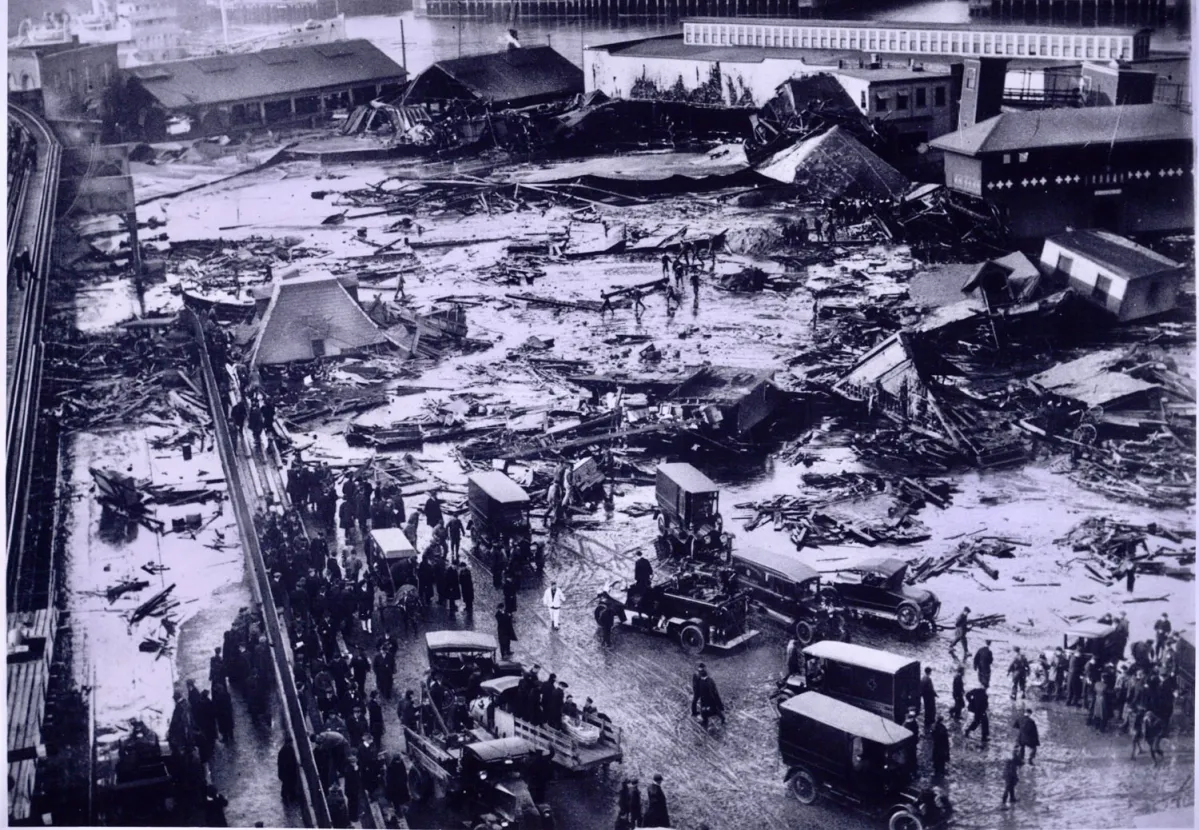
 On the afternoon of January 15, 1919, the North End of Boston was hit by a disaster so bizarre that it still sounds fictional more than a century later. Without warning, a massive steel tank burst open, releasing 2.3 million gallons of molasses into the streets. The wave was reportedly 15 feet high, moving at 35 miles per hour, powerful enough to knock buildings off their foundations, bend steel beams, and kill people instantly.
Horses drowned.
Homes collapsed.
Children were crushed.
The neighborhood was coated in sticky brown syrup that hardened in the winter cold.
This was the Great Boston Molasses Flood, one of the strangest industrial disasters in American history—and one of the most damning examples of corporate negligence ever brought before a court.
It wasn’t an accident in the way people like to imagine accidents. It was preventable. Ignored warnings. Cut corners. And the cost was paid in lives.
Boston in 1919: A City Already on Edge
To understand how the molasses flood happened—and why it was so devastating—you need to understand Boston in early 1919.
The city was restless. World War I had just ended two months earlier. Soldiers were returning home. Labor unrest was growing. Prohibition loomed on the horizon, set to take effect just days later.
The North End, where the flood occurred, was a dense, working-class neighborhood populated largely by Italian and Irish immigrants. Buildings were packed tightly together. Streets were narrow. Children played outdoors year-round.
And towering over this neighborhood was a 50-foot-tall steel tank, so large it dominated the skyline.
It held molasses.
Why So Much Molasses?
In 1919, molasses wasn’t just for baking.
It was a key industrial ingredient, used to produce industrial alcohol and ethanol, which in turn were used for:
-
Explosives
-
Munitions
-
Industrial solvents
-
Rum (before Prohibition)
The tank belonged to the United States Industrial Alcohol Company (USIA), which used molasses shipped from the Caribbean to feed its fermentation plants.
The tank itself could hold 2.5 million gallons, and at the time of the disaster, it was nearly full.
This wasn’t a quaint storage container. It was an industrial pressure vessel looming over homes, schools, and businesses.
A Tank Built to Fail
From the moment it was constructed in 1915, the tank had problems.
It leaked.
Constantly.
Residents reported molasses seeping from its seams, pooling on the ground. Children would collect it in cups. The company’s response wasn’t to repair the tank—it was to paint it brown so the leaks wouldn’t show.
There was no proper structural testing.
No qualified engineer signed off on its design.
No safety inspection.
USIA rushed construction to meet wartime demand. Speed mattered. Safety did not.
The tank had been filled and emptied repeatedly, stressing its steel walls. Each refill increased pressure. Each winter contraction and summer expansion weakened its rivets.
By January 1919, it was a disaster waiting for a date.
The Day Everything Burst
January 15 was unseasonably warm. Temperatures climbed into the 40s, after weeks of cold weather. Just two days earlier, a fresh shipment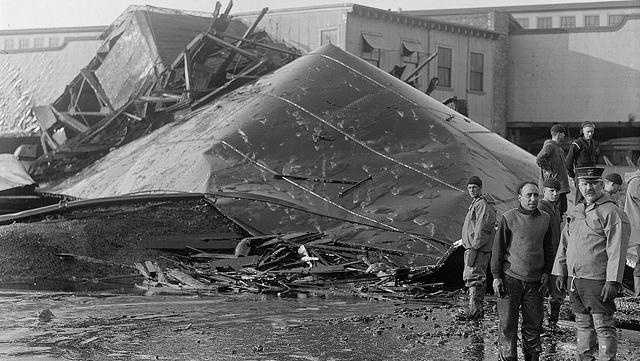 of warm molasses had been pumped into the tank, increasing internal pressure and accelerating fermentation.
Around 12:40 PM, witnesses heard a low rumble—described as sounding like a train, thunder, or a machine gun.
Then the tank exploded.
Not imploded. Not cracked.
It ruptured violently, sending steel plates flying through the air like shrapnel.
A Wave of Molasses
The molasses didn’t ooze out.
It surged.
A wall of thick, sticky liquid rushed through Commercial Street, sweeping everything in its path. Buildings were crushed or shifted off their foundations. Elevated train tracks collapsed. A firehouse was smashed flat.
People were thrown into the flood, instantly trapped by the syrup’s incredible density.
Molasses is about 40% denser than water. In cold weather, it behaves almost like wet cement.
Once you were in it, escape was nearly impossible.
The Human Toll
The official death toll was 21 people, though some historians believe it may have been higher. At least 150 others were injured.
Victims included:
-
Dockworkers
-
Teamsters
-
Housewives
-
Children playing in the street
-
A Boston firefighter pinned beneath debris
Some people drowned.
Others suffocated.
Some were crushed by collapsing buildings.
Several horses were trapped and had to be shot because they couldn’t be freed.
One victim was found days later, his body preserved in hardened molasses.
Chaos in the Aftermath
Rescue efforts were immediate but chaotic.
Police officers, sailors from nearby naval vessels, Red Cross workers, and ordinary citizens rushed to help. Rescuers waded waist-deep through syrup, struggling to pull people free before the molasses hardened further.
The cleanup took weeks.
-
Streets were washed with saltwater from the harbor
-
Sand was spread to absorb the mess
-
Workers tracked molasses throughout the city
For years afterward, locals claimed that on hot summer days, the North End still smelled faintly sweet.
Boston had been permanently marked.
The Lawsuit That Changed Everything
In the flood’s aftermath, over 100 lawsuits were filed against USIA. These cases were consolidated into one of the largest class-action-style lawsuits of the era.
The company initially claimed:
-
Sabotage by anarchists
-
A bomb planted by radicals
-
Anti-corporate conspiracy
The timing—right after WWI and during labor unrest—made the claim politically convenient.
But the evidence didn’t support it.
A Landmark Legal Battle
The case dragged on for six years, becoming a landmark moment in American legal history.
Expert witnesses testified about:
-
Faulty steel thickness
-
Poor rivet quality
-
Lack of safety margins
-
Ignored warning signs
Independent engineers confirmed what residents had known all along: the tank was structurally unsound from the start.
The court ruled decisively against USIA.
The company paid $628,000 in damages—equivalent to tens of millions today.
More importantly, the case helped establish:
-
Corporate responsibility for public safety
-
The use of expert scientific testimony
-
Modern standards for industrial construction
It was a turning point in how America regulated large-scale infrastructure.
Why the Flood Was So Deadly
It’s tempting to laugh at the idea of drowning in molasses, but the physics make it horrifyingly clear.
Molasses:
-
Moves fast when released under pressure
-
Becomes viscous as it cools
-
Creates suction that traps limbs
-
Prevents swimming or flotation
Once trapped, victims exhausted themselves quickly. Breathing became impossible.
This wasn’t slapstick. It was industrial violence.
A Neighborhood That Bore the Cost
The North End paid the price for decisions made far away in corporate offices.
Immigrant families lost breadwinners.
Homes were destroyed.
Livelihoods vanished overnight.
Many victims had little political power. Without the legal victory, their suffering might have been dismissed as collateral damage.
Instead, their voices reshaped American law.
The Myth vs. the Reality
Over time, the Boston Molasses Flood has become a punchline—a quirky trivia fact.
But that framing does a disservice to what really happened.
This wasn’t a goofy accident.
It was negligence.
It was greed.
It was the belief that poor neighborhoods could absorb risk without consequence.
And when that belief met physics, physics won.
The Tank Is Gone, But the Lesson Remains
Today, there’s no molasses tank on Commercial Street. The site is marked by a small plaque, easy to miss unless you know where to look.
But the flood’s legacy remains everywhere:
-
In building codes
-
In safety inspections
-
In corporate liability law
Every modern regulation requiring engineers to sign off on structures carries a trace of this disaster.
Final Thoughts: When Small Things Become Deadly
Molasses seems harmless. Sweet. Sticky. Domestic.
But under pressure, without oversight, it became lethal.
The Boston Molasses Flood is a reminder that disasters don’t always come with fire or explosions. Sometimes they arrive as a wave of something familiar—something people underestimated—until it was too late.
History doesn’t always drown cities in water.
Sometimes, it drowns them in sugar.