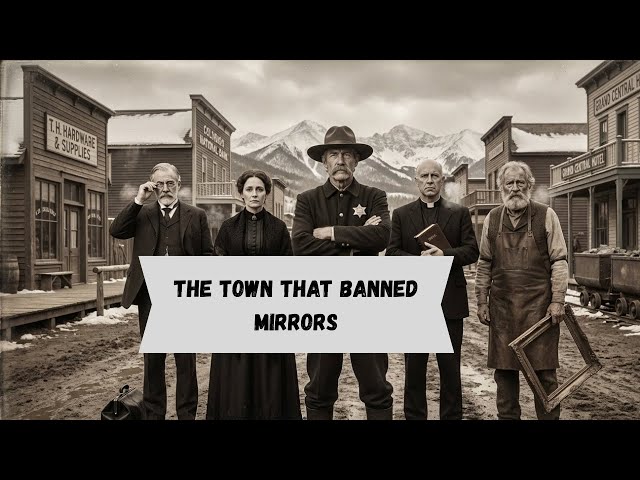
 It sounds like the setup to a fairy tale, or maybe a surreal Twilight Zone episode: a town so wary of reflection that it banned mirrors altogether. No polished glass above bathroom sinks. No compact mirrors in purses. No storefront windows doubling as accidental self-portraits. For a brief, strange chapter in American history, that idea wasn’t fiction—it was civic policy.
In the late 19th century, the small railroad town of Coverdale, Kansas (a settlement that has long since faded into county maps and footnotes) passed a local ordinance restricting the sale, display, and installation of mirrors within town limits. It didn’t survive the century, and it certainly didn’t survive modernization, but for several peculiar years, Coverdale became known regionally as “the town that outlawed mirrors.”
The story of why is less mystical than it sounds—but no less fascinating.
A Town on Edge
Coverdale was founded in the 1870s, one of dozens of prairie settlements that sprang up along expanding rail lines. It was modest—one main street, a grain elevator, a church, a dry goods store, and a saloon. Its population hovered around 600 at its peak. Like many frontier towns, it was tight-knit, deeply religious, and suspicious of outside influence.
By the 1880s, affordable manufactured mirrors—thanks to industrialized glass production—had become more common even in rural America. What had once been a luxury item was now available through mail-order catalogs. Suddenly, families who had never owned more than a small shaving mirror could install full-length pieces in their homes.
For most towns, this was just another step into modernity. For Coverdale, it became a source of moral panic.
The Preacher and the Panic
Much of the mirror controversy centered around one man: Reverend Amos Bellamy, a fiery minister who arrived in Coverdale in 1886. Bellamy preached against vanity, material excess, and what he saw as creeping urban decadence seeping into rural life.
Mirrors, in his view, were more than glass—they were instruments of pride.
In sermon after sermon, Bellamy warned that reflection bred obsession. He claimed mirrors encouraged young women to “dwell on outward appearance” and tempted men toward arrogance. More dramatically, he argued that constant self-gazing pulled attention away from God and toward the self—a dangerous spiritual inversion.
But theology wasn’t the only factor.
Around the same time, a local tragedy intensified suspicion. A teenage girl named Clara Whitfield reportedly began suffering from “nervous spells.” According to town accounts preserved in county archives, Clara claimed she saw “shadows moving” in her bedroom mirror at night. Her episodes grew severe enough that her family covered every reflective surface in their home.
When Clara was later institutionalized in Topeka, rumor hardened into belief. For some townsfolk, the connection between mirrors and mental disturbance seemed obvious.
From Concern to Law
In 1888, following a particularly heated town hall meeting, the city council drafted Ordinance 47: a measure prohibiting the commercial sale or public display of mirrors larger than a small shaving glass. Shopkeepers were barred from hanging reflective glass in storefronts. Households were “strongly discouraged” from installing them, though enforcement in private homes remained inconsistent.
The official language was surprisingly secular. It cited “public decency, moral preservation, and social harmony.” Nowhere did it explicitly mention demons, spirits, or superstition. But the subtext was clear.
Coverdale wasn’t just regulating glass. It was regulating reflection—literal and symbolic.
Life Without Reflection
For several years, the ordinance held.
Traveling salesmen passing through Coverdale noted the oddity. One 1891 trade journal mentioned “the curious anti-mirror sentiment of a Kansas township,” describing shop windows fitted with frosted panes to avoid reflection.
Barbers worked with small handheld mirrors only when absolutely necessary. Women relied on polished metal or water basins for grooming. Visiting relatives from neighboring towns reportedly found the absence unsettling.
And yet, daily life continued.
The ban did not plunge Coverdale into chaos. It didn’t transform the town into a dystopia. Instead, it created a subtle shift in routine and perception. Residents became accustomed to seeing themselves less frequently. Children grew up without full-length mirrors in their homes. Public spaces lacked the flicker of accidental self-awareness that reflective glass creates.
Ironically, some former residents later recalled that the town felt more communal during that era. Without constant visual self-checking, social interaction may have carried a slightly different texture. People were, in a small way, less preoccupied with how they looked and more focused on how they acted.
Whether that was genuine social improvement or nostalgia reshaping memory is impossible to say.
Resistance and Ridicule
Outside Coverdale, the ordinance became a mild curiosity. Nearby towns mocked it gently. Newspapers occasionally ran short blurbs framing it as quaint or backward. Mail-order catalogs quietly continued shipping small mirrors labeled as “personal grooming tools,” skirting the ordinance’s size restriction.
Within town, dissent simmered.
Younger residents, especially those traveling by rail to larger cities, began questioning the rule. By the mid-1890s, generational tension grew. Modern fashions were changing, photography was spreading, and the culture of self-presentation was evolving. Mirrors were becoming normal everywhere else.
In 1896, a hardware store owner named Henry Lott openly challenged the ordinance by installing a decorative mirror in his storefront. The city fined him. He paid it—then put the mirror back up.
The second fine sparked debate.
The Repeal
By 1898, Reverend Bellamy had left Coverdale for a larger congregation. Without his influence, the ordinance lost much of its fervent backing. Economic considerations also played a role. Merchants argued that the rule discouraged business and made the town appear antiquated.
That year, after heated debate, the council voted narrowly to repeal Ordinance 47.
There was no dramatic ceremony. No smashing of symbolic glass. Mirrors simply returned—first in shop windows, then in homes. Within a decade, the anti-mirror period had become a strange anecdote rather than an active controversy.
Coverdale itself declined in the early 20th century as rail routes shifted. By the 1930s, much of the town had emptied out. Today, only fragments remain.
Why It Matters
On the surface, banning mirrors seems absurd. But Coverdale’s ordinance reveals something deeper about the anxieties of its time.
The late 19th century was an era of rapid change: industrialization, urbanization, mass production. Objects that once symbolized luxury or self-examination suddenly became commonplace. Mirrors weren’t just household items—they were part of a broader cultural shift toward individual identity and personal presentation.
For a small prairie town grounded in collective values and religious discipline, that shift felt threatening.
The ban wasn’t about glass. It was about control.
It reflected fear of modernity, fear of moral drift, fear of losing a communal center. Mirrors became the stand-in for a larger anxiety: what happens when people start focusing on themselves more than their community or their faith?
That tension still resonates today.
Reflection in a Modern Age
In hindsight, Coverdale’s mirror ordinance feels almost prophetic. We live in an era saturated with reflection—smartphone cameras, social media profiles, endless digital self-curation. The mirror has multiplied into a thousand screens.
What Reverend Bellamy feared—obsession with self-image—has arguably become a defining trait of modern culture. The difference is scale. What was once a glass rectangle above a washbasin is now a global stage.
Would banning mirrors today reduce vanity? Almost certainly not. But the instinct behind the ban—the desire to slow or shield a community from overwhelming cultural change—remains familiar.
Every generation identifies some object or technology as morally destabilizing. In Coverdale’s case, it was the mirror. In other eras, it was the novel, the radio, television, video games, the internet.
The pattern repeats.
Myth and Memory
Over time, the story of Coverdale grew exaggerated. Later retellings claimed the town believed mirrors trapped souls or invited spirits. There’s little archival evidence supporting those claims. The original ordinance language suggests moral concern more than supernatural terror.
But myths are sticky. “The town that outlawed mirrors” is a better headline than “The town that temporarily restricted reflective glass for moral reasons.”
And so the legend outpaced the nuance.
What survives is the image of a community so wary of its own reflection that it chose to remove it from daily life. Whether seen as prudish, paranoid, or principled, Coverdale carved out a peculiar place in American oddities.
A Brief Experiment in Self-Forgetfulness
For roughly a decade, one small town tried living with fewer reflections.
It didn’t collapse. It didn’t transcend into spiritual purity. It simply functioned—awkwardly, imperfectly, and a little self-consciously.
Perhaps that’s the most telling part of the story. Human communities are adaptable. Remove mirrors, and people adjust. Reintroduce them, and life goes on. Objects carry meaning, but they rarely determine destiny.
Still, there’s something haunting about the idea of walking down a main street with no reflective surfaces. No accidental glimpse of yourself in a shop window. No quick check before stepping into public view. Just unmediated presence.
For a short while on the Kansas prairie, that was reality.
And in a world increasingly defined by curated images and constant self-examination, the strangest part of this story isn’t that a town outlawed mirrors.
It’s that, for a brief moment, they decided they might be better off without them.