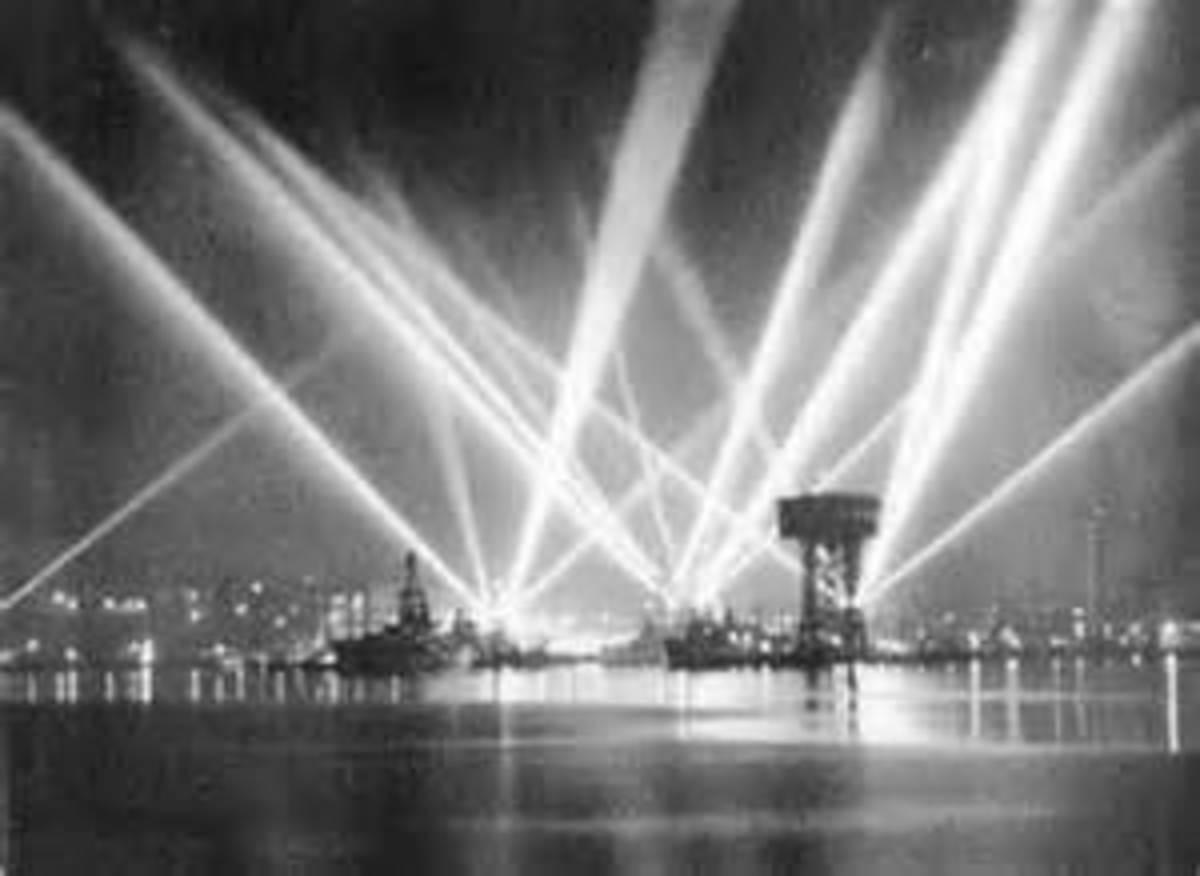
 In the early hours of February 25, 1942, Los Angeles went dark.
Sirens wailed.
Searchlights pierced the sky.
Anti-aircraft guns roared to life.
For hours, the city believed it was under attack.
Shells exploded over Santa Monica. Windows shattered miles inland. Civilians huddled in blacked-out homes, certain that Japanese bombers were overhead.
By morning, more than 1,400 anti-aircraft shells had been fired into the night sky.
No confirmed enemy aircraft were found.
No bombs fell.
No invasion materialized.
This strange episode would become known as The Battle of Los Angeles—a night of fear, confusion, and misidentification that revealed how deeply Pearl Harbor had shaken America.
America on Edge
The timing matters.
It had been less than three months since Pearl Harbor. On December 7, 1941, Japanese planes attacked the U.S. Pacific Fleet in Hawaii, killing more than 2,400 Americans.
The attack shattered the illusion that the continental United States was untouchable.
Rumors spread constantly in early 1942:
-
Japanese submarines off the West Coast
-
Spy networks operating in California
-
Plans for coastal bombardment
And there was some truth behind the fear.
On February 23, 1942—just two days before the “battle”—a Japanese submarine shelled an oil field near Santa Barbara. The damage was minimal, but the psychological impact was enormous.
The West Coast felt exposed.
Los Angeles was primed to panic.
The Radar Blips
Just after midnight on February 25, radar contacts were reported off the Southern California coast.
This was early radar technology—new, imperfect, prone to false readings.
Still, military authorities took no chances.
At 2:21 AM, a full blackout was ordered across Los Angeles County.
The city vanished into darkness.
Searchlights and Shellfire
Around 3:00 AM, observers reported lights in the sky.
Searchlights snapped on, crisscrossing over the ocean and inland hills. Some witnesses described slow-moving glowing objects. Others saw flares. Some saw nothing at all.
The anti-aircraft batteries opened fire.
For nearly an hour, heavy guns thundered.
Shells arced upward and burst into white-hot flashes against the night sky. Shrapnel rained down onto neighborhoods. Windows shattered. Roofs were punctured. Debris littered streets.
The noise was deafening.
Civilians believed invasion had begun.
Casualties Without an Enemy
When dawn came, the truth was baffling.
There were no confirmed enemy aircraft.
No wreckage.
No bomb craters.
The only damage came from falling shell fragments.
At least five civilians died—some from heart attacks triggered by stress, others from accidents during the blackout.
The city had fired thousands of rounds at… something.
Or nothing.
Official Explanations
The morning after, newspapers blared headlines announcing a successful defense against Japanese planes.
But within hours, the story began to unravel.
The Navy declared it a false alarm.
The Army insisted unidentified objects had been present.
The Secretary of the Navy suggested weather balloons or flares might have triggered the response.
The public was left confused.
Were there enemy planes or not?
No definitive answer emerged.
A Nation in Fear
The “battle” reflected more than radar confusion.
It reflected fear.
After Pearl Harbor, Americans expected further attacks. The Pacific War was escalating. Japanese forces were advancing across Southeast Asia.
The West Coast had:
-
Aircraft factories
-
Naval bases
-
Oil refineries
Strategic targets everywhere.
The military could not afford complacency.
Better to fire at ghosts than ignore real bombers.
The Photo That Fueled Legends
One newspaper image would later become iconic.
It showed multiple searchlight beams converging on a bright object in the sky above Los Angeles.
The image, grainy and dramatic, seemed to confirm something was there.
Decades later, UFO enthusiasts would seize on the photograph as evidence of extraterrestrial visitation.
But at the time, it simply intensified the mystery.
The Japanese Perspective
Historical records show no Japanese air raid on Los Angeles that night.
Japan did launch limited submarine-based floatplane raids against Oregon later in 1942. But no credible evidence indicates Japanese aircraft were over Los Angeles on February 25.
The consensus among historians is that no enemy attack occurred.
So what triggered the response?
Likely Causes
Several explanations have been proposed:
1. Weather Balloons
Stray balloons could have drifted into radar range, appearing as aircraft.
2. Flares or Illumination Shells
Accidental or misidentified flares might have created visual illusions.
3. Radar Error
Early radar systems were notoriously unreliable.
4. Meteorological Phenomena
Cloud formations reflecting searchlights could have appeared as solid objects.
Most historians conclude it was a combination of radar anomalies and overreaction.
But in wartime, perception often outruns reality.
The Psychological Impact
The Battle of Los Angeles reinforced a powerful message:
America was vulnerable.
If searchlights and guns could erupt over California without a confirmed enemy, what else might happen?
Within weeks, the U.S. government intensified security measures.
Suspicion toward Japanese Americans grew even more severe.
A Darker Consequence: Internment
On February 19, 1942—just days before the incident—President Franklin D. Roosevelt signed Executive Order 9066, authorizing the internment of Japanese Americans.
The Los Angeles panic deepened public support for that policy.
Though no Japanese Americans were involved in the “battle,” fear blurred distinctions.
Over 120,000 people of Japanese descent would be forcibly relocated to internment camps.
The panic of one night contributed to a broader injustice.
War Hysteria in Context
The Battle of Los Angeles was not unique in wartime history.
Similar episodes occurred in:
-
Britain during the Blitz
-
The United States during World War I
-
Cold War radar scares
Fear amplifies ambiguity.
When the cost of underreaction feels catastrophic, overreaction becomes acceptable.
The Guns That Fired at Nothing
The anti-aircraft crews were not reckless.
They followed protocol.
They responded to radar.
They acted on visual reports.
In wartime conditions, hesitation could mean disaster.
Yet the image of thousands of shells exploding over a peaceful city, targeting a phantom, remains haunting.
It reveals how thin the line is between vigilance and panic.
The UFO Myth
In later decades, the event gained a second life in popular culture.
UFO researchers claimed:
-
The object in the photo was extraterrestrial
-
The military covered up a sighting
-
The “battle” was a secret alien encounter
There is no credible evidence supporting those claims.
But the mystery persists because the official explanations never felt fully satisfying.
Ambiguity invites imagination.
A Dress Rehearsal for Cold War Anxiety
In hindsight, the Battle of Los Angeles feels like a preview of the Cold War.
Radar blips.
Missile alerts.
Nuclear fears.
False alarms nearly triggering catastrophe.
In 1942, technology and fear combined in a way that foreshadowed future crises.
The difference was scale.
In Los Angeles, the damage was limited.
Later, the stakes would be existential.
The Sound of the Guns
For those who lived through it, the memory endured.
The thunder of artillery.
The flicker of searchlights.
The blackout that swallowed the city.
Children woke screaming.
Parents whispered reassurances they did not believe.
For hours, Los Angeles thought it was at war on its own soil.
In a sense, it was.
The enemy was fear.
Final Reflections: When the Sky Becomes the Enemy
The Battle of Los Angeles was not a battle.
No enemy was confirmed.
No invasion occurred.
But it was real.
Real shells.
Real panic.
Real consequences.
It reminds us that war does not always arrive with clarity.
Sometimes it arrives as a radar echo, a flash in the sky, a sound that may or may not mean danger.
In February 1942, America looked up at the night and saw threat everywhere.
And in that moment, the sky itself became the enemy.
History often records great victories and crushing defeats.
But sometimes it records something stranger:
A city firing into darkness, uncertain what it’s fighting—and learning that fear can be as loud as any bomb.