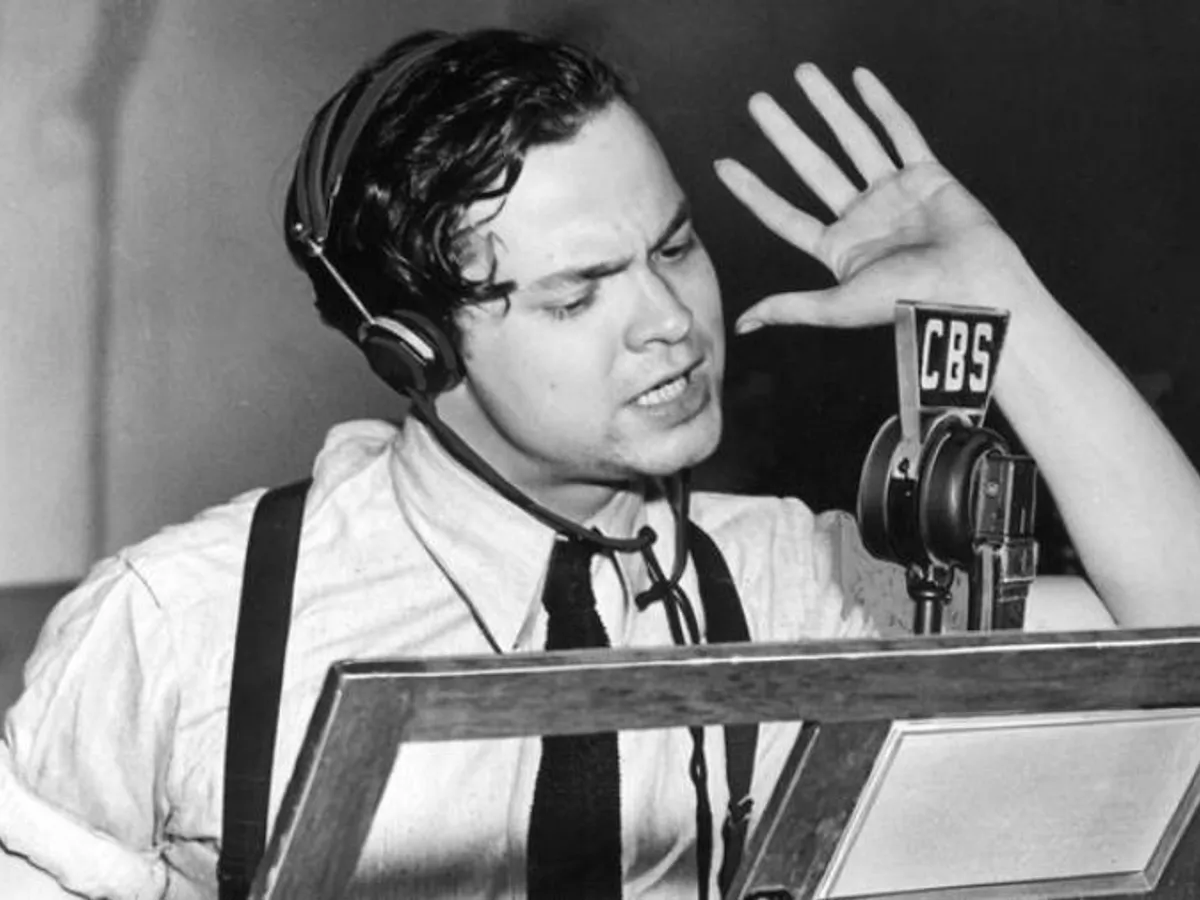
 On the evening of October 30, 1938 — the night before Halloween — millions of Americans gathered around their radios expecting music, drama, and light entertainment. Radio was the dominant medium of the era. It brought news of war in Europe, presidential fireside chats, comedy programs, and serialized dramas directly into living rooms. Families trusted it. They believed what they heard.
What they didn’t expect was an alien invasion.
That night, a 23-year-old director named Orson Welles and his Mercury Theatre on the Air performed a radio adaptation of H.G. Wells’s 1898 novel The War of the Worlds. Presented as a series of simulated news bulletins interrupting regular programming, the broadcast described Martians landing in Grover’s Mill, New Jersey, unleashing heat rays and poison gas, and marching toward New York City.
By the time the fictional Martians were done, parts of America were reportedly in chaos.
Or were they?
The so-called “War of the Worlds radio panic” has become one of the most famous moments in media history — a story of mass hysteria sparked by a radio drama. But like many legends, the truth is more complicated than the myth.
The Broadcast That Sounded Too Real
The program aired on CBS at 8:00 p.m. Eastern Time. It began conventionally enough — an introduction stating it was a dramatization based on the novel. But many listeners tuned in late. The rival network NBC was airing the hugely popular Chase and Sanborn Hour with ventriloquist Edgar Bergen. When that show cut to a musical number, some listeners flipped the dial and landed on CBS — right as Welles’s broadcast was shifting into its mock-breaking-news format.
The drama unfolded like real reporting. A dance orchestra playing “Ramon Raquello and his Orchestra” was interrupted by urgent bulletins: strange explosions observed on Mars, a mysterious meteorite crash in New Jersey, scientists examining a cylinder from space.
Then came the turning point.
A reporter on the scene described a metal cylinder unscrewing. A creature emerged. A heat ray ignited nearby soldiers. The reporter’s voice dissolved into screams before going silent.
For listeners who missed the opening disclaimer, it sounded disturbingly authentic.
The broadcast continued with escalating urgency — military mobilization, mass casualties, smoke drifting over Manhattan. Government officials delivered solemn statements. At one point, a simulated Secretary of the Interior addressed the nation in tones reminiscent of President Franklin D. Roosevelt.
It felt real because it was structured like reality.
The Reported Panic
Newspaper headlines the following day described widespread panic. Stories circulated of families fleeing their homes, roads clogged with traffic, churches filling with praying congregants, and people donning wet cloths to protect themselves from poison gas.
In New Jersey, some residents reportedly rushed outside to look for signs of explosions. Others called police stations and radio stations seeking confirmation. Hospitals and newspapers were inundated with inquiries.
The image of a nation losing its mind over Martians quickly took hold.
But how widespread was the hysteria?
Separating Panic from Publicity
Modern historians have debated the scale of the panic for decades. At the time, radio was locked in fierce competition with newspapers for advertising revenue and influence. Newspapers had an incentive to portray radio as irresponsible and dangerous.
Contemporary studies suggest that while many listeners were frightened or confused, the level of chaos may have been exaggerated. Some research estimates that of the roughly six million people who tuned in, perhaps one million were at least temporarily alarmed. A smaller fraction took dramatic action.
That’s still significant — but not quite the apocalyptic frenzy later retellings suggest.
Sociologist Hadley Cantril conducted one of the earliest studies of the event, publishing The Invasion from Mars in 1940. He concluded that people who panicked tended to have lower media literacy, were already anxious about world events, or failed to verify the information.
Europe was on the brink of war in 1938. Hitler had annexed Austria earlier that year. Tensions were high. The idea of catastrophic news interrupting music programming wasn’t implausible.
The broadcast exploited that plausibility.
Why It Worked
Several factors made the drama convincing.
First, radio was trusted. Unlike today’s fragmented media landscape, radio news carried authority. If a voice came through the speaker in urgent tones, many assumed it had been verified.
Second, the format was innovative. Welles and writer Howard Koch deliberately structured the play to mimic live reporting. Instead of traditional narration, the story unfolded through faux interviews, field correspondents, and official announcements.
Third, the setting was contemporary and local. Rather than adapting H.G. Wells’s Victorian England setting, the Mercury Theatre relocated the invasion to present-day New Jersey. That proximity made it personal.
The power of suggestion did the rest.
The Aftermath for Orson Welles
The morning after the broadcast, Orson Welles faced a swarm of reporters. In a now-famous press conference, he appeared contrite and claimed he never intended to cause panic.
Whether genuinely surprised or shrewdly aware of the publicity value, Welles emerged from the incident with national fame. Within two years, he would direct and star in Citizen Kane, widely regarded as one of the greatest films ever made.
The “panic” effectively launched his career.
CBS, for its part, issued statements emphasizing that disclaimers had been included and that the program was clearly labeled as fiction. No major fines or legal penalties followed, though the network reportedly tightened its policies on realistic dramatizations.
A Lesson in Media Literacy
The War of the Worlds broadcast has since become a case study in media effects. It illustrates how format, authority, and context can shape audience perception.
But it also demonstrates the importance of verification. Some listeners who doubted the broadcast attempted to confirm it by switching stations — only to find other networks playing music, which they interpreted as evidence that normal programming had been suspended due to emergency conditions.
Ironically, the act of checking made the situation seem more real.
The event foreshadowed modern concerns about misinformation and viral panic. Though the technology has evolved from radio to social media, the psychological mechanisms remain similar.
Myth Versus Reality
In popular memory, the War of the Worlds broadcast is often described as causing nationwide hysteria — suicides, riots, total breakdown of order. There is little evidence supporting such extreme claims.
What did occur was confusion, fear, and a significant number of alarmed listeners. Police stations fielded calls. Some people temporarily fled homes. But society did not collapse.
The legend grew over time, amplified by retellings and dramatizations.
Still, the fact that a fictional Martian invasion could unsettle even a fraction of the public speaks volumes about the power of storytelling.
Enduring Legacy
The War of the Worlds radio panic remains one of the most cited examples of media-induced hysteria. It’s invoked in discussions of fake news, propaganda, and crisis communication.
The broadcast also stands as a milestone in creative storytelling. It demonstrated how immersive formats can blur the boundary between fiction and reality — a technique later echoed in mockumentaries and found-footage films.
Every Halloween season, snippets of the broadcast resurface. The scratchy audio of panicked reporters describing alien war machines still carries a chill.
But perhaps the most enduring lesson is this: the medium matters as much as the message.
In 1938, the radio was a trusted voice in the home. When that voice described Martians descending from the sky, some listeners believed it — if only for a few tense minutes.
The Martians never came. The heat rays were imaginary. The invasion was scripted.
But for one strange night on the eve of Halloween, America learned just how thin the line can be between entertainment and alarm — and how easily fear can travel on invisible waves through the air.