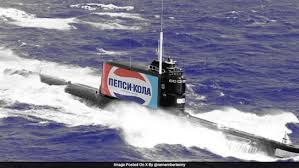
 It sounds like the setup to a punchline: a soft drink company walks into a Cold War superpower and walks out with a fleet of warships. But for a brief, surreal stretch at the end of the 1980s, PepsiCo technically became the owner of one of the largest navies in the world — at least on paper.
No, Pepsi didn’t start patrolling oceans or launching missiles in the Cola Wars. It didn’t repaint submarines in red, white, and blue. But in a twist of late–Cold War economics that feels stranger than fiction, the American beverage giant acquired a flotilla of Soviet naval vessels as part of a massive barter deal. For a moment, the world’s biggest soda rivalry had drifted into the realm of geopolitics.
To understand how a cola company ended up with submarines, you have to go back to the uneasy thaw between the United States and the Soviet Union — and to Pepsi’s uniquely aggressive global ambitions.
A Cola Enters the Cold War
Pepsi’s relationship with the Soviet Union began long before the navy deal. In 1959, then–Vice President Richard Nixon attended the American National Exhibition in Moscow, where he famously debated Soviet Premier Nikita Khrushchev in what became known as the “Kitchen Debate.” At the same exhibition, Pepsi executive Donald Kendall seized an opportunity. He persuaded Khrushchev to sample Pepsi in front of cameras.
The photo of Khrushchev sipping Pepsi became iconic. It also planted the seed for what would become one of the most unusual trade relationships of the Cold War.
In 1972, Pepsi became the first American consumer product manufactured and sold in the Soviet Union. The deal was complex because the ruble was not freely convertible on global markets. The Soviets couldn’t simply pay Pepsi in hard currency. Instead, the agreement involved a barter system: Pepsi would sell its concentrate to Soviet bottlers, and in exchange, the Soviet government would grant Pepsi the exclusive rights to distribute Stolichnaya vodka in the United States.
It was an elegant workaround. Americans got vodka. Soviets got cola. Pepsi got a massive new market. And for years, the arrangement worked.
Expansion and a Payment Problem
By the 1980s, Pepsi had become wildly popular in the Soviet Union. It was a symbol of Western modernity, a fizzy taste of American culture behind the Iron Curtain. But as consumption grew, so did the imbalance in trade.
The Soviet Union needed more Pepsi syrup than ever. However, vodka exports alone were no longer sufficient to balance the books. The USSR’s economy was under strain, oil prices were volatile, and foreign currency reserves were limited.
Once again, creative barter was required.
In 1989, Pepsi and the Soviet government negotiated a new deal reportedly worth around $3 billion. In exchange for Pepsi syrup and other goods, the Soviet Union would transfer a collection of decommissioned naval vessels — including 17 submarines, a cruiser, a frigate, and a destroyer — along with several oil tankers.
The vessels were not brand-new war machines ready for battle. Most were aging ships slated for scrapping. But on paper, they were still naval assets.
For a brief moment, PepsiCo technically owned them.
The “Sixth-Largest Navy” Joke
The absurdity of the situation was not lost on anyone. Media outlets ran headlines marveling at the idea of a soda company possessing submarines. A Pepsi executive famously joked that the company was “disarming the Soviet Union faster than the U.S. government.”
The claim that Pepsi briefly operated the “sixth-largest navy in the world” was more punchline than reality, but it captured public imagination. The idea of a corporate navy — even if it was destined for scrap — felt like something out of satire.
Of course, Pepsi had no intention of launching maritime operations. The ships were quickly transferred to a Swedish firm for scrapping and recycling. The oil tankers were leased out. The deal was purely economic, not militaristic.
Still, the symbolism was powerful.
Barter in a Broken System
The Pepsi navy episode highlights the strange economic mechanics of the late Soviet period. With a non-convertible currency and mounting financial pressures, the USSR relied heavily on barter agreements to secure foreign goods.
For Western corporations willing to navigate the bureaucracy and political complexity, the Soviet market represented enormous potential. But traditional payment systems didn’t apply.
Pepsi’s executives were unusually bold. Rather than treating the Soviet Union as an untouchable ideological foe, they saw it as a business opportunity. That pragmatism allowed Pepsi to gain a foothold where many other American brands hesitated.
The navy deal wasn’t about warships. It was about converting obsolete military hardware into scrap value — and using that value to balance international trade.
The Timing: A World on the Brink of Change
The deal came at a pivotal historical moment. By 1989, the Cold War was thawing rapidly. Mikhail Gorbachev’s policies of glasnost and perestroika had opened Soviet society and economy to limited reforms. Eastern Europe was in flux. The Berlin Wall would fall later that year.
The transfer of naval vessels to an American corporation felt like a sign of the times. The ideological rigidity that once defined U.S.-Soviet relations was softening into pragmatic negotiation.
In a strange way, Pepsi’s acquisition of Soviet ships symbolized the winding down of an era. These were decommissioned vessels, relics of naval rivalry, now reduced to scrap metal in the hands of a consumer brand.
It was capitalism and communism meeting in a scrapyard.
The Limits of the Story
It’s important to clarify what Pepsi did not do. The company never operated the ships as military assets. There were no Pepsi-branded submarines cruising the Atlantic. The vessels were immediately earmarked for dismantling.
The “Pepsi Navy” existed only on paper and only briefly.
But that doesn’t diminish the strangeness of the arrangement. Corporate barter deals of this scale are rare, especially involving military hardware.
In a world accustomed to straightforward financial transactions, the idea of paying for soda concentrate with submarines feels almost medieval — a reminder that global trade can take bizarre forms when currency systems break down.
The End of an Era
The Soviet Union dissolved in 1991. The economic system that had required such elaborate barter deals collapsed with it. Pepsi’s Soviet ventures transitioned into operations within newly independent Russia and other former republics.
The era of trading cola syrup for cruisers ended.
In retrospect, the deal stands as one of the most surreal footnotes of the Cold War. It captures the improvisational spirit of late Soviet economics and the audacity of American corporate expansion.
It also highlights how deeply consumer brands had penetrated global consciousness. A soft drink — once a novelty at a Moscow exhibition — had become so embedded in Soviet life that its continued supply justified trading off naval assets.
Corporate Power and Pop Culture
The Pepsi navy story endures because it blurs lines. It blurs the line between government and corporation, between military hardware and consumer goods, between geopolitical rivalry and brand competition.
It also feeds into a broader cultural narrative about corporate power. The idea that a soda company could momentarily command a fleet — even if only symbolically — resonates in an age of multinational corporations wielding enormous influence.
Yet in truth, the episode was less about power and more about necessity. It was a workaround in a constrained economic system.
Still, it makes for irresistible storytelling.
A Fleet of Fizzy Folklore
Today, the image of Pepsi owning submarines lives mostly as trivia — a strange anecdote shared in documentaries and history threads. But it remains one of the clearest examples of how bizarre the final years of the Cold War could be.
For a fleeting moment, the Cold War’s naval chessboard intersected with the Cola Wars. Warships became commodities. Scrap yards became arenas of détente.
No missiles were launched. No sailors saluted corporate logos. But the symbolism lingers.
A soft drink company once held title to a Soviet fleet.
And in the grand theater of 20th-century history, that’s a reminder that reality often outpaces satire — especially when geopolitics and global capitalism collide over something as simple as a bottle of soda.