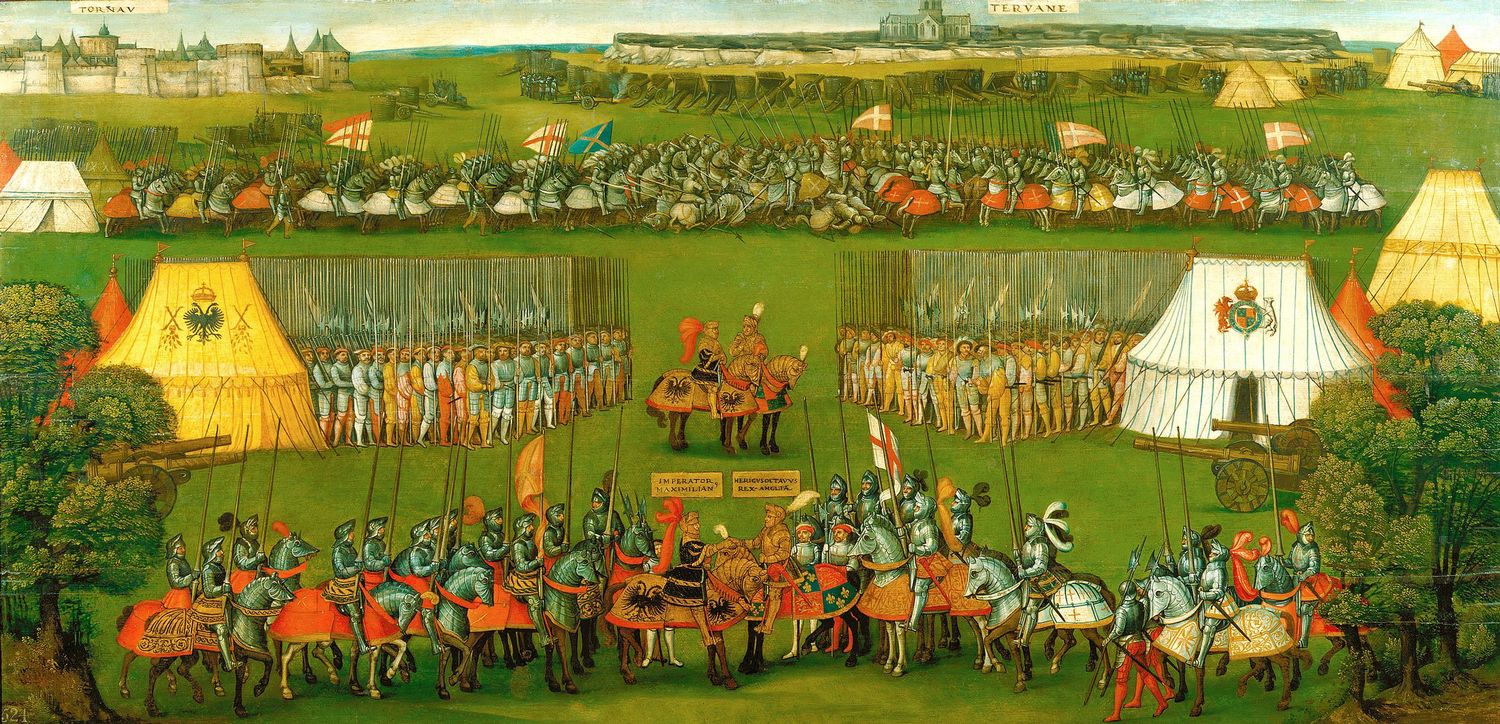
 On August 16, 1513, beneath the blazing summer sun of northern France, two armies faced one another in a moment that was supposed to define glory.
On one side stood the English, led in spirit and ambition by a young king hungry for martial reputation: Henry VIII.
On the other stood the French cavalry — armored nobles raised in a culture that equated honor with the thunder of hooves and the shock of steel.
What followed was not a legendary clash of blades.
It was a rout.
The French cavalry fled so quickly that the battle earned a humiliating name: The Battle of the Spurs — because the French, it was said, made more use of their spurs than their swords.
It was over in hours.
But the consequences, symbolism, and theater of the event would ripple through the politics of Renaissance Europe.
A Young King’s Dream of War
In 1513, Henry VIII was only 22 years old.
He had been king of England for four years and was eager to prove himself not just as a monarch, but as a warrior.
The medieval ideal of kingship still loomed large in his imagination. Henry idolized figures like Henry V — the victor of Agincourt. He longed to carve his name into history through conquest.
France was the traditional enemy.
England had lost most of its continental possessions in the Hundred Years’ War. But the idea of reclaiming glory in France still stirred English pride.
And so, when an opportunity arose to join a coalition against France, Henry seized it.
Europe in Flames: The War of the League of Cambrai
The Battle of the Spurs was not an isolated conflict.
It took place during the broader War of the League of Cambrai, a sprawling European struggle involving France, Spain, the Holy Roman Empire, Venice, and the Papacy.
Alliances shifted constantly.
In 1513, England aligned with Maximilian I, Holy Roman Emperor, against France.
Henry personally led an expeditionary force across the English Channel, determined to fight on French soil.
It was a calculated gamble.
Success would elevate England’s status.
Failure would embarrass a young king.
The Siege of Thérouanne
The English campaign focused on the fortified town of Thérouanne in northern France.
Henry’s forces — bolstered by Imperial allies — laid siege to the city in July 1513.
The French king, Louis XII, could not ignore the incursion.
He dispatched cavalry units to harass and relieve the besieged town.
The French cavalry, composed largely of mounted nobles, represented the old aristocratic model of warfare — armored knights charging with valor.
But warfare was changing.
Gunpowder and disciplined infantry formations were reshaping battlefields.
And the French cavalry would soon learn that the age of pure chivalric dominance was fading.
The Clash Near Guinegate
On August 16, 1513, French forces attempted to reinforce Thérouanne.
They encountered English troops near the village of Guinegate.
The French cavalry charged.
But the English army was well-prepared.
English longbowmen and Imperial landsknechts — pikemen skilled in anti-cavalry tactics — formed defensive lines.
Artillery supported them.
As the French horsemen advanced, they met organized resistance rather than disorganized prey.
When Spurs Did More Work Than Swords
The French cavalry charge faltered almost immediately.
Under arrow fire and facing disciplined infantry squares, momentum broke.
Instead of pressing forward into bloody close combat, the French cavalry turned.
They fled.
Accounts describe mounted nobles riding hard away from the field — spurring their horses in retreat.
The English pursued.
What might have been a dramatic knightly engagement became a chase.
Hence the name:
The Battle of the Spurs.
A Humiliation for France
In purely military terms, the engagement was minor.
Casualties were relatively light compared to larger Renaissance battles.
But symbolically, it was devastating for France.
The aristocratic cavalry — once the pride of medieval warfare — had failed to deliver.
Knights were captured.
Standards were taken.
The aura of French chivalry suffered.
For England, the optics were priceless.
Henry’s Moment
Henry VIII was not in the thickest fighting, but he was present in the campaign.
The victory bolstered his self-image as a warrior king.
He reveled in ceremony afterward.
Prisoners of noble rank were paraded.
Celebrations followed.
The English court embraced the narrative of triumph.
Henry had tasted continental victory.
It would not be the last time he chased that taste.
The Capture of Thérouanne and Tournai
Following the battle, Thérouanne fell.
Shortly after, the English captured the city of Tournai.
These were tangible territorial gains.
Yet they were expensive to hold and of limited long-term strategic value.
Still, for Henry, they were trophies.
Proof that England could project power into France.
The Changing Nature of War
The Battle of the Spurs illustrates a turning point in military history.
The medieval ideal of armored knights dominating the battlefield was eroding.
Disciplined infantry formations and gunpowder weapons increasingly dictated outcomes.
Cavalry still mattered — but not as an unstoppable shock force against prepared lines.
The French flight at Guinegate was not merely cowardice.
It was recognition — perhaps instinctive — that conditions were unfavorable.
But history remembers retreat more harshly than caution.
Meanwhile, in Scotland
While Henry campaigned in France, another crisis unfolded.
Scotland, allied with France through the Auld Alliance, invaded northern England.
On September 9, 1513 — less than a month after the Battle of the Spurs — the English defeated Scottish forces at the Battle of Flodden.
King James IV of Scotland was killed.
Thus, 1513 became a year of English victories on two fronts.
Henry’s prestige soared.
A Victory of Image
In the grand scheme of European wars, the Battle of the Spurs was minor.
But in the theater of reputation, it was enormous.
It allowed Henry VIII to cultivate an image of martial competence.
It embarrassed France at a moment when alliances were fluid.
And it demonstrated that England remained a continental force.
War is fought with steel.
But it is remembered through story.
The Irony of Chivalry
The battle’s name carries an ironic sting.
Spurs are tools of encouragement — used to urge horses forward.
At Guinegate, they were used to flee.
The label “Battle of the Spurs” immortalized the French retreat more effectively than any casualty count.
It turned a tactical misstep into a narrative humiliation.
Names matter.
The Aftermath
Despite the victory, England did not maintain its French gains long-term.
By 1518, treaties returned Tournai to France.
The War of the League of Cambrai shifted alliances yet again.
European politics remained volatile.
Henry’s ambitions did not end with 1513.
He would continue to pursue glory — militarily and matrimonially.
The Young King’s Appetite
The Battle of the Spurs fed Henry’s appetite for war.
It reinforced his belief in his own martial destiny.
But England’s resources were limited.
Continental campaigns were expensive.
Over time, Henry would shift his focus from French battlefields to domestic transformation — including the seismic break with Rome.
Yet in 1513, he was still chasing knightly glory.
And at Guinegate, he got a taste.
Final Reflections: The Sound of Retreat
The Battle of the Spurs was brief.
It was not drenched in blood.
It did not redraw Europe’s map.
But it captured a moment when the old ideals of chivalry collided with emerging realities of modern warfare.
The French cavalry fled.
The English cheered.
A young king basked in validation.
History sometimes turns on grand sieges and epic massacres.
Other times, it turns on the sound of hooves running away.
In 1513, beneath the French sun, honor was measured not by the clash of swords — but by the direction of spurs.
And for France, that direction was backward.