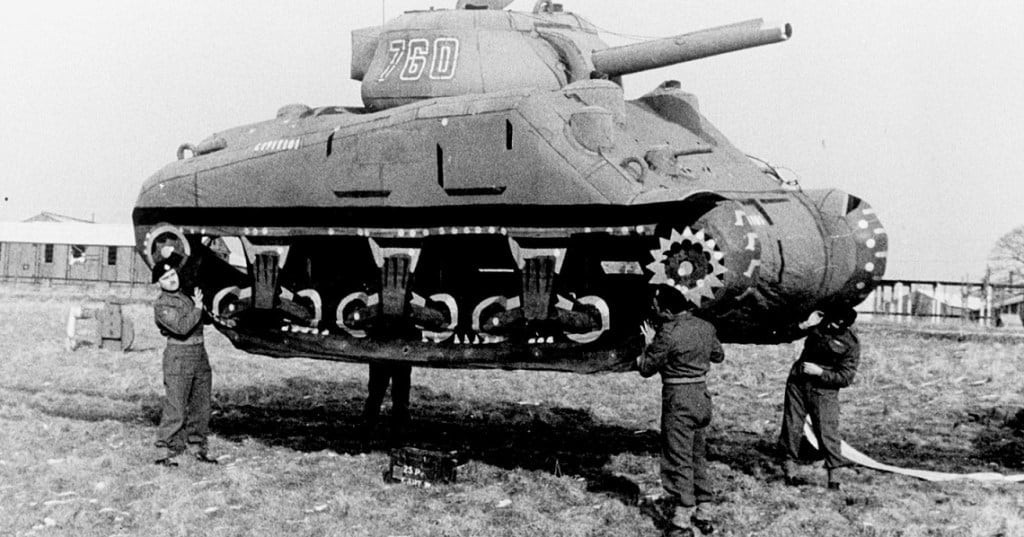
 In the winter of 1944, somewhere along the battered hedgerows of France, German reconnaissance units peered through binoculars and saw what looked like an unmistakable threat: columns of American tanks assembling in a field, artillery pieces being positioned for bombardment, radio traffic buzzing with coded urgency. It looked like a major Allied offensive was about to begin.
It wasn’t.
The tanks were rubber. The artillery was plywood. The radio traffic was fake. And the “army” preparing for battle was one of the strangest and most creative fighting forces ever assembled: the Ghost Army.
Officially known as the 23rd Headquarters Special Troops, this top-secret U.S. Army unit used deception—visual trickery, sonic illusions, and elaborate misinformation campaigns—to fool the German military across the European theater during World War II. Their mission was simple in theory but breathtaking in execution: make the enemy see and hear things that weren’t there.
And they were astonishingly good at it.
The Birth of a Phantom
The idea of military deception was not new in 1944. Armies had used feints and false movements for centuries. But World War II introduced a new scale of warfare—mechanized divisions, aerial reconnaissance, radio intelligence—that demanded something far more sophisticated.
Enter Colonel Billy Harris and a handful of strategists who believed that art and illusion could be weaponized. In early 1944, as Allied forces prepared for the invasion of Western Europe, the U.S. Army assembled a highly unusual unit. Instead of filling its ranks with hardened infantrymen, they recruited artists, architects, sound engineers, radio operators, advertising designers, and even fashion illustrators.
The result was the 23rd Headquarters Special Troops.
At its peak, the Ghost Army consisted of about 1,100 men. But through deception, they could impersonate divisions of 30,000 or more. Their job was not to fight directly. It was to confuse, mislead, and manipulate German commanders into moving troops away from real Allied attacks—or toward entirely fake ones.
Inflatable Armies and Painted Illusions
The most visually dramatic element of the Ghost Army’s operations came from its 603rd Camouflage Engineers. These men were masters of inflatable deception.
They deployed life-sized inflatable tanks, trucks, jeeps, and artillery pieces made from rubberized fabric. When properly positioned and viewed from a distance—or from aerial reconnaissance—they looked convincingly real. Crews would inflate dozens of dummy Sherman tanks in a matter of hours, carefully arranging them in formations that mimicked actual armored divisions.
Tracks were faked in the dirt to simulate heavy vehicle movement. Empty ration boxes and cigarette butts were scattered around to suggest recent activity. Laundry was hung out to dry. Mess tents were erected.
The illusion extended beyond visuals. The 3132nd Signal Service Company created fake radio traffic, replicating the unique “fingerprints” of real U.S. divisions. Every radio operator has a distinctive rhythm and style. Ghost Army operators studied and mimicked these patterns to convince German signals intelligence that specific units had moved into an area.
And then there was the sound.
Sonic Warfare: The Sounds of an Invisible Army
The 3132nd Signal Service Company also fielded a specialized sonic deception unit. Using state-of-the-art recording equipment for the time, they captured sounds of tanks rolling, troops marching, bridges being built, and artillery being moved.
These recordings were blasted through powerful speakers mounted on half-tracks. Under the right atmospheric conditions, the sound of an armored column could carry for miles. German forces listening in the night would hear what they believed to be entire divisions on the move.
The Ghost Army could simulate the buildup of a major offensive without a single real tank in sight.
It was psychological warfare at its most creative.
Operation Normandy: The First Big Test
Shortly after D-Day, the Ghost Army was deployed to France. One of their earliest missions involved Operation Brest in August 1944. As Allied forces sought to capture the port city of Brest, the Ghost Army impersonated the U.S. 6th Armored Division to convince German defenders that a major assault was imminent from a different direction.
Inflatable tanks were positioned. Radio chatter intensified. Fake unit insignias appeared in local towns.
German forces repositioned accordingly.
Time and again, the Ghost Army would move into an area under cover of darkness, inflate their phony equipment, stage their illusion, and then vanish before sunrise. They were nomads of deception, always one step ahead of discovery.
Operation Viersen: The Rhine River Ruse
Perhaps their most famous mission came in March 1945 during the Allied push toward the Rhine River.
As part of Operation Viersen, the Ghost Army was tasked with deceiving German forces about the location of the upcoming river crossing. The real crossing was planned at Remagen and other strategic points. The Ghost Army’s job was to make the Germans believe that the 30th and 79th Infantry Divisions were preparing to cross at a completely different location.
They set up a sprawling fake encampment. Inflatable artillery lined the banks. Sound units blasted recordings of engineers constructing pontoon bridges. Radio operators generated convincing chatter about crossing plans.
German artillery responded—firing on empty fields and phantom units.
Meanwhile, the real Allied forces crossed elsewhere with reduced resistance.
It was one of the largest tactical deceptions ever carried out by U.S. forces during the war.
Artists at War
What makes the Ghost Army story even more fascinating is who these men were.
Many would go on to become influential figures in American art and culture. Among them:
-
Bill Blass, who later became a renowned fashion designer.
-
Ellsworth Kelly, who became a major figure in abstract painting.
-
Art Kane, a legendary photographer.
-
Arthur Singer, a prominent wildlife artist.
They were young—many in their early twenties—and thrown into one of the most dangerous conflicts in history armed not with rifles, but with creativity.
Yet they were not immune to danger. Though their mission was deception, they often operated near front lines. If captured, their nontraditional activities might have been interpreted as espionage. They carried weapons for self-defense and lived under constant threat of discovery.
Their courage was real, even if their tanks were not.
The Secrecy and Silence
After the war ended in 1945, the Ghost Army quietly disbanded. Their mission had been classified top secret. The men were sworn to silence.
For decades, their story remained largely unknown. Official records were buried. Many veterans never spoke publicly about their service. Some even told family members they had simply been part of a standard engineering unit.
It wasn’t until the 1990s that the full story began to emerge, thanks to declassified documents and the efforts of surviving members who wanted their unique contribution recognized.
In 2022, the U.S. Congress awarded the Ghost Army the Congressional Gold Medal, honoring their extraordinary service and ingenuity. By then, only a handful of original members were still alive.
The Psychology of Deception
The Ghost Army’s success relied on understanding not just military tactics, but human psychology.
German commanders were not fools. They knew deception was possible. But war demands constant interpretation of incomplete information. When aerial reconnaissance showed tanks, when radio intercepts confirmed unit movements, when scouts heard engines in the distance—those data points reinforced each other.
The Ghost Army exploited confirmation bias.
They created just enough evidence to make the enemy believe what they were already afraid of. A large Allied force was always somewhere nearby. The trick was convincing them it was in the wrong place.
It was theater with deadly stakes.
The Impact on the War
How much did the Ghost Army influence the outcome of World War II?
Historians estimate that the unit carried out more than 20 battlefield deceptions between June 1944 and March 1945. In some cases, they diverted entire German divisions. They are believed to have saved thousands of Allied lives by drawing enemy fire away from real units.
While it would be an exaggeration to say they “won” the war, they unquestionably shaped key moments in the European campaign.
Their work fits into a broader Allied strategy of deception, including Operation Fortitude—the elaborate ruse that convinced Hitler the D-Day invasion would land at Pas-de-Calais instead of Normandy. But unlike large-scale strategic deception planned from London, the Ghost Army operated tactically, on the ground, often within artillery range of German forces.
They were hands-on illusionists in a mechanized war.
A Legacy of Creativity and Courage
The story of the Ghost Army resonates because it feels almost cinematic. Inflatable tanks. Fake radio chatter. Sound effects echoing through dark forests. Young artists outsmarting hardened Wehrmacht commanders.
Yet it was all very real.
In a war defined by brutality and staggering loss, the Ghost Army represents a different kind of heroism—one built on intellect, imagination, and restraint. Their goal was not destruction, but misdirection. Not annihilation, but confusion.
They proved that sometimes the most powerful weapon is the mind.
The Ghost Army Today
Today, museums and documentaries have begun to tell their story more widely. Exhibits display restored inflatable tanks and original sketches from camouflage designers. Interviews with surviving members reveal a mix of pride and lingering disbelief at what they accomplished.
Their techniques have influenced modern military deception and psychological operations. Inflatable decoys, electronic spoofing, and misinformation campaigns remain staples of warfare in the 21st century—though now far more technologically advanced.
But the core idea remains unchanged: perception shapes reality on the battlefield.
The Ghost Army understood that better than anyone.
Conclusion: The Army That Wasn’t There
World War II produced countless stories of valor—storming beaches, dogfights over Europe, brutal hand-to-hand combat in frozen forests. The Ghost Army’s story stands apart.
They didn’t charge machine-gun nests. They didn’t liberate cities. They didn’t fire the first shot in most of their engagements.
Instead, they created armies out of air and noise. They tricked the enemy into fighting shadows. They turned art into strategy and imagination into survival.
In a conflict defined by overwhelming force, the Ghost Army proved that deception could be just as powerful as firepower.
They were the soldiers who mastered illusion—and in doing so, helped shape the outcome of the largest war in human history.
An army that wasn’t there.
And yet, one that mattered.