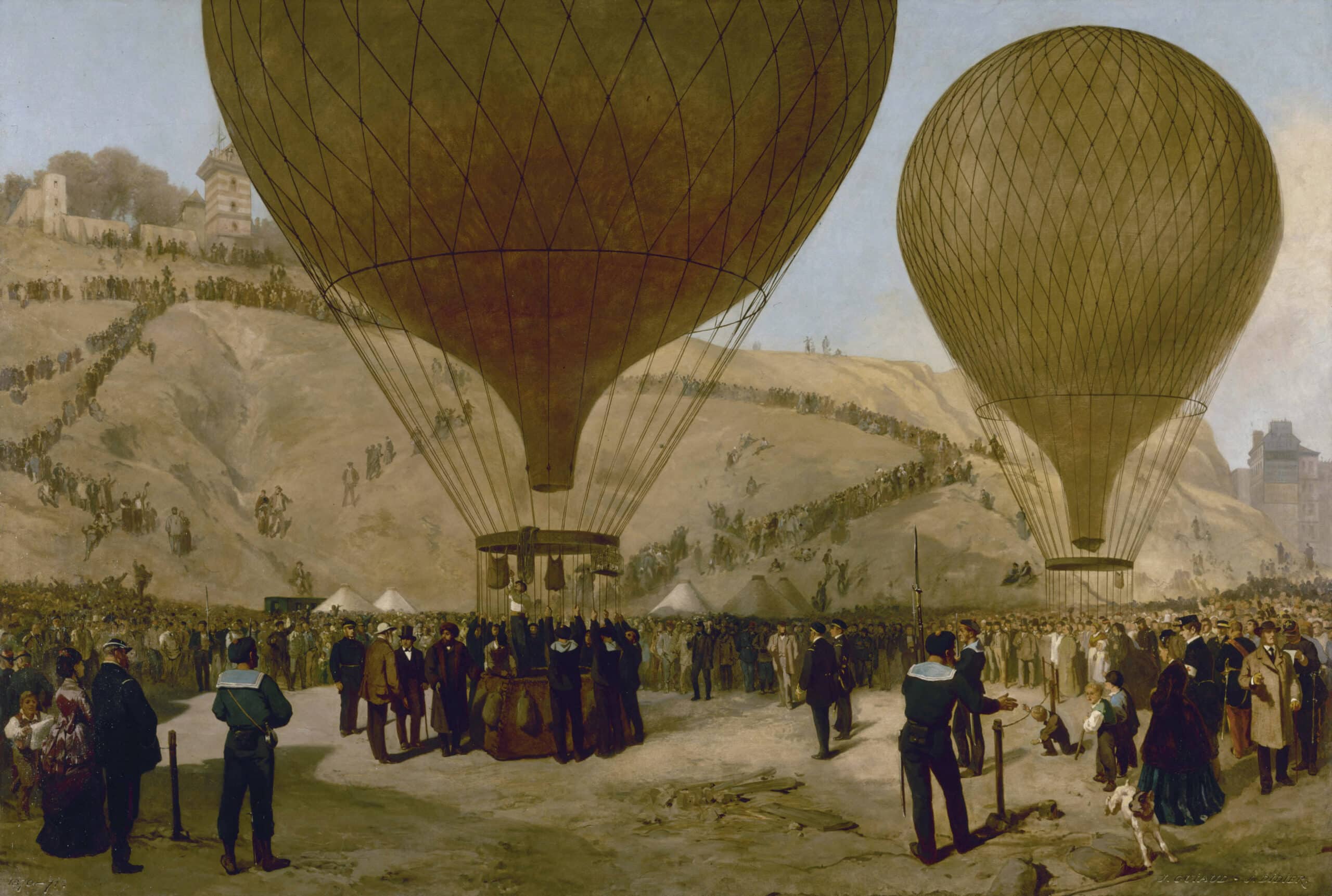
 In the autumn of 1870, Paris was starving.
The bakeries were empty. The markets were stripped bare. Horses disappeared from the streets—not because they had fled, but because they had been eaten. Zoo animals followed. Dogs vanished. Cats too. The city’s elegant cafés served whatever could be found. Even the rats were hunted.
The Prussian army had encircled Paris in a tightening iron ring. Telegraph lines were cut. Railways were severed. Roads were blocked. The capital of France—once the glittering center of art, fashion, and revolution—was trapped.
So Paris did something audacious.
It went up.
What followed would become known as The Great Paris Balloon Escape, one of the most improbable chapters of the Franco-Prussian War—a desperate, daring aerial lifeline that turned hot-air balloons into instruments of survival.
For months, the sky became Paris’s only open road.
A City Under Siege
The Franco-Prussian War began in July 1870. Within weeks, French forces suffered catastrophic defeats. Emperor Napoleon III was captured at Sedan. The Second Empire collapsed. Paris declared a republic.
But declarations do not stop armies.
By September, Prussian forces surrounded the capital. They did not storm it immediately. They starved it.
The siege would last from September 19, 1870, to January 28, 1871.
For over four months, nearly two million people were cut off from the outside world.
No mail.
No reinforcements.
No supplies.
Paris was alone.
Communication Becomes a Weapon
In modern war, communication is survival.
In 1870, the telegraph was the lifeblood of military coordination. With wires cut, Paris could not direct provincial armies or rally support.
The Prussians expected the city to crumble.
But Parisians were inventive.
If they could not go around the blockade…
They would go over it.
The First Ascent
On September 23, 1870, a balloon named Neptune rose above the city.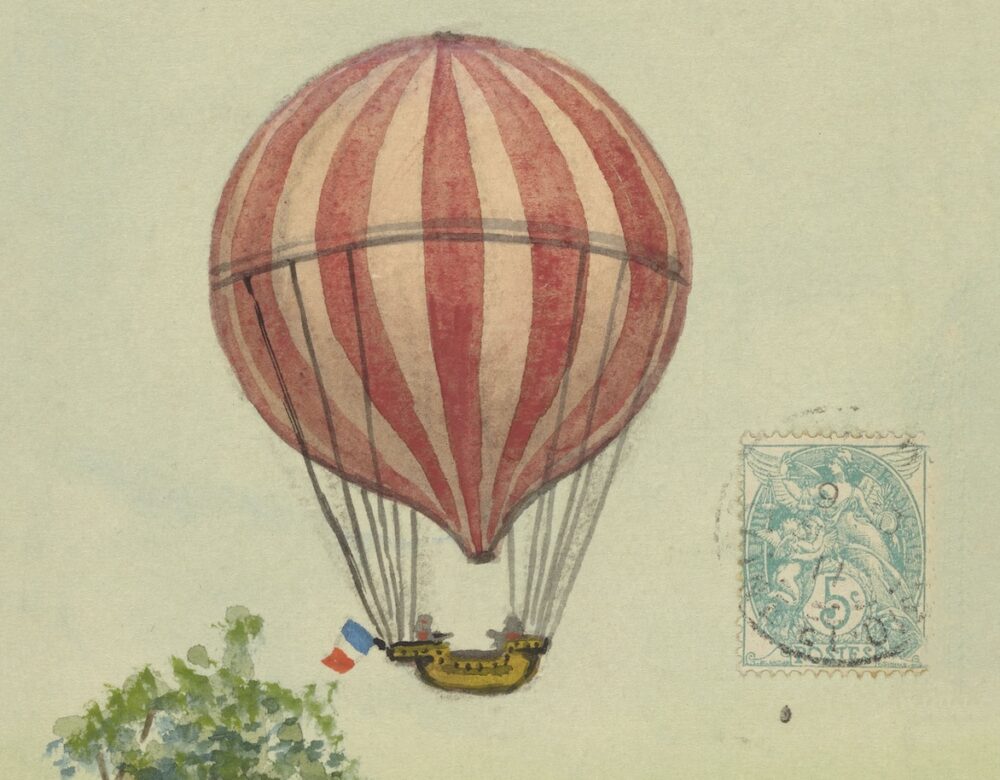
It carried mail and a single passenger.
As it drifted silently over Prussian lines, soldiers below fired rifles uselessly into the sky. The balloon floated on.
It landed safely in French-held territory.
The experiment had worked.
The skies belonged to no army.
Balloons as Lifelines
Soon, balloon launches became organized operations.
From makeshift workshops, aeronauts constructed dozens of gas balloons. The city’s coal gas supply fueled them. Silk and canvas were stitched into envelopes large enough to lift men and cargo.
Between September 1870 and January 1871:
-
66 balloons left Paris
-
Over 2 million letters were transported
-
More than 100 passengers escaped
-
Carrier pigeons were sent back into the city
Paris was not merely surviving.
It was communicating.
Aerial Mail
Each balloon carried sacks of letters—messages from families to soldiers, from officials to commanders, from lovers separated by siege lines.
Letters were microfilmed outside Paris and sent back into the city by pigeon.
The pigeons carried tiny photographic plates, each containing thousands of messages. Once back in Paris, the images were projected and transcribed.
It was one of the earliest examples of aerial mail and microfilm technology used at scale.
In the middle of war, innovation flourished.
The Risks of the Sky
Balloon travel in 1870 was no gentle drift.
Pilots had limited control. Balloons moved wherever the wind carried them. There were no engines, no steering mechanisms—only ballast and prayer.
Flights faced:
-
Anti-aircraft fire
-
Storms
-
Freezing temperatures
-
Uncertain landings
Some balloons landed safely in friendly territory.
Others drifted far off course.
Lost in the Wind
One balloon drifted all the way to Norway.
Another landed in Germany, its passengers captured.
One disappeared over the Atlantic and was never seen again.
Every ascent was a gamble.
But remaining in Paris was a slower death.
The Minister Who Fled
Perhaps the most famous passenger was Léon Gambetta, Minister of the Interior.
On October 7, 1870, Gambetta escaped Paris by balloon to coordinate resistance from the provinces.
His departure was both symbolic and strategic.
If Paris fell, France would not.
His ascent proved that leadership could not be fully contained by siege lines.
Life Below the Balloons
While balloons rose, Paris starved.
Food shortages grew severe.
Horse meat became common.
Then dog.
Then cat.
Then zoo animals—including elephants from the Jardin des Plantes.
Restaurants advertised exotic meats as delicacies. Behind the humor lay desperation.
Winter brought cold. Coal ran low. Hunger hollowed faces.
And yet, when balloons rose from the city, crowds gathered to cheer.
They represented hope.
The Sound of Escape
Witnesses described the launches vividly.
Gas hissing into silk.
Ropes released.
Crowds shouting.
The balloon would lift slowly, majestically, rising above rooftops and church spires.
Then drift toward enemy lines.
Every launch was an act of defiance.
Prussian Frustration
The Prussian army had not anticipated aerial escape.
They attempted to shoot balloons down. They tried to track landing sites.
But wind direction was unpredictable.
The sky refused to cooperate with siege tactics.
The blockade was no longer airtight.
Innovation Under Pressure
The siege accelerated technological creativity.
Engineers improved balloon construction.
Photographers refined microfilm techniques.
Military planners experimented with aerial reconnaissance.
The Great Paris Balloon Escape foreshadowed the age of aviation.
Within decades, airplanes would replace balloons in warfare.
But in 1870, balloons were revolutionary.
Psychological Warfare
Beyond logistics, the balloons served morale.
Each ascent signaled resilience.
Paris might be starving—but it was not silent.
News still traveled.
Orders still moved.
Hope still floated.
In siege warfare, morale is as critical as ammunition.
The Limits of the Sky
Despite their ingenuity, balloons could not carry food or large reinforcements.
They were messengers, not saviors.
By January 1871, starvation and bombardment had weakened Paris beyond endurance.
The city surrendered.
The Franco-Prussian War ended shortly after.
Germany unified under Prussian leadership.
France reeled from defeat.
The balloons could not prevent that outcome.
But they had written a legend.
A Symbol of Defiance
The Great Paris Balloon Escape remains one of history’s most poetic wartime improvisations.
It symbolizes:
-
Human ingenuity under pressure
-
The refusal to be silenced
-
The power of communication
In a city cut off from the world, the sky became a corridor.
A Precursor to Air Warfare
Though primitive, the balloon operations hinted at the future.
World War I would see aircraft used for reconnaissance and bombing.
By World War II, skies would dominate battlefields.
In 1870, Paris glimpsed that future.
Memory and Myth
Today, the siege of Paris is remembered for its suffering—and its audacity.
The balloons occupy a romantic place in history: fragile vessels rising above cannons and blockades.
They remind us that even in defeat, creativity can flourish.
Final Reflections: The Sky Cannot Be Besieged
The Great Paris Balloon Escape teaches a simple truth.
Walls can be built.
Armies can surround.
Supply lines can be cut.
But the sky is harder to conquer.
In 1870, Paris looked upward and found possibility.
Starving, cold, encircled—it chose to rise.
And for a few fragile hours at a time, it did.
Above the cannons.
Above the trenches.
Above the war.
Floating not just letters—but defiance.