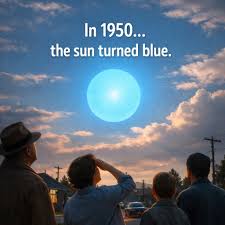
 In late September 1950, something deeply unsettling happened across parts of North America and Europe.
The sun turned blue.
Not metaphorically.
Not poetically.
Literally.
In towns from Alberta to New England, from Scotland to parts of Scandinavia, people looked upward and saw a pale, ghostly blue disk hanging in a strangely tinted sky. Shadows shifted color. Streetlights glowed oddly in mid-afternoon. The world seemed filtered through glass.
Some thought it was the end.
Some blamed atomic tests.
Others whispered about divine signs.
But the real culprit lay thousands of miles away, in forests burning out of control.
This is the story of the day the sun turned blue — and the science that made it possible.
A Sky Gone Wrong
On September 24 and 25, 1950, reports flooded newspapers.
In Edmonton, Canada, the sky appeared lavender and pink.
In New York City, pedestrians paused to stare upward in confusion.
In parts of Britain, residents described a bluish or violet sun suspended in haze.
Photographs from the time capture an eerie quality: daylight dimmed, colors distorted, horizons muted.
It was not an eclipse.
It was not a storm.
It was something stranger.
The phenomenon lasted for hours in some places, days in others.
And it crossed continents.
The Immediate Fear
The year was 1950.
The world was less than a decade removed from Hiroshima and Nagasaki.
The Cold War had begun.
Atmospheric nuclear testing was underway in remote regions.
When skies changed color unexpectedly, people thought of radiation.
Radio stations fielded anxious calls.
Was this fallout?
Was it a secret test?
Was it war?
The timing heightened paranoia.
The Korean War had erupted just months earlier in June 1950.
The sky felt political.
Forests on Fire
But the cause was neither bomb nor omen.
It was fire.
In the summer of 1950, enormous wildfires tore through western Canada — particularly in Alberta and British Columbia.
The fires were massive.
Hundreds of thousands of acres burned.
Smoke columns rose high into the atmosphere.
Ash and particulate matter traveled thousands of miles.
The smoke did not remain local.
Upper-level winds carried it eastward across North America and eventually across the Atlantic.
By late September, the sky over eastern Canada and the United States was thick with suspended particles.
The Science of Blue Suns
Why would smoke make the sun appear blue?
The answer lies in light scattering.
Sunlight contains all visible wavelengths — red, orange, yellow, green, blue, violet.
Under normal conditions, the atmosphere scatters shorter blue wavelengths more efficiently than red ones. That’s why the sky appears blue.
But when smoke particles of a particular size dominate the atmosphere, they scatter light differently.
The wildfire smoke in 1950 contained particles small enough to scatter red wavelengths more effectively than blue.
The result?
Red light was filtered out.
The remaining visible light skewed blue.
The sun — normally golden — appeared sapphire.
An Inverted World
Witnesses described a surreal atmosphere.
Shadows had strange hues.
Clouds looked metallic.
The air felt thick.
In some places, streetlights turned on automatically during midday because ambient light levels dropped so low.
Farmers paused fieldwork.
Drivers slowed on highways.
The sun, that most stable of celestial markers, had changed color.
And when the sun changes, instinct kicks in.
A Global Phenomenon
The smoke did not stop at the Atlantic.
By late September, reports of a blue sun came from:
-
Scotland
-
Northern Ireland
-
Parts of Scandinavia
Meteorologists eventually traced the smoke plume’s path across the ocean.
Particles from Canadian wildfires had circled the globe.
It was an early demonstration of atmospheric interconnectedness — long before satellite imagery made such movement routine knowledge.
The planet, it turned out, shared its sky.
The Smell of Fire
Along with the visual phenomenon came a faint scent.
Some reported a smoky odor, even thousands of miles from the fires.
Fine ash settled on cars.
Laundry left outside gathered residue.
Visibility dropped in urban centers.
The air carried Canada’s burning forests into distant lungs.
Echoes of Krakatoa
This was not the first time atmospheric particles had altered sunlight dramatically.
In 1883, the eruption of Krakatoa produced spectacular sunsets worldwide. Volcanic ash in the upper atmosphere scattered light, creating deep reds and purples.
But Krakatoa’s sunsets were fiery.
The 1950 sun was cool.
Blue.
And that color inversion was what made it feel unnatural.
Media and Explanation
By September 26, scientists began offering explanations.
Meteorologists connected the phenomenon to Canadian wildfires.
Newspapers published diagrams of atmospheric scattering.
Calm replaced panic.
But the psychological impact lingered.
For two days, the world felt subtly alien.
The Psychological Shock
The sun is more than a star.
It is continuity.
It is rhythm.
It rises and sets in familiar tones.
When it shifts color, something deep inside human perception reacts.
Throughout history, unusual skies have sparked:
-
Religious revivals
-
Apocalyptic fears
-
Scientific revolutions
In 1950, science prevailed quickly.
But for a moment, ancient instincts stirred.
The Broader Fire Season
The 1950 Canadian wildfire season was among the worst on record at the time.
Dry conditions and lightning strikes ignited forests across Alberta and British Columbia.
Firefighting resources were limited compared to today.
Smoke columns rose tens of thousands of feet into the atmosphere.
Modern researchers have revisited the event to understand how particulate density and composition can produce blue suns — a relatively rare optical effect.
A Reminder of Interconnection
The 1950 blue sun underscored a reality we now take for granted:
Events in one region can alter conditions globally.
Today, we understand how:
-
Volcanic eruptions cool global temperatures.
-
Wildfire smoke crosses oceans.
-
Industrial pollution spreads internationally.
But in 1950, this realization felt novel.
The world’s air was shared.
The Return to Normal
By September 27, shifting winds dispersed the densest smoke.
The sun gradually returned to its usual golden hue.
People resumed routines.
The newspapers moved on.
But those who witnessed it remembered.
The day the sun turned blue became a quiet footnote in meteorological history.
Modern Parallels
In recent years, similar phenomena have occurred.
During major wildfire seasons in North America and Australia, skies have turned orange, red, and occasionally bluish due to particulate filtering.
Climate change has increased wildfire intensity in many regions.
The 1950 event feels less anomalous today.
But at the time, it was startling.
Final Reflections: When the Familiar Turns Strange
On September 24, 1950, people across continents looked up and saw a blue sun.
For a moment, reality felt fragile.
The explanation — wildfire smoke and atmospheric physics — was rational and precise.
But the emotional response was ancient.
When the sky changes, we notice.
When the sun shifts color, we question stability.
The event lasted only days.
But it reminded humanity of something profound:
The planet’s systems are vast and interconnected.
Smoke from a forest fire can travel oceans.
Tiny particles can bend light.
And even the most constant thing in our sky can, under the right conditions, appear utterly transformed.
The sun did not change.
The air did.
But in 1950, it was enough to make the world feel briefly, beautifully unfamiliar.