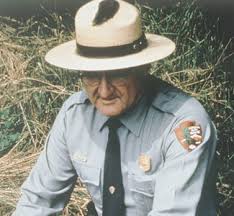
 In the annals of improbable survival, few stories are as electrifying — literally — as that of Roy Sullivan, the Virginia park ranger who holds the record for being struck by lightning seven times.
Seven.
To most people, being struck once is a near-mythic event, a freak accident whispered about for decades. To be struck twice seems cosmically unfair. Three times? Impossible.
But between 1942 and 1977, Roy Sullivan was hit by lightning on seven separate occasions — and survived every single one.
His story sounds like folklore. It reads like exaggeration. But it is documented, investigated, and recognized by Guinness World Records.
And yet, as astonishing as the number is, the deeper story isn’t just about lightning.
It’s about probability, fear, endurance, and a man who became both a legend and a reluctant spectacle.
A Ranger in the Storm
Roy Cleveland Sullivan was born in 1912 in Greene County, Virginia. He spent most of his life working outdoors as a ranger in Shenandoah National Park.
If there were a profession statistically more likely to encounter lightning than others, it would be park ranger. Sullivan spent his days on mountain ridges, fire towers, trails, and open terrain — exactly the kind of places lightning favors.
Still, even accounting for exposure, his experience defies ordinary expectation.
The odds of being struck by lightning in a given year in the United States are estimated at around 1 in several hundred thousand. The odds of being struck seven times in a lifetime? Astronomical.
And yet, the sky kept finding him.
Strike One – 1942
The first strike came in 1942.
Sullivan was inside a fire lookout tower when a storm rolled in. The tower had no lightning rod — an omission that would prove significant. Lightning struck the structure multiple times, igniting it.
Sullivan fled.
As he ran, a bolt struck his leg, tearing off his toenail and burning his foot. He survived, shaken but alive.
It was terrifying — but survivable. Lightning injuries often cause burns, neurological damage, and cardiac disruption. Sullivan’s first strike left him injured, but not permanently disabled.
He returned to work.
Most people would have viewed the event as an unlucky anomaly.
For Sullivan, it was just the beginning.
Strike Two – 1969
Nearly three decades passed before lightning found him again.
In 1969, while driving a park truck, Sullivan encountered a sudden storm. He later claimed that a cloud appeared to follow him — something he would say more than once in his life.
Lightning struck nearby, jumped into the open window of his vehicle, and set his hair on fire.
He managed to stop the truck and extinguish the flames.
Hair on fire would become an eerie pattern in his story.
The second strike intensified his fear. Sullivan reportedly began carrying a can of water with him, just in case.
But the storms weren’t finished.
Strike Three – 1970
In July 1970, Sullivan was again struck — this time in his yard.
The bolt hit a transformer nearby and then traveled toward him. Once more, his hair ignited. He knocked the flames out.
Three strikes.
At this point, co-workers began whispering. Some joked. Others grew uneasy. There is something deeply unsettling about repeated lightning strikes. It suggests, irrationally but powerfully, that the sky has chosen someone.
Sullivan himself reportedly began to feel hunted.
He claimed that storms seemed to form when he was present.
Of course, meteorology does not work that way.
But trauma reshapes perception.
Strike Four – 1972
In 1972, lightning struck him inside a ranger station.
The bolt traveled through electrical wiring and set his hair ablaze yet again.
This time, the pattern was undeniable.
Four strikes. Multiple hair fires.
Sullivan reportedly kept a bucket of water nearby at all times. His anxiety deepened. If clouds gathered, he left the area immediately.
Some co-workers avoided standing too close to him during storms.
It wasn’t just fear of lightning.
It was fear of proximity to something uncanny.
Strike Five – 1973
In 1973, lightning struck again — while Sullivan was patrolling.
This strike burned his hair and knocked him unconscious.
When he awoke, his clothes were smoldering.
The psychological toll was heavy. Sullivan’s wife later recounted that he became increasingly fearful of storms. He would sometimes pull his vehicle over and lie down during thunderclouds, convinced that standing upright made him a target.
He felt marked.
But lightning does not mark.
It follows physics — not fate.
Strike Six – 1976
By 1976, Sullivan’s reputation had spread beyond Shenandoah. He was already being discussed in newspapers.
That year, lightning struck his ankle while he was camping.
The injury was painful but not fatal. Once again, he survived.
By now, the odds were so improbable that journalists sought him out. Skeptics questioned whether the strikes were truly separate incidents. But documentation existed — medical records, witness accounts, park reports.
He was not fabricating the story.
It was happening.
Strike Seven – 1977
The seventh strike came in 1977 while Sullivan was fishing.
Lightning hit his head, set his hair on fire, and traveled down his body, burning his chest and stomach.
As if that weren’t surreal enough, a bear reportedly approached his fishing gear afterward — and Sullivan chased it off with a stick.
Seven strikes.
Seven survivals.
The Guinness Book of World Records confirmed him as the person struck by lightning more times than anyone else in recorded history.
The Science Behind Survival
Lightning is unimaginably powerful — a bolt can carry hundreds of millions of volts and reach temperatures hotter than the surface of the sun.
Yet survival is more common than many assume. Roughly 90% of lightning strike victims survive, though often with long-term consequences.
Lightning injuries vary depending on the path the current takes through the body. In many cases, electricity travels over the skin’s surface in a phenomenon known as a “flashover,” minimizing internal damage.
Sullivan’s injuries included burns, hair ignition, and neurological symptoms — but he avoided catastrophic cardiac arrest.
Still, seven survivals stretch statistical comprehension.
Experts suggest that his occupation dramatically increased his exposure. Mountain ridges, fire towers, open trails — these environments attract lightning. Being outdoors during storms, repeatedly, raises cumulative risk.
Even so, seven is extraordinary.
The Psychological Aftermath
Physical survival is only part of the story.
Being struck by lightning is traumatic. Repeated strikes amplify that trauma. Sullivan reportedly became reclusive. He believed clouds followed him. He feared standing near others during storms, worried they would be endangered.
Some acquaintances avoided him — half joking, half serious.
There is a deep human instinct to avoid perceived curse or anomaly. Sullivan became a kind of living myth — admired, pitied, and slightly feared.
He once said that lightning was attracted to him, though he acknowledged he did not know why.
The truth is more mundane — but no less astonishing.
Probability sometimes clusters.
Randomness can repeat.
Fame and Isolation
With recognition from Guinness World Records, Sullivan gained a strange form of celebrity.
He appeared in interviews. Photographs showed him holding the hat he wore during some of the strikes — its brim burned through.
Yet the fame did not bring comfort.
Lightning may have spared his life repeatedly, but it did not protect him from ordinary human struggles.
In 1983, Roy Sullivan died at age 71 from a self-inflicted gunshot wound. Reports indicate he was distressed over a romantic relationship.
The man who survived seven lightning strikes could not survive heartbreak.
It is a sobering reminder that survival of extraordinary events does not guarantee peace.
Curse or Coincidence?
Stories like Sullivan’s tap into something ancient.
Humans instinctively search for meaning in repetition. Seven strikes feel symbolic. Biblical. Supernatural.
But lightning does not choose.
It follows conductive pathways and atmospheric physics. Shenandoah’s mountainous terrain produces frequent storms. Sullivan’s long career outdoors multiplied his exposure. His survival, while improbable, aligns with known survival rates.
There is no curse.
There is no cosmic targeting.
Only rare statistical convergence.
And yet, knowing that does not diminish the wonder.
The Odds Debate
Statisticians have attempted to calculate the probability of seven strikes.
The difficulty lies in independence. Each strike is not entirely independent of exposure. A park ranger in a storm-prone region has higher cumulative risk than the general population.
Still, the odds remain staggeringly low.
Even adjusting for exposure, Sullivan’s experience stands as an outlier.
Random events cluster unpredictably. Humans remember patterns more vividly than isolated incidents. Sullivan became the ultimate pattern.
Seven times.
Lightning in Human History
Lightning has long occupied a mythic place in human culture — the weapon of gods, the symbol of divine judgment.
From Zeus to Thor, the bolt has represented power beyond human control.
Sullivan’s story brushes against that mythology. A man repeatedly struck yet living evokes ancient tales.
But unlike mythic figures, Sullivan did not command storms.
He endured them.
Legacy of a Living Conductor
Today, Roy Sullivan’s story remains one of the most cited examples of extreme survival.
Visitors to Shenandoah National Park sometimes hear his name mentioned by rangers. His charred hat is displayed in exhibits. His record still stands.
No one else has been documented surviving seven lightning strikes.
His life illustrates both the fragility and resilience of the human body.
It also reminds us that extraordinary events do not transform people into superheroes.
They remain human.
Vulnerable.
Complicated.
Conclusion: The Man the Sky Couldn’t Keep Down
Roy Sullivan did not seek attention. He did not chase storms for glory. He worked outdoors in a job he loved, and lightning found him again and again.
Each strike could have ended him.
Each time, he stood up — burned, shaken, and alive.
Seven times the sky cracked open above him.
Seven times he walked away.
It is tempting to frame his life as a battle between man and nature, or fate and survival. But perhaps it is simpler than that.
Sometimes, improbable things happen to ordinary people.
And sometimes, they endure them.
The man struck by lightning seven times was not myth.
He was a park ranger in Virginia who carried water to douse his burning hair and kept going back to work.
The sky never claimed him.
But it tried.
Seven times.