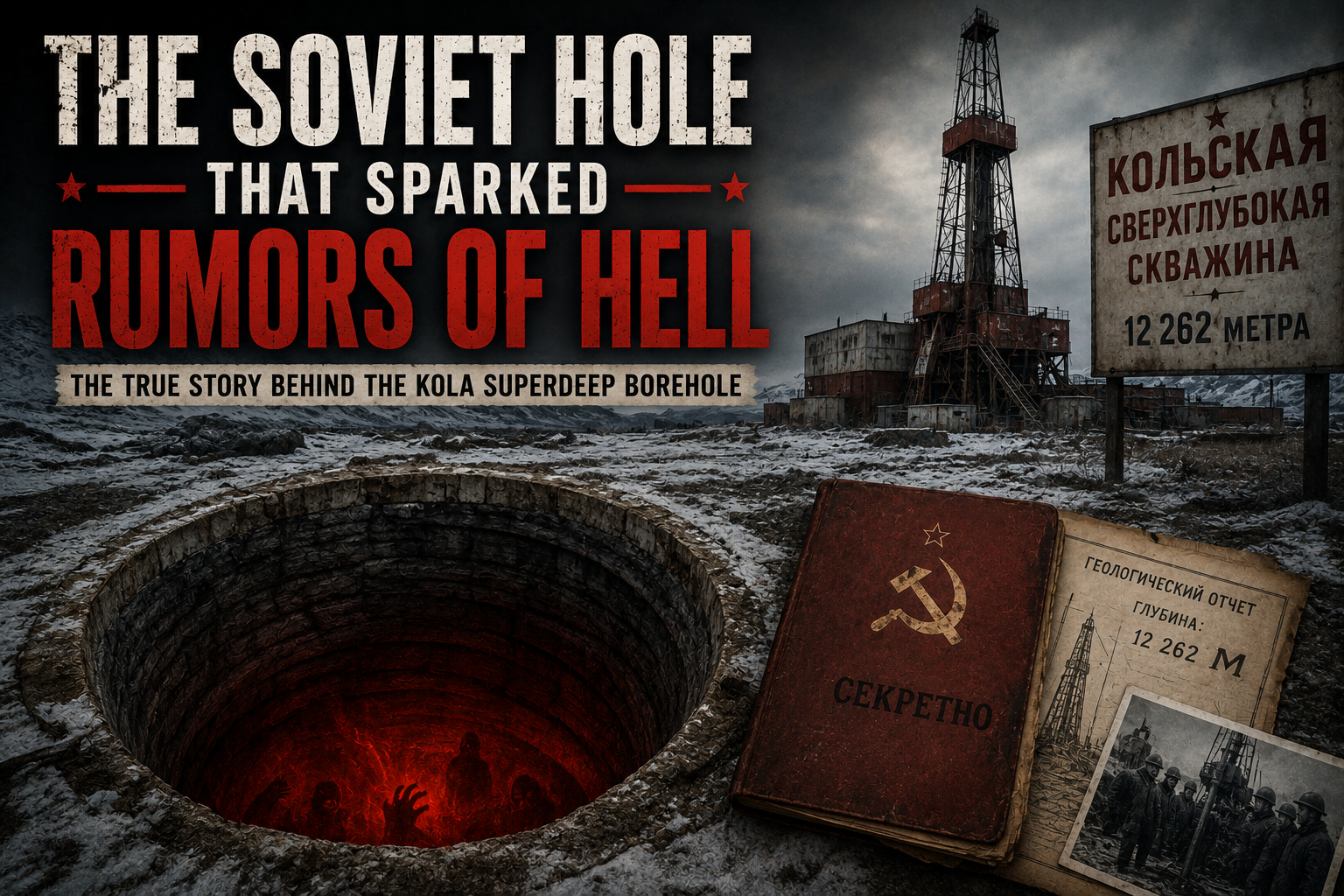
 Far above the Arctic Circle, hidden in the frozen wilderness of northwestern Russia, Soviet scientists spent nearly two decades drilling deeper into the Earth than humanity had ever gone before. The project was supposed to be a triumph of science — a Cold War-era attempt to unlock the secrets buried beneath the planet’s crust.
Instead, it became the source of one of the most infamous urban legends of the 20th century.
According to the story that spread around the world, Soviet engineers drilled so deep into the Earth that they accidentally reached hell itself. Temperatures supposedly exploded beyond expectations. Strange noises echoed upward from the depths. Then, according to the most dramatic versions of the tale, researchers lowered microphones into the shaft and recorded the screams of the damned.
The story was complete nonsense.
But the truth behind the so-called “Well to Hell” was fascinating enough on its own.
The real project, known as the Kola Superdeep Borehole, became one of the most ambitious scientific experiments ever attempted — and one of the strangest symbols of Cold War obsession.
The Cold War Race Beneath the Earth
During the Cold War, the United States and the Soviet Union competed in nearly every imaginable field.
They raced into space.
They stockpiled nuclear weapons.
They competed in athletics, espionage, science, and technology.
Even the Earth itself became a battlefield for prestige.
American scientists focused heavily on ocean drilling projects, hoping to penetrate the Earth’s crust beneath the sea. Soviet scientists responded with an even more audacious idea: drill directly into continental crust deeper than anyone had ever imagined possible.
The chosen location sat on the Kola Peninsula near the Norwegian border.
It was remote, brutally cold, and geologically valuable.
Most importantly, the area contained some of the oldest rocks on Earth.
In 1970, the Soviet Union officially began drilling.
At first, the operation attracted little attention outside scientific circles. But over time, the project grew into something almost mythic.
Digging Into the Unknown
The Kola Superdeep Borehole was not a massive open pit like a mine. In reality, it was surprisingly narrow — roughly the width of a dinner plate at its deepest point.
What made it extraordinary was its depth.
The goal was to penetrate more than 15 kilometers into the Earth’s crust, farther than any human project had ever gone before. Soviet researchers hoped the borehole would reveal hidden geological information about the planet’s structure, temperature, seismic activity, and ancient rock formations.
The drilling process was agonizingly slow.
Progress often measured only a few meters per day.
Equipment constantly failed under the intense pressure and heat underground. Specialized drill bits had to be designed specifically for conditions no machine had previously encountered.
Still, year after year, the Soviets kept drilling deeper.
By the late 1970s, the borehole had already broken world records.
Then things started becoming difficult.
Temperatures from a Nightmare
Scientists expected the underground temperature to increase steadily with depth.
What they did not expect was just how fast the temperature would rise.
At extreme depths, the heat became overwhelming.
By the time the drill reached over 12 kilometers below the surface, temperatures reportedly approached 350 degrees Fahrenheit (roughly 180 degrees Celsius). Some estimates suggested the heat could eventually exceed 500 degrees Fahrenheit if drilling continued further.
The conditions became almost impossible for machinery.
Metal components warped.
Drill bits failed constantly.
Rock formations behaved unpredictably under the combination of immense heat and pressure.
Soviet engineers realized the Earth’s crust was far more hostile than anticipated.
In a sense, the planet itself was fighting back.
Strange Discoveries Underground
Despite the technical difficulties, the Kola project produced major scientific discoveries.
Researchers found microscopic fossils buried miles beneath the surface — ancient remains of marine plankton preserved in rock over two billion years old. The discovery shocked scientists because it suggested life had once existed in environments previously considered impossible.
Even stranger, researchers encountered water deep underground where none was expected to exist.
Scientists had believed such depths would be completely dry due to immense pressure. Instead, water appeared trapped inside minerals and released through geological processes far below the surface.
The deeper the Soviets drilled, the more mysterious the Earth seemed to become.
Rock formations behaved differently than existing theories predicted.
Geological layers appeared unexpectedly fractured.
The planet’s interior turned out to be far less orderly than scientists imagined.
And then the rumors began.
The Birth of the “Well to Hell” Story
During the late 1980s and early 1990s, bizarre stories about the Kola Borehole suddenly exploded across tabloids, religious broadcasts, and paranormal magazines.
According to the legend, Soviet scientists drilled so deep that they accidentally broke into a cavern beneath the Earth filled with tortured souls.
One version claimed the drill hit an empty pocket underground where temperatures exceeded 2,000 degrees Fahrenheit.
Another claimed researchers lowered sensitive microphones into the shaft and recorded horrifying human screams echoing from below.
The alleged recording became famous worldwide.
Religious radio programs broadcast the story as proof that hell literally existed beneath the Earth’s crust. Some newspapers repeated the claims as factual events.
The legend spread rapidly because it combined science, religion, horror, and Cold War mystery into one irresistible story.
The Soviet Union already seemed secretive and frightening to many Western audiences. The idea of Soviet scientists accidentally discovering hell itself sounded bizarrely plausible within the paranoid atmosphere of the era.
There was just one problem.
None of it actually happened.
The Fake Recording
The infamous “screaming souls” audio recording turned out to be a complete fabrication.
The sound clip widely circulated during the 1990s was apparently created using edited audio effects, including clips from horror films and manipulated recordings. Some versions even incorporated sounds from Italian movies.
No legitimate scientific team at Kola ever recorded human screams underground.
The story itself likely originated from a Finnish newspaper that published the tale as an April Fool’s joke. From there, the legend spiraled wildly out of control as religious broadcasters and paranormal enthusiasts repeated it without verification.
Soon, millions of people believed the Soviet Union had literally drilled into hell.
Ironically, the real Kola Borehole was scientifically extraordinary enough without supernatural additions.
Life at the End of the Earth
The Kola drilling station itself looked bleak and isolated.
Located in the Arctic wilderness, the site consisted mainly of industrial buildings, drilling towers, mud systems, pipes, laboratories, and worker housing surrounded by frozen landscapes.
For years, scientists and engineers lived in near-total isolation while operating highly specialized equipment around the clock.
The work was dangerous and exhausting.
Mechanical failures were common.
The freezing climate created constant logistical problems.
And the deeper the drill descended, the more unstable conditions became underground.
Yet despite all the hardships, the project inspired enormous pride among Soviet researchers. The borehole represented scientific ambition at its most extreme — humanity attempting to physically penetrate the Earth’s hidden layers.
The operation resembled something between a laboratory and a science fiction outpost.
The Deepest Hole Ever Made
In 1989, the Kola Superdeep Borehole reached its maximum depth: 12,262 meters, or approximately 7.6 miles beneath the Earth’s surface.
To this day, it remains the deepest artificial point humanity has ever created.
That fact surprises many people because the depth sounds relatively small compared to the size of the Earth itself.
But penetrating even a tiny fraction of the crust proved almost impossibly difficult. The pressure and temperature at those depths pushed engineering technology to its limits.
If the Earth were compared to an apple, the borehole barely scratched through the skin.
Even so, humanity had never gone deeper.
The Soviet Union had achieved something remarkable.
Unfortunately, the project soon began collapsing alongside the country itself.
The End of the Soviet Dream
By the early 1990s, the Soviet Union was falling apart economically and politically.
Funding for expensive scientific programs evaporated rapidly.
The Kola project became increasingly difficult to justify financially, especially as drilling conditions worsened. Temperatures deep underground had grown so extreme that further progress became nearly impossible with existing technology.
In 1992, the drilling officially stopped.
The site was eventually abandoned.
Buildings decayed.
Equipment rusted.
The once-proud scientific facility slowly transformed into a ghostly ruin sitting silently in the Arctic cold.
Today, the entrance to the borehole itself is reportedly sealed by a heavy metal cap welded shut over the opening.
Beneath it lies the deepest scar humanity has ever carved into the planet.
Why the Story Refused to Die
The “USSR dug to hell” legend survived because it touched something primal in human imagination.
People have always feared what lies beneath the Earth.
Ancient cultures placed hell, monsters, demons, or underworld realms underground. The idea of drilling too deep and discovering something horrifying feels almost mythological.
The Cold War atmosphere made the story even more believable.
To many Western audiences, Soviet scientific projects already seemed mysterious and secretive. Rumors flourished easily because so little reliable information emerged from behind the Iron Curtain.
And unlike many urban legends, the Kola Borehole was real.
There truly was a Soviet project drilling deeper into the Earth than ever before.
There truly were terrifying underground temperatures.
There truly were strange geological surprises.
Reality simply became wrapped in supernatural fiction.
A Hole Into Human Curiosity
The Kola Superdeep Borehole ultimately revealed less about hell than it did about humanity itself.
The project showed how far humans are willing to push technology in pursuit of knowledge. It demonstrated scientific ambition operating at enormous scale under brutal conditions.
But it also revealed something else.
People desperately want mystery.
A deep scientific drilling operation somehow transformed into a global legend about demons and eternal suffering because the unknown remains irresistible. The deeper humans dig — into oceans, caves, space, or the Earth itself — the more imagination rushes to fill the darkness.
Today, the abandoned Soviet drilling site sits largely forgotten in the Arctic wilderness.
No screams echo upward from the shaft.
No gateway to hell was discovered.
Just a narrow hole descending farther into the Earth than any human creation before or since — a frozen remnant of Cold War ambition that accidentally inspired one of the world’s most enduring modern myths.