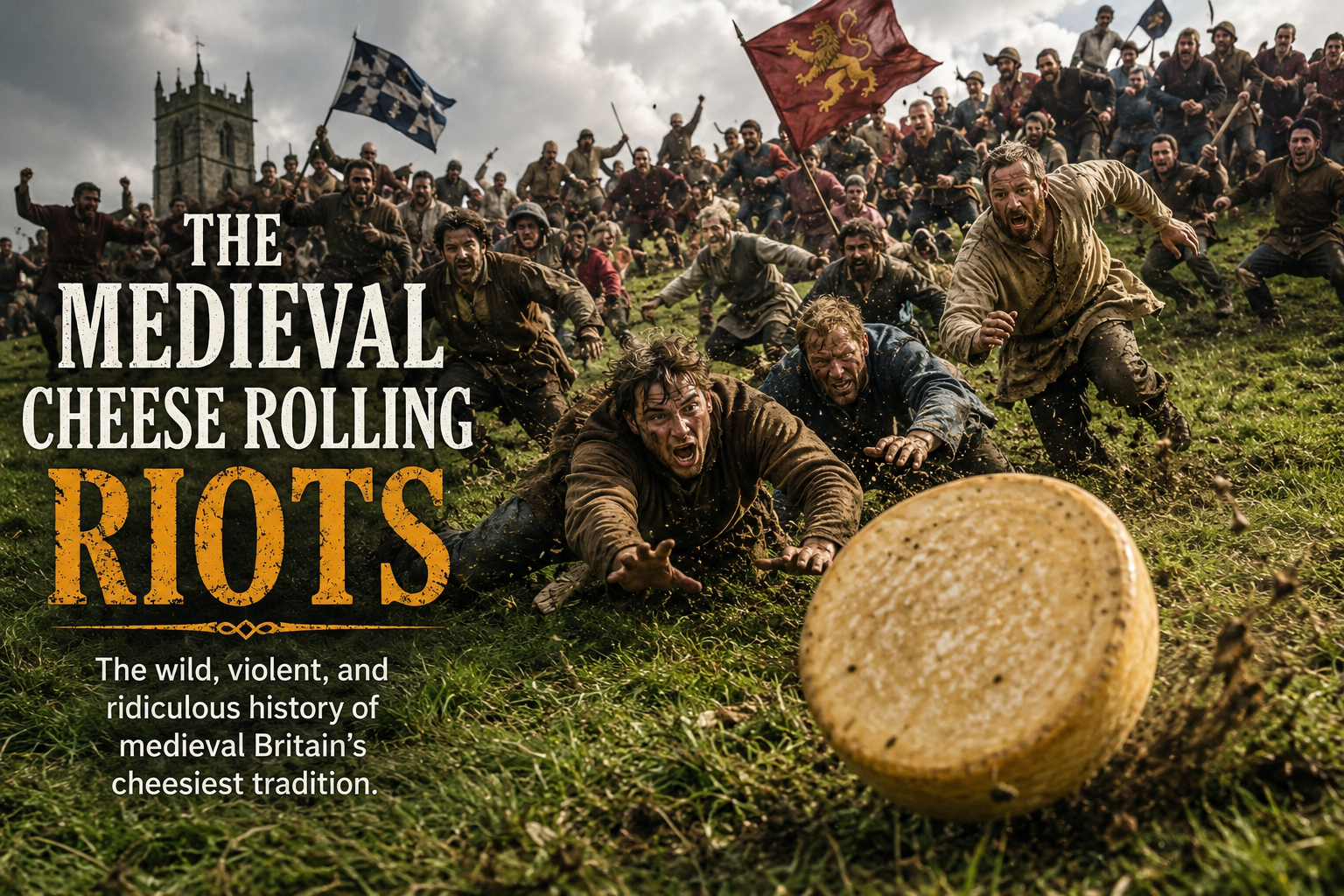
 Long before organized sports filled giant stadiums and televised competitions turned athletes into celebrities, people in medieval Europe entertained themselves with traditions that were chaotic, dangerous, and occasionally downright ridiculous. Among the strangest of these customs was cheese rolling — a practice that sounds harmless until you understand how passionately people took it. In some regions of England and parts of continental Europe, cheese rolling was more than a village game. It was a matter of pride, honor, local identity, and occasionally rebellion. What began as a festive rural tradition sometimes exploded into violent confrontations now remembered as the medieval cheese rolling riots.
Though modern cheese rolling festivals survive today in toned-down form, their medieval ancestors were far rougher affairs. They blended religious celebration, drunken revelry, economic tension, and tribal loyalty into one explosive mixture. The result was a spectacle where wheels of cheese could trigger fistfights, mob violence, and even clashes with local authorities.
The Origins of Cheese Rolling
The origins of cheese rolling are murky, partly because medieval peasants rarely documented their festivals in detail. Historians believe the tradition likely emerged in agricultural communities sometime during the late Middle Ages, especially in regions where dairy farming dominated local economies.
In its simplest form, the contest involved rolling a large wheel of cheese down a steep hill while competitors chased after it. Whoever reached the cheese first claimed it as a prize. Because the wheels were heavy and the hills often muddy, the event became wildly unpredictable. Participants tumbled, collided, and broke bones with alarming regularity.
But the event carried symbolic meaning as well. Cheese represented prosperity and survival in rural Europe. Dairy production was essential to village economies, and a successful cheese-making season could determine whether a community thrived or starved during winter. Rolling cheese downhill may have originated as a pagan fertility rite celebrating abundance and the changing of seasons.
By the 1300s and 1400s, these events had become deeply rooted in village culture across parts of England, particularly in Gloucestershire, where the tradition would later become legendary.
Festivals That Became Battlefields
Medieval festivals were rarely calm or orderly. Most peasants lived difficult lives defined by brutal labor, rigid class structures, disease, and constant hardship. Feast days and seasonal celebrations provided rare opportunities for release. Drinking, gambling, mock combat, and chaotic games were common.
Cheese rolling festivals often coincided with spring celebrations, May Day festivities, or religious holidays. Entire villages gathered to watch. Ale flowed freely. Rivalries between neighboring towns intensified emotions.
What transformed ordinary cheese rolling into riots was the tribal nature of medieval communities. Villages fiercely defended their customs and privileges. If outsiders attempted to interfere — or if local lords tried to suppress festivities — violence frequently erupted.
Some historical records describe crowds hurling stones, overturning carts, and attacking officials who attempted to stop competitions considered too dangerous or disorderly. In certain cases, disputes over who deserved the cheese prize escalated into brawls involving dozens or even hundreds of people.
To medieval villagers, these festivals were not silly games. They were part of communal identity. Attempts to regulate or cancel them could be interpreted as attacks on local freedom itself.
The Church Versus the People
One major source of conflict came from the medieval Church. Church authorities often viewed rural festivals with suspicion because many traditions blended Christian holidays with older pagan customs. Cheese rolling, with its reckless physicality and drunken atmosphere, drew criticism from priests and bishops alike.
Religious leaders condemned the events as immoral and disorderly. Some clergy claimed the games encouraged gambling, blasphemy, and sinful behavior. Others worried about injuries and deaths, which were common in large unruly crowds.
Attempts to ban or restrict the festivals sometimes triggered open resistance. Medieval villagers deeply resented outside interference in community traditions. In several documented cases across England, parish officials who attempted to stop seasonal games faced threats or outright violence.
This pattern repeated across many medieval sports. Football games became riots. Wrestling matches led to feuds. Archery contests occasionally erupted into street violence. Cheese rolling fit naturally into this volatile culture.
The Hills of Gloucestershire
No place became more associated with cheese rolling than Gloucestershire in western England. The steep hills surrounding villages such as Brockworth created ideal terrain for dangerous downhill races.
The famous slope later known as Cooper’s Hill became notorious for its brutal descents. Even today, competitors tumble violently while chasing rolling cheese wheels that can reach astonishing speeds. Medieval versions were likely even more dangerous because safety measures did not exist.
Records from local chronicles and oral traditions suggest that large gatherings at these hills occasionally spiraled into chaos. Vendors fought over territory. Drunken spectators clashed. Participants accused one another of cheating or theft. Rival villages used the gatherings to settle grudges.
Because the events attracted huge crowds from surrounding regions, local authorities struggled to maintain order. Sheriffs and magistrates sometimes attempted to police the festivals, but medieval law enforcement was primitive and understaffed.
When tempers flared, riots could spread quickly.
Ale, Gambling, and Violence
Alcohol played a central role in medieval celebrations. Beer and ale were safer to drink than contaminated water in many communities, and public festivals became massive drinking events.
At cheese rolling competitions, gambling added another layer of volatility. Spectators wagered on winners, accidents, and outcomes. Disputes over bets frequently escalated into physical confrontations.
Traveling merchants also attended these gatherings, turning them into temporary marketplaces. Pickpockets, thieves, and con artists mixed with peasants and local laborers. Arguments over stolen goods or unpaid debts sometimes sparked wider disturbances.
In some accounts, riotous crowds overturned ale barrels, attacked tax collectors, or harassed local nobles. Medieval festivals often provided rare opportunities for lower-class people to vent frustrations against authority.
The line between celebration and rebellion was dangerously thin.
When Authorities Tried to Crack Down
By the late medieval period, English authorities increasingly worried about disorderly public gatherings. Kings and local officials feared riots because peasant uprisings were genuine threats.
The memory of events like the Peasants’ Revolt of 1381 haunted ruling elites for generations. Large drunken crowds gathering in the countryside made authorities nervous, even when the official purpose was harmless entertainment.
Some local rulers attempted to ban dangerous sports altogether. Medieval records show repeated efforts to outlaw unsanctioned football games, rowdy festivals, and violent public competitions. Cheese rolling occasionally fell under these restrictions.
But enforcement proved difficult.
Villagers often ignored bans entirely. In some communities, officials who attempted to confiscate cheese wheels or disperse crowds faced organized resistance. Mobs sometimes drove authorities away with sticks and stones.
The riots were rarely political in a modern sense, but they reflected deep resentment toward outside control. Medieval villagers valued communal traditions fiercely, especially in an era where ordinary people possessed few freedoms.
Injuries and Deaths
Part of the reason cheese rolling caused such concern was the staggering number of injuries associated with it. Medieval hills were uneven, rocky, and muddy. Participants wore no protective gear. Many competitors were intoxicated.
Broken arms, concussions, and crushed ribs were common. Spectators could also be injured by runaway cheese wheels or falling competitors.
Some chroniclers described fatalities occurring during major events. Although exact numbers are impossible to confirm, medieval festivals in general were surprisingly deadly by modern standards.
Yet danger only increased the appeal.
Medieval society admired physical toughness and reckless courage. Winning a cheese roll brought prestige, free food, and local fame. Young men especially treated the races as demonstrations of bravery and masculinity.
The more dangerous the hill, the more legendary the contest became.
Riot Culture in Medieval England
To modern readers, the idea of cheese-related riots may sound absurd, but medieval England experienced riots constantly. Food shortages, taxes, sports competitions, religious disputes, and local feuds could all trigger mob violence.
Public entertainment was especially combustible because it brought together large crowds already primed for excitement and aggression. Without organized policing or modern crowd control, even minor disputes could spiral rapidly.
Many medieval games encouraged physical confrontation. Football resembled warfare more than sport. Bear baiting drew bloodthirsty crowds. Tournaments occasionally erupted into real combat.
Cheese rolling existed within this broader culture of rough public spectacle.
In fact, the medieval understanding of recreation differed dramatically from modern sportsmanship. Competition was often chaotic, tribal, and violent. Rules were loosely enforced or nonexistent. Crowds actively participated rather than merely watched.
The riots surrounding cheese rolling were not anomalies. They were products of the age itself.
Survival of the Tradition
Remarkably, cheese rolling survived centuries of criticism, injuries, and attempts at suppression. Even as England modernized, rural communities continued holding the events.
By the 18th and 19th centuries, newspapers described cheese rolling as a bizarre local custom that attracted adventurous spectators. Authorities still worried about injuries, but the events increasingly became celebrated as eccentric folk traditions rather than dangerous public disorders.
Modern cheese rolling festivals — especially the famous Gloucestershire event — remain chaotic but are now treated with humor and nostalgia. Participants still tumble violently downhill chasing massive cheese wheels, often suffering sprains and fractures.
Yet today’s version is relatively tame compared to its medieval predecessors. Modern emergency crews stand by. Crowds are controlled. The violence between rival groups has largely disappeared.
The old riots belong to another world — one where entertainment, survival, religion, and rebellion blurred together in explosive ways.
A Window Into Medieval Life
The medieval cheese rolling riots reveal something important about ordinary people in the Middle Ages. Too often, medieval history focuses on kings, knights, wars, and castles while ignoring the lives of peasants and villagers.
Cheese rolling festivals show us a society bursting with energy, emotion, and communal identity. These were people desperate for joy in harsh conditions. Festivals offered escape from endless labor and rigid hierarchy.
The riots also demonstrate how fiercely communities defended tradition. In an era where peasants possessed little political power, local customs became symbols of independence and dignity.
What appears ridiculous on the surface — crowds fighting over rolling cheese — actually reflected deeper tensions involving authority, class, religion, and social control.
And perhaps that is why the story still fascinates people today.
There is something timelessly human about communities gathering for absurd traditions, pushing celebrations too far, and turning harmless competition into total chaos. Medieval cheese rolling riots remind us that history was not always solemn or orderly. Sometimes it was loud, drunken, muddy, and completely out of control.
In the end, the image perfectly captures the spirit of medieval life itself: a crowd of determined villagers hurling themselves down a dangerous hill after a flying wheel of cheese while chaos erupts all around them.