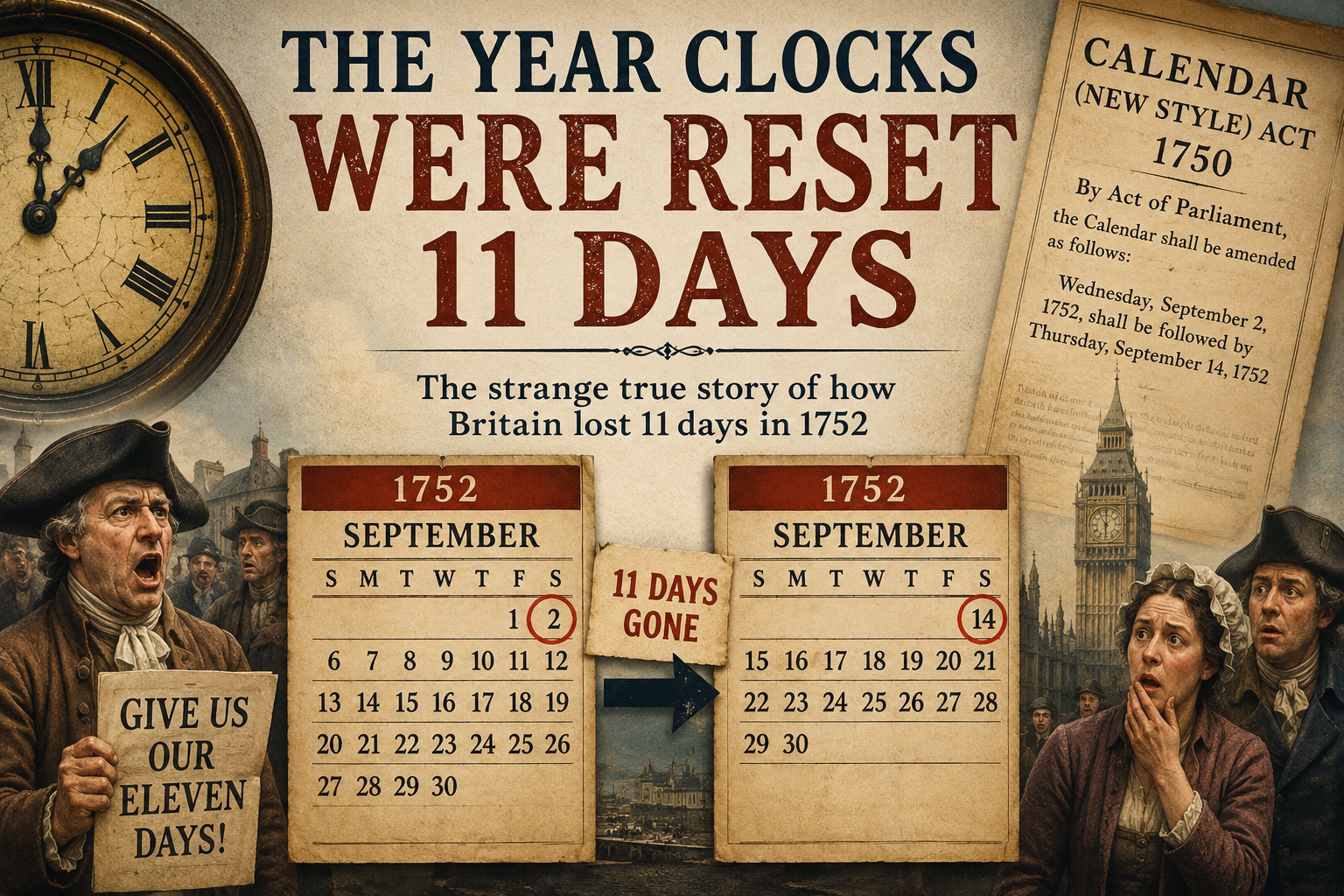
Imagine going to bed on September 2nd and waking up on September 14th.
No September 3rd. No September 4th. Nearly two weeks of your life seemingly erased overnight.
That bizarre event actually happened in Britain in 1752, when the government officially removed 11 days from the calendar in one of the strangest administrative decisions in history. For ordinary people, it felt surreal. Rent was still due. Taxes still had to be paid. Birthdays vanished. Workers feared they were being cheated out of wages. Rumors spread that the government had literally stolen time itself.
The change was not the result of war, plague, or natural disaster. Instead, it happened because the calendar the Western world had used for centuries was wrong.
Not slightly wrong, either. Wrong enough that the seasons themselves were slowly drifting away from the dates people expected them to arrive.
The story of the missing 11 days is one of astronomy, politics, religion, confusion, and public outrage — and it remains one of the strangest moments in British history.
The Problem With Time
For centuries, much of Europe used the Julian calendar, introduced by Julius Caesar in 45 BC. At the time, it was considered a major improvement over earlier Roman calendars, which had become chaotic and politically manipulated.
The Julian calendar established the familiar concept of a leap year every four years, creating an average year length of 365.25 days.
The problem was that Earth does not actually orbit the sun in exactly 365.25 days.
The real solar year is approximately 365.2422 days long.
That tiny difference — less than 11 minutes per year — seemed insignificant. But over centuries, those extra minutes accumulated. By the 1500s, the calendar had drifted about 10 days out of alignment with the solar year. Religious holidays tied to astronomical events, especially Easter, were slowly moving away from their intended seasons.
This was not merely an inconvenience. In medieval and early modern Europe, calendars shaped agriculture, religious life, taxation, legal contracts, and everyday routines. If the calendar drifted too far, it could eventually place spring festivals in winter or harvest dates far from the actual harvest season.
Something had to be done.
The Gregorian Calendar
In 1582, Pope Gregory XIII introduced a corrected system now known as the Gregorian calendar. The reform adjusted leap year rules to better match the solar year and immediately skipped 10 days to realign the calendar with the seasons.
In countries that adopted the reform, Thursday, October 4th, 1582, was followed directly by Friday, October 15th.
Catholic nations such as Spain, Portugal, and Italy adopted the new calendar quickly. Protestant countries, however, were deeply suspicious.
This was an era when religious conflict dominated Europe. The Protestant Reformation had shattered Christian unity, and many Protestant nations distrusted anything associated with the pope. To some English Protestants, accepting the Gregorian calendar felt dangerously close to accepting papal authority.
As a result, Britain stubbornly continued using the outdated Julian calendar for nearly 170 more years.
During that time, the calendar drift worsened. By the mid-1700s, Britain was now 11 days behind most of continental Europe.
This caused constant confusion in trade, diplomacy, navigation, and communication. Dates often had to be written twice to avoid misunderstandings. Historians still encounter “Old Style” and “New Style” dates from this period because of the competing systems.
Eventually, practical necessity overcame religious resistance.
Britain Finally Changes the Calendar
In 1750, the British Parliament passed the Calendar (New Style) Act.
The law introduced two major changes.
First, Britain would officially adopt the Gregorian calendar.
Second, the start of the legal new year would move from March 25th to January 1st. Prior to this change, the British legal year traditionally began in late March, a practice that seems bizarre to modern readers.
But the most dramatic part of the reform involved correcting the accumulated drift.
By 1752, Britain needed to remove 11 days to synchronize with the Gregorian system already used across much of Europe.
So Parliament made a remarkable decision.
Wednesday, September 2nd, 1752, would be immediately followed by Thursday, September 14th.
Eleven calendar days simply vanished.
Public Confusion and Panic
For educated elites, astronomers, and government officials, the logic behind the change was straightforward.
For ordinary citizens, it was bewildering.
Most people in 18th-century Britain had little understanding of astronomy or calendar mathematics. Many genuinely believed time itself had been stolen from them.
Stories spread that angry crowds marched through the streets demanding, “Give us our eleven days!”
Although historians debate how widespread these protests truly were, there is little doubt that confusion and resentment existed. Political cartoons mocked the situation, and many citizens deeply distrusted the government’s motives.
Workers worried employers would cheat them out of nearly two weeks of wages.
Tenants feared they would still owe full monthly rent despite losing 11 days.
People questioned how interest payments, taxes, and contracts would be calculated.
Even birthdays became strange casualties of the reform. Someone born on September 10th suddenly discovered that date no longer existed in 1752 Britain.
For ordinary people already suspicious of government authority, the entire event felt unnatural and deeply unsettling.
The Calendar and Everyday Life
The calendar reform exposed how heavily society depended on consistent timekeeping.
Markets, court dates, shipping schedules, church holidays, farming cycles, and financial systems all relied on agreed-upon dates. Removing 11 days disrupted routines people had followed their entire lives.
Some people feared the shortened year might affect their health or lifespan. Others believed the missing days had religious significance.
The confusion also reflected a deeper truth about human psychology: people treat calendars as natural and permanent even though they are entirely human inventions.
Days, months, and years feel fixed and eternal, but calendars are systems created by governments and societies to organize time. The 1752 reform abruptly reminded people that those systems could be altered by political decision.
In a strange way, the missing 11 days challenged people’s sense of reality itself.
Why the Change Was Necessary
Despite public anxiety, the reform was undeniably practical.
Without correction, the calendar would have continued drifting farther from the solar year. Over centuries, seasonal dates would gradually move into entirely inappropriate parts of the year.
The Gregorian system dramatically improved accuracy. In fact, it remains the international standard today because it is remarkably precise. Even the Gregorian calendar is not perfect, but its error accumulates so slowly that it takes thousands of years to become significant.
Britain’s adoption of the Gregorian calendar also improved trade and diplomacy with European nations already using the system. International communication became simpler and more reliable.
What seemed shocking in 1752 eventually became completely normal.
Today, most people never even think about the fact that our modern calendar was once fiercely controversial.
The Lost Days in Popular Culture
The story of Britain’s missing 11 days has remained a source of fascination for historians, writers, and lovers of strange historical events.
The phrase “Give us our eleven days!” became legendary, symbolizing public distrust of political authority. Whether massive riots truly occurred remains debated, but the phrase survives because it perfectly captures the absurdity of the situation.
The event also highlights how differently people understood science in the 18th century. Today, calendar reform would likely be accepted with little drama because most people understand the astronomical reasoning behind leap years and solar cycles. In 1752, however, many citizens experienced the reform almost like magic.
The missing days have appeared in novels, historical documentaries, and discussions about the strange quirks of British history. It remains one of those rare real-life events that sounds almost fictional.
After all, how often does a government simply decide that 11 days no longer exist?
A Strange Moment Frozen in Time
The calendar reform of 1752 stands as one of history’s oddest examples of how science, politics, and everyday life can collide.
On paper, the change was a rational astronomical correction. In practice, it felt deeply personal to millions of ordinary people whose understanding of time itself suddenly shifted overnight.
For Britain, the transition marked the end of an outdated medieval system and the embrace of a more scientifically accurate world. Yet the emotional reaction showed that calendars are far more than mathematical tools. They shape memory, identity, routine, and our sense of reality.
The lost 11 days remain a reminder that even something as fundamental as timekeeping is ultimately a human creation — and sometimes, those creations can change in ways that leave entire nations bewildered.
Somewhere in the strange corners of history, September 3rd through September 13th, 1752, still linger as days that simply never happened.