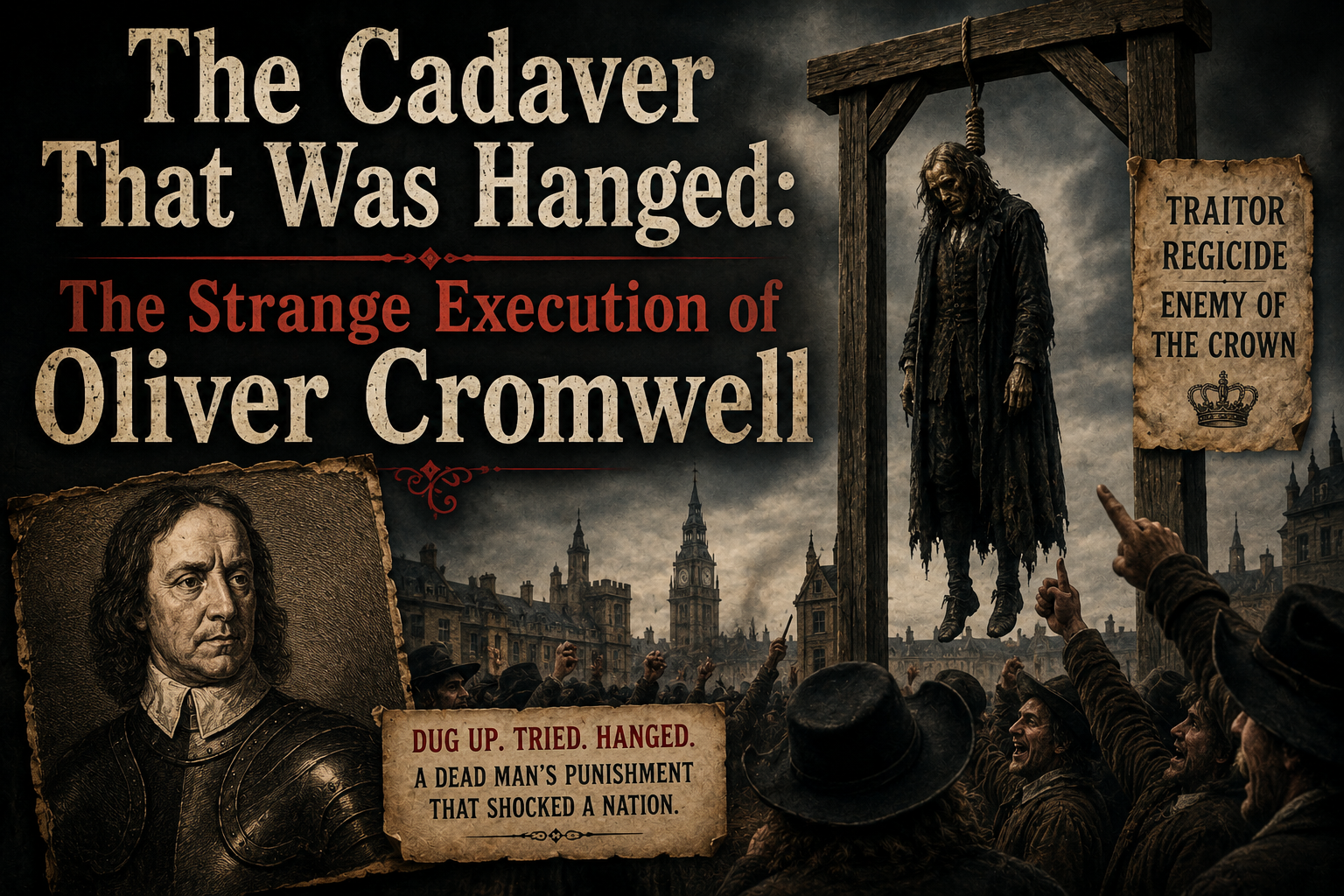
 History is filled with strange acts of revenge, political theater, and symbolic punishment, but few are as bizarre as the day England dug up a dead man, dragged his rotting corpse through the streets, and publicly executed it. The man was Oliver Cromwell — the military leader who helped overthrow the English monarchy, ruled the country as Lord Protector, and forever changed British history.
What made the event truly surreal was that Cromwell had already been dead for more than two years when the government decided to punish him.
In January 1661, authorities exhumed Cromwell’s decomposing body, placed it on trial symbolically, hauled it to the gallows at Tyburn, and hanged the corpse in front of a crowd. Afterward, the body was decapitated, and the severed head was displayed on a spike above Westminster Hall for decades.
It remains one of the strangest acts of posthumous revenge ever carried out by a government.
The Rise of Oliver Cromwell
To understand why England executed a dead man, it is important to understand just how deeply Cromwell divided the nation.
Born in 1599, Oliver Cromwell was originally a relatively minor member of the English gentry. He was not born into royalty or immense power. In fact, for much of his early life, few would have predicted he would become one of the most feared and controversial figures in British history.
Everything changed during the English Civil War.
During the 1640s, tensions exploded between King Charles I and Parliament. Disputes over religion, taxes, and royal authority pushed England into open warfare. On one side were supporters of the king, known as Royalists. On the other were Parliamentary forces seeking to limit the monarch’s power.
Cromwell emerged as a brilliant military commander during the conflict.
Leading the famous New Model Army, he helped Parliament crush Royalist forces in battle after battle. His cavalry tactics became legendary, and his soldiers were known for strict discipline and fierce religious zeal.
Eventually, the Parliamentary forces captured King Charles I himself.
What happened next shocked Europe.
The King Who Lost His Head
Until that moment, most Europeans believed kings ruled by divine right. Monarchs were considered chosen by God. Executing a king was almost unthinkable.
Cromwell and his allies disagreed.
In 1649, Charles I was tried for treason against England itself. He was convicted and publicly beheaded outside the Banqueting House in London.
The execution horrified many across Europe.
England abolished the monarchy and declared itself a republic known as the Commonwealth. Cromwell eventually became Lord Protector, effectively ruling the country as a military dictator.
To supporters, he was a defender of liberty and Protestantism.
To enemies, he was a regicidal tyrant who had murdered the king.
That hatred would not disappear after his death.
Cromwell Rules England
Cromwell’s government was powerful, strict, and deeply controversial.
He enforced harsh moral laws inspired by Puritan religious beliefs. Theaters were closed. Certain celebrations were restricted. Public behavior was heavily regulated.
His military campaigns in Ireland became especially infamous.
During sieges at Drogheda and Wexford, Cromwell’s forces killed large numbers of defenders and civilians. To this day, Cromwell remains one of the most hated figures in Irish history.
Meanwhile, political tensions simmered constantly in England. Many citizens grew tired of military rule and longed for the return of the monarchy.
Still, Cromwell maintained power through military strength and political control.
For a time, it seemed the monarchy might never return.
Then fate intervened.
The Death of Cromwell
Oliver Cromwell died on September 3, 1658.
The official cause was likely a combination of malaria and infection, though historians still debate the exact details. His health had deteriorated badly in his final years, worsened by stress, illness, and the death of his beloved daughter Elizabeth.
His funeral was grand and elaborate.
Ironically, Cromwell received a ceremony resembling that of a monarch despite having helped abolish kingship itself. His body was embalmed and buried in Westminster Abbey among England’s greatest figures.
But the government he built quickly began collapsing.
Cromwell’s son Richard lacked his father’s authority and military skill. Political chaos spread rapidly. Within two years, support for restoring the monarchy became overwhelming.
In 1660, Charles II — the executed king’s son — returned triumphantly to England.
The monarchy had been restored.
And many people wanted revenge.
Revenge Against a Dead Man
The restored royal government viewed Cromwell not merely as a former ruler but as a traitor responsible for the murder of King Charles I.
Executing him again was impossible.
But symbolic punishment was not.
Authorities ordered the bodies of Oliver Cromwell, Henry Ireton, and John Bradshaw — key figures connected to the king’s execution — to be dug up from Westminster Abbey.
The timing was deliberate.
The executions were scheduled for January 30, 1661, exactly twelve years after Charles I had been executed.
It was political theater at its darkest.
The monarchy wanted England to witness the humiliation of the men who had destroyed royal authority.
Even if those men were already dead.
Digging Up the Dead
Workers entered Westminster Abbey and exhumed the corpses.
By this point, Cromwell’s body had been buried for over two years.
The remains were badly decomposed.
Still, the cadavers were dressed, handled publicly, and transported through London as though they were living prisoners headed toward execution.
Crowds gathered to watch the bizarre spectacle.
Some mocked the bodies.
Others celebrated.
The entire event had a grotesque carnival atmosphere.
England was not simply punishing enemies. It was making a public statement about power, loyalty, and revenge.
The message was unmistakable: no attack against the monarchy would ever truly be forgiven.
The Hanging at Tyburn
The corpses were taken to Tyburn, London’s famous execution site.
Normally, traitors were hanged alive before being cut down and dismembered. In this case, the bodies themselves were already lifeless, yet authorities followed much of the traditional execution ritual anyway.
The cadavers were suspended from the gallows in front of spectators.
They reportedly hung there for hours.
Imagine the surreal horror of the scene.
A rotting corpse swinging from a public gallows while crowds gathered to witness the punishment.
It was revenge transformed into theater.
But the punishment was not finished.
The Decapitation
After the hanging, executioners cut down the bodies and decapitated them.
Cromwell’s severed head became the centerpiece of the macabre display.
Authorities placed it atop a large spike above Westminster Hall, where it remained for approximately 25 years.
Visitors entering the area could look upward and see the dried, weathered head of England’s former ruler staring down at them.
Rain, wind, and time slowly transformed it into a terrifying relic.
Yet even after decades exposed to the elements, the head survived.
Its strange journey was only beginning.
The Wandering Head of Oliver Cromwell
At some point in the late 1600s, the spike holding Cromwell’s head reportedly broke during a storm.
The skull fell to the ground and disappeared into private hands.
What followed sounds almost unbelievable.
For centuries, Cromwell’s severed head passed between collectors, museums, curiosity shows, and private owners. It became one of Britain’s strangest historical artifacts.
Some displayed it publicly for money.
Others treated it almost like a sacred political relic.
Experts debated whether the head was genuine, though modern analysis strongly suggests it probably was.
Descriptions of the artifact were disturbing. Fragments of skin and hair reportedly remained attached for years. The facial structure was still partially recognizable.
The head became part horror object, part political symbol.
Incredibly, it remained in circulation well into the 20th century.
Finally Buried
After centuries of bizarre handling, Cromwell’s head was finally buried secretly in 1960 at Sidney Sussex College in Cambridge, where he had once studied.
The exact location was deliberately kept private.
Those responsible feared the remains might otherwise become a target for theft, vandalism, or political obsession once again.
At last, after centuries of public humiliation, display, and morbid fascination, Oliver Cromwell finally received something resembling peace.
Why the Story Still Fascinates People
The execution of Cromwell’s corpse remains fascinating because it reveals how emotional and symbolic politics can become.
The monarchy did not simply want Cromwell defeated politically.
They wanted him erased, humiliated, and transformed into a warning for future generations.
The event also demonstrates how deeply personal political conflicts were during the 17th century. The English Civil War was not merely a disagreement over policy. Families were divided. Religions clashed violently. Entire visions of society collided.
Hatred lingered long after death itself.
The public execution of a corpse may sound absurd today, but at the time it served an important symbolic purpose. It restored royal authority through spectacle and fear.
The monarchy was announcing that rebellion against the crown carried consequences beyond the grave.
One of History’s Strangest Executions
Many bizarre punishments appear throughout world history, but the hanging of Oliver Cromwell’s corpse stands apart because of its sheer theatrical cruelty.
The government dug up a decomposing body, dragged it across London, hanged it publicly, chopped off its head, and displayed the skull for decades.
It sounds less like history and more like gothic fiction.
Yet every part of the story truly happened.
Even stranger, Cromwell himself had once ruled England more completely than almost any king before him. He commanded armies, shaped religion, controlled Parliament, and altered the course of British history forever.
Then, only a few years after his death, his enemies reduced him to a rotting warning dangling from a gallows.
History often remembers great leaders through monuments and statues.
Oliver Cromwell became famous for becoming the cadaver that was hanged.