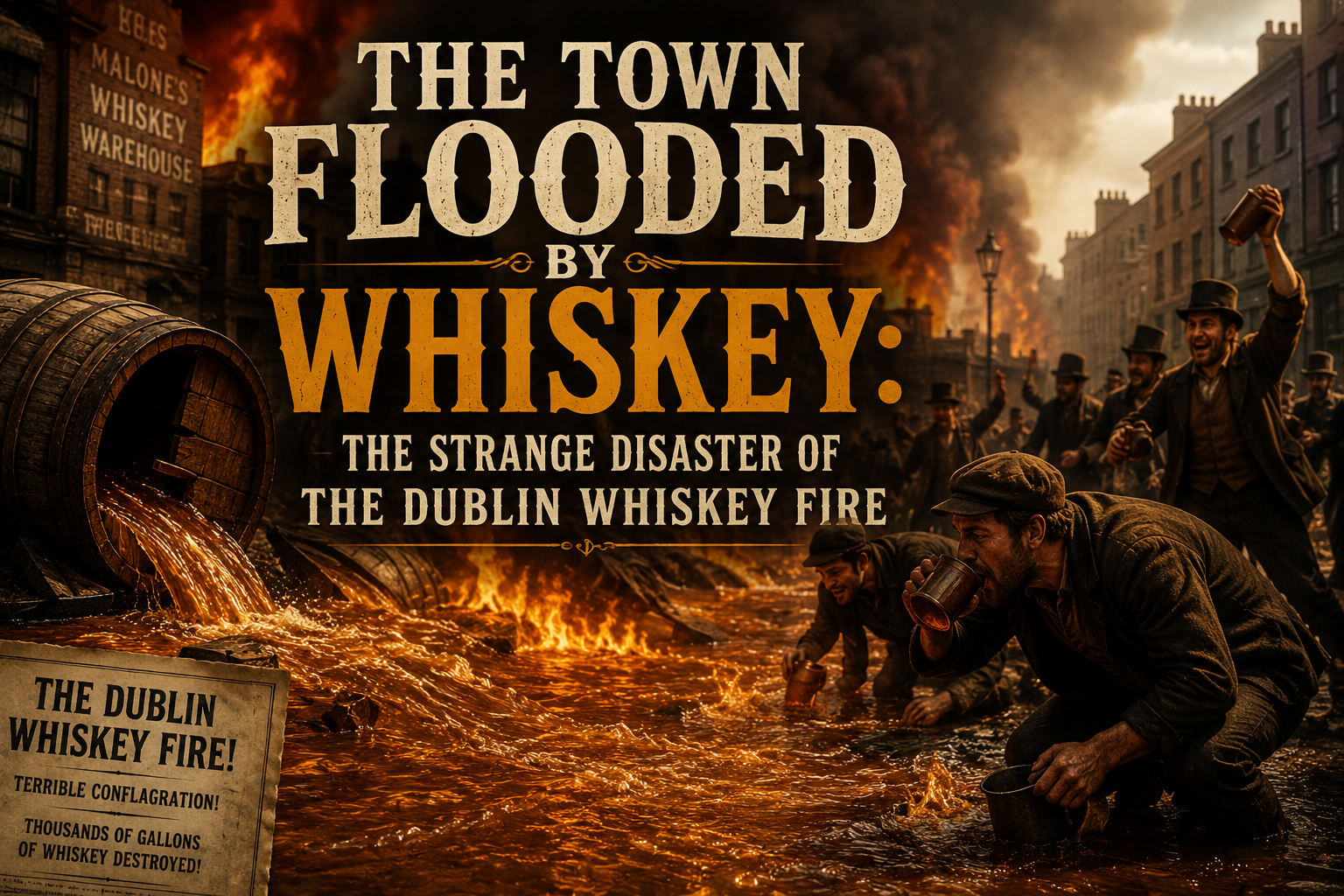
 History is full of bizarre disasters, but few are as surreal as the day an entire section of Dublin, Ireland, was overwhelmed by a literal river of burning whiskey. It sounds almost like dark comedy or the setup to an old folk tale, yet the event was horrifyingly real. In June of 1875, a massive fire erupted in a whiskey warehouse, triggering explosions and releasing thousands upon thousands of gallons of flaming liquor into the streets. The result was one of the strangest urban disasters of the 19th century — a catastrophe involving fire, destruction, toxic fumes, stampeding crowds, and people literally drinking whiskey from gutters while the city burned around them.
The event became known as the Dublin Whiskey Fire, and even today it remains one of the weirdest tragedies in Irish history.
A City Built Around Whiskey
To understand why this disaster became so infamous, it helps to understand Dublin’s relationship with whiskey during the 1800s. At the time, Irish whiskey was one of the most respected and valuable spirits in the world. Dublin was packed with distilleries, bonded warehouses, taverns, breweries, and merchants whose fortunes depended on alcohol production.
Whiskey was not merely a drink in Ireland during this era. It was a massive industry and a cultural institution.
Entire neighborhoods revolved around warehouses filled with aging barrels. The smell of malt and spirits drifted constantly through parts of the city. Workers rolled casks through crowded streets while taverns served laborers, sailors, businessmen, and politicians alike.
One of these storage facilities sat on Chamber Street in Dublin.
Nobody expected it would soon become the center of an inferno unlike anything the city had ever witnessed.
The Fire Begins
On the evening of June 18, 1875, smoke began rising from Malone’s bonded whiskey warehouse. At first, the blaze appeared manageable. Fires in industrial areas were dangerous but not uncommon during the 19th century. Cities were filled with wooden structures, open flames, gas lamps, and primitive safety systems.
But this fire was different.
Inside the warehouse were enormous quantities of whiskey stored in barrels and vats. Once the flames reached the alcohol, conditions changed instantly.
The fire intensified with terrifying speed.
Witnesses described hearing thunderous explosions as casks burst apart from the heat. Whiskey streamed through the building while flames shot into the night sky. The burning alcohol created conditions firefighters had almost no experience dealing with.
Then the walls gave way.
Suddenly, a massive wave of flaming whiskey surged into the surrounding streets.
Rivers of Fire
Accounts from the disaster sound almost apocalyptic.
Witnesses described literal rivers of burning whiskey flowing through Dublin streets. The fiery liquid poured into alleys, basements, homes, and businesses while thick black smoke filled the air. The blaze spread rapidly as alcohol carried flames across entire blocks.
Some reports claimed the whiskey flood reached several inches deep in certain areas.
The liquid ignited everything it touched.
Wooden carts caught fire instantly.
Buildings erupted in flames.
Horses panicked and bolted through crowded streets.
Residents fled carrying children and belongings while firefighters struggled to contain the rapidly spreading inferno.
The sheer absurdity of the situation made it even more terrifying. This was not a normal fire. The city was effectively under attack by flaming liquor.
At one point, the heat became so intense that nearby lead pipes reportedly melted.
A Horrifying Crowd Reaction
One of the strangest and darkest aspects of the disaster involved the reaction of some local residents.
As whiskey flooded through the streets, crowds gathered with cups, pots, buckets, and even their bare hands to collect the alcohol. Some people reportedly lay down beside gutters and drank directly from the flowing whiskey despite the surrounding smoke and flames.
It was an astonishing scene.
Firefighters battled an uncontrollable inferno while nearby civilians scrambled to gather free liquor from the streets.
For many poorer Dublin residents, whiskey was expensive and difficult to afford in large quantities. The sudden appearance of entire rivers of alcohol created chaos. Some individuals became intoxicated during the disaster itself while others attempted to carry away salvaged whiskey before authorities could stop them.
The situation became so bizarre that police eventually struggled not only with the fire but with crowd control.
Unfortunately, the whiskey itself created another deadly problem.
Death by Alcohol Poisoning
Remarkably, relatively few people died directly from the fire itself. Considering the scale of the inferno, the casualty numbers from burns and collapsing buildings were surprisingly low.
But the whiskey caused deaths in another way.
The alcohol flowing through the streets had mixed with smoke, debris, dirt, and chemicals from the burning warehouse. Large quantities were consumed anyway.
In the days following the disaster, multiple people died from alcohol poisoning.
Reports from the time indicated that many victims had consumed enormous amounts of the contaminated whiskey they collected from the gutters and streets. Some became violently ill almost immediately. Others died after binge drinking salvaged liquor over the following days.
It remains one of the strangest causes of death connected to a major urban disaster.
The fire itself was catastrophic enough, yet many fatalities ultimately came from people drinking the disaster.
Firefighters Facing the Impossible
The Dublin Fire Brigade encountered nearly impossible conditions during the crisis.
Water alone was often ineffective because the burning alcohol continued spreading flames across the streets. Firefighters had to improvise barriers using sand, manure, and other materials to block the movement of the whiskey flood.
Some accounts state that firefighters used burning debris strategically to consume pools of whiskey before they could spread further.
Meanwhile, explosions continued erupting from the warehouse as additional barrels ignited.
The noise reportedly sounded like artillery fire.
Dense smoke covered the area while crowds pushed dangerously close to the flames. Firefighters worked for hours in overwhelming heat trying to stop the disaster from engulfing larger sections of Dublin.
The fire eventually burned itself out after enormous quantities of whiskey had already been destroyed.
The Scale of the Disaster
Modern estimates suggest that roughly 5,000 barrels of whiskey were involved in the fire.
That translates into hundreds of thousands of gallons of alcohol.
The financial damage was enormous. Warehouses, homes, businesses, and infrastructure suffered severe destruction. Entire streets were left blackened and soaked in sticky residue from burned whiskey.
Yet despite the dramatic nature of the disaster, the event has faded from mainstream memory outside Ireland.
That is partly because the story sounds too strange to be real.
A city district consumed by rivers of flaming whiskey feels more like a scene from absurd fiction than a documented historical catastrophe.
But newspapers across Britain and Ireland covered the event extensively. Witness statements, official reports, and illustrations from the period confirm just how chaotic the disaster became.
Why Whiskey Fires Were So Dangerous
Industrial alcohol fires during the 19th century posed unique dangers because many cities lacked modern firefighting technology and safety regulations.
Whiskey vapor itself is highly flammable.
Once large quantities ignite, explosions can occur rapidly as pressure builds inside sealed barrels or storage vats. In the Dublin disaster, the intense heat caused containers to rupture continuously, feeding the blaze with fresh alcohol.
Even worse, liquid whiskey could transport flames across long distances.
Rather than staying contained in one building, the burning alcohol transformed streets into pathways for fire.
This made the disaster unusually difficult to predict or control.
The Chamber Street fire became one of the clearest examples of how dangerous massive liquor storage could become inside crowded urban environments.
The Strange Legacy of the Whiskey Flood
Over time, the Dublin Whiskey Fire evolved into a legendary piece of Irish urban folklore.
Some retellings exaggerated details, claiming people swam through whiskey-filled streets or that entire neighborhoods became drunk from fumes alone. While many of these stories drift into myth, the core disaster was horrifying enough without embellishment.
The image of residents collecting whiskey from gutters while a city burned around them became especially famous.
It symbolized desperation, temptation, and chaos all at once.
Historians often point to the event as an example of how poverty shaped human behavior during disasters. For some residents, the opportunity to obtain free alcohol outweighed the obvious danger surrounding them.
Others simply reacted irrationally amid panic and confusion.
Either way, the disaster revealed how quickly social order could collapse during a crisis.
A Disaster Unlike Any Other
The Dublin Whiskey Fire occupies a unique place in history because it combined so many bizarre elements into one event.
It was an industrial accident.
It was a massive urban fire.
It was a public health disaster.
It became a riot-like scene involving intoxicated civilians.
And somehow, it also involved literal flaming rivers of whiskey pouring through city streets.
Few historical disasters sound more surreal.
Even today, modern readers often assume the story must be exaggerated or fictional. Yet contemporary newspaper accounts paint an even stranger picture than many modern summaries.
Witnesses saw alcohol burning blue across cobblestones.
Crowds filled containers with liquor while explosions shook nearby buildings.
Firefighters battled an inferno fueled by whiskey itself.
The entire event felt almost dreamlike in its absurdity.
The Town Flooded by Whiskey
Although Dublin itself was not completely flooded, the disaster became remembered as “the town flooded by whiskey” because entire sections of the city were overtaken by the alcohol spill.
For residents living near Chamber Street, the memory must have been unforgettable.
The smell alone reportedly lingered for days.
Burned whiskey soaked into wood, brick, and pavement while damaged buildings smoldered across the district. Survivors described scenes of confusion, heat, smoke, screaming horses, shattered barrels, and rivers of flaming liquid rolling through the streets.
It remains one of the strangest true disasters ever recorded.
History is filled with wars, plagues, and natural catastrophes, but sometimes the weirdest events come from human industry colliding with terrible luck. In 1875, Dublin experienced exactly that — a nightmare fueled by whiskey, fire, and chaos that transformed ordinary streets into something almost impossible to imagine.