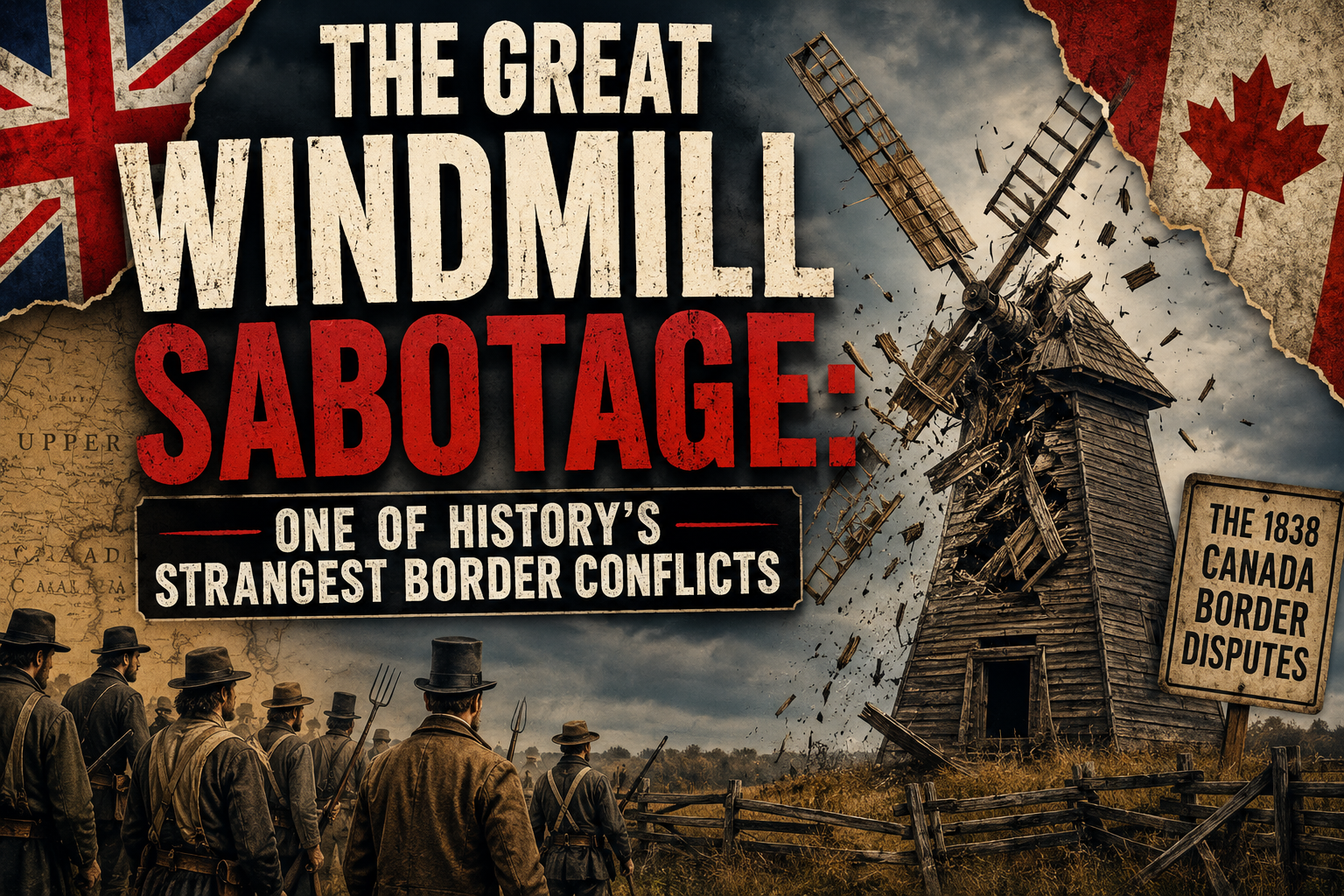
 In the late 1830s, North America was simmering with political unrest, failed rebellions, revolutionary dreams, and strange acts of desperation that today feel almost surreal. Among the strangest of these forgotten episodes was what many historians now connect to the Battle of the Windmill — an odd and violent conflict involving Canadian rebels, American sympathizers, secret societies, and a fortified stone windmill overlooking the St. Lawrence River. Though not always officially referred to as “The Great Windmill Sabotage,” the event has earned that nickname among enthusiasts of bizarre historical incidents because of its strange mixture of military incompetence, political idealism, sabotage attempts, and catastrophic miscalculation.
The entire affair unfolded in 1838 near Prescott, Upper Canada, in the aftermath of the Canadian Rebellions of 1837. It was a period when revolution seemed possible across much of the Western world. Democratic uprisings had erupted in Europe, tensions between reformers and colonial governments were growing in Canada, and many Americans believed British control over Canada was weak enough to collapse under pressure.
Instead, the so-called sabotage effort surrounding the windmill ended in disaster.
Today, the event stands as one of the strangest military episodes in North American history.
Canada on the Edge of Rebellion
To understand the bizarre windmill conflict, it is important to understand the atmosphere in Canada during the 1830s. Upper Canada, now modern-day Ontario, was controlled by a small elite political group often referred to as the “Family Compact.” Many ordinary citizens believed the colonial government was corrupt, unfair, and designed to protect wealthy insiders while excluding reform-minded citizens from power.
One of the loudest critics of the system was William Lyon Mackenzie, a fiery newspaper publisher and political reformer who increasingly pushed for radical political change. Inspired partly by American republicanism, Mackenzie and his supporters eventually believed peaceful reform was impossible.
In 1837, tensions exploded into open rebellion.
The uprising itself was poorly organized and quickly crushed by British and Canadian loyalist forces. Mackenzie fled across the border into the United States, where he found support among Americans who hated British influence in North America. While many Americans officially wanted peace, thousands of volunteers were fascinated by the possibility of helping overthrow British rule in Canada.
This strange alliance eventually gave birth to secret militant groups called the Hunters’ Lodges.
The Hunters’ Lodges
The Hunters were a strange mix of adventurers, idealists, opportunists, and anti-British activists. Some genuinely believed they were fighting for liberty and democracy. Others simply wanted excitement, military glory, or revenge against Britain.
The organization spread rapidly throughout border states including New York, Michigan, Ohio, and Vermont. Some estimates suggested there were tens of thousands of members.
The Hunters believed Canada was ready to rise up if enough armed volunteers crossed the border.
They were disastrously wrong.
Still, that belief led to a series of chaotic raids into Canadian territory during 1838. Most were poorly planned and ended in confusion or defeat. But none became stranger than the operation centered around the massive stone windmill near Prescott.
Why the Windmill Mattered
The windmill itself stood on Windmill Point along the St. Lawrence River. Built from thick stone and towering above the surrounding area, it was originally intended for grinding grain. However, its position also made it an excellent defensive structure.
The building overlooked the river and surrounding countryside, offering clear visibility in every direction. Its stone walls were thick enough to withstand musket fire and even light artillery.
To the invading rebels and American sympathizers, the windmill seemed perfect.
The plan was ambitious but reckless. The invaders hoped to land near Prescott, seize territory, spark a popular uprising among Canadians, and create momentum for a larger rebellion against British rule.
In theory, the windmill would become a fortified base of operations.
In reality, it became a trap.
The Invasion Begins
On November 12, 1838, roughly 250 armed men crossed from Ogdensburg, New York, into Upper Canada. Many expected local Canadians to join their cause immediately.
Instead, local residents sounded alarms.
Militia forces quickly mobilized.
The invaders failed to capture Prescott and retreated toward Windmill Point, where they occupied the windmill and nearby stone buildings. Though the operation had already gone wrong, the rebels believed they could still hold out long enough for reinforcements and support to arrive.
The problem was that almost nobody in Canada wanted to join them.
Rather than welcoming the invaders as liberators, many Canadians viewed them as dangerous foreign attackers threatening local communities.
The rebellion that the Hunters imagined simply never materialized.
The Strange Siege of the Windmill
The next several days became one of the oddest military standoffs in North American history.
British regular troops, Canadian militia, and armed steamships surrounded the area. Cannons opened fire on the windmill, but the thick stone walls absorbed much of the punishment. Smoke filled the air as artillery shells slammed into the structure.
Inside, the rebels attempted to hold their ground.
The fighting quickly turned brutal.
British commanders initially underestimated the defenders and launched direct attacks that resulted in surprisingly heavy casualties. Several soldiers were killed and many more wounded as rebel riflemen fired from protected positions inside the windmill complex.
For a brief moment, the invaders may have believed victory was still possible.
But their situation deteriorated rapidly.
Food supplies dwindled.
Ammunition began running low.
Expected reinforcements failed to arrive.
Most importantly, the hoped-for Canadian uprising never happened.
The invaders found themselves isolated in hostile territory with little chance of escape.
Sabotage, Chaos, and Desperation
Part of what later gave this incident its “Great Windmill Sabotage” nickname was the bizarre atmosphere surrounding the siege. Rumors spread on both sides about sabotage attempts, secret operations, spies, destroyed supply lines, and failed communication between rebel groups.
Some accounts suggested rebel sympathizers attempted to interfere with British movements along the river. Others claimed the invaders themselves sabotaged transportation routes or damaged equipment during their retreat.
Confusion dominated nearly every aspect of the operation.
Messages failed to arrive.
Plans changed constantly.
Different rebel groups misunderstood each other’s objectives.
The operation resembled less of a disciplined military campaign and more of a chaotic revolutionary fantasy collapsing in real time.
Even the leadership structure was unstable.
The rebel commander, Nils von Schoultz, was a fascinating figure himself. A Finnish-born adventurer and poet, von Schoultz had previously served in European conflicts before becoming involved with the Hunters. Charismatic and intelligent, he became the reluctant leader of the invasion.
Unfortunately for him, courage could not overcome terrible planning.
The Final Assault
By November 16, British and Canadian forces prepared for a final overwhelming attack.
Reinforcements arrived.
Heavier artillery was deployed.
Gunboats positioned themselves along the river.
The defenders inside the windmill could see their fate approaching.
The bombardment intensified throughout the afternoon. Explosions echoed across the river as artillery smashed into buildings surrounding the windmill. Smoke drifted through the battlefield while militia units advanced toward the remaining rebel positions.
Some invaders attempted to surrender.
Others kept fighting.
But the outcome was no longer in doubt.
By evening, the resistance collapsed.
Survivors were captured while a few escaped into the darkness. Dozens were dead or wounded. The dream of liberating Canada through a surprise invasion had ended in complete failure.
Executions and Exile
The aftermath was severe.
British authorities wanted to send a message that armed invasions of Canada would not be tolerated.
Several captured leaders were executed.
Others were sentenced to transportation, meaning exile to penal colonies in Australia. For many prisoners, the punishment effectively destroyed their lives forever.
Nils von Schoultz himself was hanged in December 1838.
Before his execution, he reportedly accepted responsibility for the invasion and attempted to shield some of his followers from blame. His death transformed him into a strange historical figure — part revolutionary idealist, part reckless adventurer.
Meanwhile, the windmill itself survived.
Despite cannon fire, battle damage, and years of exposure, the stone structure remained standing as a physical reminder of one of the strangest conflicts in Canadian history.
Why the Story Was Forgotten
Unlike famous battles or major wars, the Battle of the Windmill faded from mainstream historical memory.
Part of the reason is that the event was embarrassing for almost everyone involved.
The invaders looked incompetent.
The rebellion they expected never happened.
The operation achieved nothing strategically.
Even many reformers in Canada distanced themselves from the violence.
At the same time, the conflict did not fit neatly into American historical mythology either. The United States government officially opposed the invasions, even while many American citizens sympathized with the rebels.
As decades passed, the entire affair became a historical curiosity rather than a celebrated national story.
But that is exactly what makes it fascinating today.
One of History’s Weirdest Military Misadventures
The so-called Great Windmill Sabotage remains remarkable because it feels almost unbelievable.
A group of American volunteers and Canadian exiles attempted to spark a revolution by invading Canada, occupying a giant stone windmill, and hoping ordinary citizens would suddenly rise up against the British Empire.
Instead, they found themselves trapped inside a milling structure while artillery shells crashed around them.
It was a strange blend of idealism, fantasy, poor communication, sabotage rumors, and military disaster.
The entire event had an almost cinematic absurdity to it.
Yet beneath the weirdness was something very real: political frustration, revolutionary dreams, and the dangerous belief that history could be changed through one dramatic act.
The failed invasion demonstrated how easily revolutionary movements can misread public support. The Hunters believed Canadians were desperate to overthrow British rule. In reality, most people wanted stability rather than war.
That misunderstanding doomed the operation before it even began.
The Windmill Today
Today, the historic windmill near Prescott, Ontario, still stands as part of Battle of the Windmill National Historic Site of Canada.
Visitors can walk the grounds where the bizarre 1838 battle unfolded and see the same towering stone structure that once absorbed cannon fire during the siege.
The peaceful modern setting makes it difficult to imagine the chaos that once surrounded the site.
Gunboats once fired from the river.
Militia troops advanced through smoke-filled fields.
Desperate rebels waited inside thick stone walls for reinforcements that would never come.
And all of it centered around a giant windmill.
In the long history of strange historical events, few stories combine political revolution, sabotage rumors, border invasions, and milling equipment quite like the Great Windmill Sabotage. It remains one of the most bizarre forgotten conflicts ever to unfold in North America — a failed revolution trapped inside a stone tower beside the St. Lawrence River.