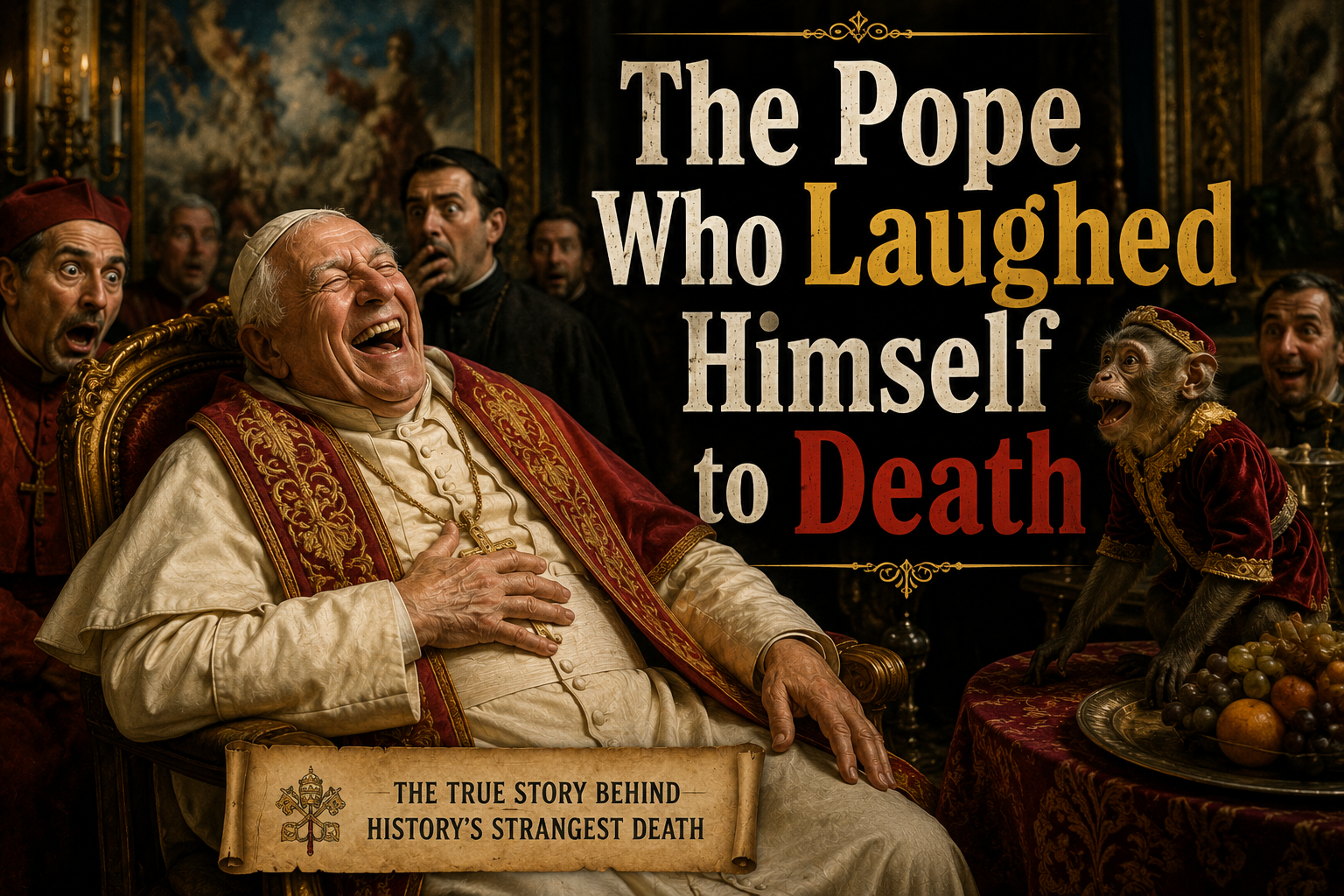
 On a hot summer night in August 1555, one of the most powerful men in Europe reportedly began laughing uncontrollably at a joke involving a monkey. The laughter grew louder and more violent until the elderly pope could barely breathe. Within moments, he collapsed. Not long afterward, he was dead.
The man was Pope Julius III.
For centuries, stories have circulated claiming the pontiff literally laughed himself to death after witnessing or hearing something absurd involving his pet monkey. Whether every detail is perfectly accurate has long been debated by historians, but the tale survived because it perfectly captured the bizarre atmosphere surrounding Julius III’s papacy — a reign filled with extravagance, scandal, strange court behavior, political chaos, and rumors that shocked even Renaissance Rome.
The image of a pope dying in hysterics sounds almost fictional, yet the story became one of the strangest legends in Vatican history.
Rome During the Renaissance
To modern audiences, it is easy to imagine popes solely as religious figures. But during the Renaissance, popes were also political rulers, military strategists, patrons of the arts, and major players in European power struggles.
The Vatican functioned almost like a royal court.
Popes commanded armies, negotiated alliances, financed massive building projects, and surrounded themselves with artists, advisors, nobles, servants, and entertainers. Rome itself was a city overflowing with spectacle, ambition, corruption, and public drama.
By the time Julius III became pope in 1550, the Catholic Church was under enormous pressure.
The Protestant Reformation had shattered religious unity across Europe. Martin Luther’s movement continued spreading rapidly while many critics accused the Church of corruption and excess. The Vatican desperately needed strong leadership capable of restoring stability and credibility.
Instead, many people believed Julius III turned the papacy into something resembling a lavish Renaissance circus.
The Rise of Julius III
Born Giovanni Maria Ciocchi del Monte in 1487, the future pope came from a respected but not especially dominant noble family. He was intelligent, politically skilled, and experienced in church diplomacy.
During his early career, he gained recognition as a capable administrator and negotiator. He participated in important church councils and gradually climbed the Vatican hierarchy.
When he became Pope Julius III in 1550, many cardinals expected moderation and competence.
At first, he seemed promising.
He attempted to restart the Council of Trent, the major Catholic effort to respond to the Protestant Reformation. He also worked to balance competing European powers, particularly France and the Holy Roman Empire.
But Julius III soon became notorious for behavior that many contemporaries viewed as embarrassing, indulgent, or outright bizarre.
The Lavish Pope
Julius III loved luxury.
He spent enormous sums on banquets, entertainment, gardens, architecture, and elaborate celebrations. He commissioned the construction of the Villa Giulia, a magnificent Renaissance villa filled with fountains, artwork, and lavish decorations.
While many Renaissance popes enjoyed luxury, Julius gained a reputation for excess during a time when the Church could hardly afford scandal.
Critics believed he lacked seriousness.
Some accused him of caring more about pleasure than reform.
Others viewed his court as chaotic and filled with favoritism.
Stories circulated constantly about unusual behavior inside the Vatican during his reign. Foreign diplomats often described the atmosphere around Julius III as theatrical and unpredictable.
Yet one figure at the center of many rumors caused even greater controversy than the pope himself.
Innocenzo and the Vatican Scandal
One of the most infamous aspects of Julius III’s papacy involved a young man named Innocenzo Ciocchi Del Monte.
According to many accounts, Innocenzo was originally a teenage street boy or servant whom Julius encountered before becoming pope. Despite the boy’s humble origins and lack of education, Julius rapidly elevated him to positions of enormous wealth and influence after taking office.
The pope made Innocenzo a cardinal astonishingly quickly.
The appointment shocked Rome.
Cardinals were supposed to be serious religious officials, yet Innocenzo was viewed by critics as inexperienced, immature, and wildly unqualified. Rumors exploded throughout Europe regarding the true nature of the pope’s relationship with him.
Enemies mocked the Vatican openly.
Political cartoons and satirical writings circulated widely.
The scandal badly damaged Julius III’s reputation and reinforced perceptions that his papacy lacked dignity.
Even centuries later, historians still debate the full truth behind the relationship. But at the time, the controversy became impossible to ignore.
A Court Filled With Oddities
The atmosphere surrounding Julius III’s court encouraged gossip and legend.
Unlike stern or disciplined rulers, Julius enjoyed spectacle and amusement. His household reportedly included entertainers, exotic animals, musicians, jesters, and unusual pets.
Among those pets was supposedly a monkey.
Monkeys fascinated wealthy Europeans during the Renaissance because they were rare, expensive, and exotic. Nobles often displayed them almost as living status symbols. Some dressed them in tiny clothing or trained them to perform tricks during banquets.
Accounts vary regarding the exact details, but many versions of the story claim Julius III either witnessed his monkey performing something ridiculous or heard a particularly hilarious story involving the animal shortly before his death.
The pope began laughing uncontrollably.
And then things went terribly wrong.
The Fatal Laugh
By 1555, Julius III was already in poor health.
He suffered from gout and various physical ailments common among aging Renaissance elites who consumed rich food and wine regularly. Doctors of the time possessed limited medical understanding, and even minor health problems could quickly become deadly.
According to the legend, the pope’s laughter spiraled beyond control.
Some versions claim he watched the monkey behaving absurdly.
Others say someone told a joke so funny that Julius could not stop laughing.
Still others suggest the pope became hysterical during a comic performance inside the Vatican.
Whatever the precise cause, the story says the laughter triggered a fatal seizure, stroke, or heart-related collapse.
Shortly afterward, the pope was dead.
Whether entirely factual or partly embellished over time, the story spread rapidly because people found it irresistible. The idea of a pope — supposedly God’s representative on Earth — dying from uncontrolled laughter at a monkey perfectly matched the bizarre reputation Julius III had developed during his reign.
Did He Really Laugh Himself to Death?
Modern historians debate how literally the story should be taken.
It is entirely possible that Julius III died from natural causes and later writers exaggerated the circumstances to mock him. Renaissance Rome was overflowing with political propaganda, gossip, and satire. Enemies of unpopular popes often spread humiliating stories after their deaths.
At the same time, people absolutely can die during episodes of extreme laughter if underlying medical conditions exist.
Violent laughter can trigger heart attacks, strokes, breathing problems, or fatal ruptures in vulnerable individuals. Modern medicine has documented rare cases of laughter-related deaths.
So while the details involving the monkey may have grown more theatrical over time, the basic concept is not impossible.
The legend endured because it felt emotionally true to the era and the man himself.
A Papacy Overshadowed by Ridicule
Julius III’s death became symbolic of how many critics viewed his entire papacy.
Rather than being remembered primarily for church reform or political achievements, he became associated with indulgence, scandal, and absurdity. Protestant critics especially seized upon stories about Julius as evidence that the Catholic Church had become morally corrupt.
The timing could hardly have been worse.
The Protestant Reformation was already challenging papal authority across Europe. Stories about scandalous or ridiculous popes only strengthened anti-Catholic arguments.
For supporters of reform, Julius III represented everything wrong with Renaissance excess.
For historians, however, the truth is more complicated.
More Than a Punchline
Despite his reputation, Julius III was not merely a foolish clown sitting on the papal throne.
He genuinely attempted to continue important church reforms. He helped restart the Council of Trent, which ultimately became one of the defining events of the Catholic Counter-Reformation. His diplomatic efforts also helped stabilize certain political tensions during a turbulent era.
Like many Renaissance rulers, he was a contradictory figure.
He could be intelligent yet reckless.
Cultured yet indulgent.
Politically skilled yet personally careless.
The famous laughter story survives partly because it reduces a complex historical figure into one unforgettable image.
A pope laughing so hard at a monkey that he dies.
It is grotesque, comedic, tragic, and oddly human all at once.
Death in Renaissance Rome
The story also reflects the strange atmosphere of Renaissance Italy itself.
This was an age where immense religious devotion existed alongside shocking extravagance. Cardinals hosted lavish feasts while plague outbreaks devastated cities. Artists painted breathtaking religious masterpieces while political assassinations unfolded nearby.
The papal court could feel both holy and deeply theatrical.
Against that backdrop, the story of Julius III’s bizarre death almost feels appropriate.
The Renaissance blurred the line between sacred authority and public spectacle. Popes were expected to embody divine dignity, yet many lived like secular princes surrounded by luxury and entertainment.
Julius III simply became one of the most extreme examples.
The Legend That Wouldn’t Die
Over the centuries, the story of the pope who laughed himself to death kept resurfacing in books, trivia collections, historical oddities, and discussions of unusual deaths.
The image is impossible to forget.
A frail old pope, surrounded by the splendor of Renaissance Rome, suddenly overcome with hysterical laughter at something ridiculous, collapsing as the Vatican court watches in horror.
Whether entirely accurate or partly mythologized, the story survives because it captures something timeless about power and mortality.
Even the most powerful men in the world remain vulnerable to absurdity.
Kings fall from horses.
Generals lose battles through stupidity.
Emperors choke at banquets.
And one pope, according to legend, laughed himself into the grave.
Among all the dramatic deaths in religious history, few are remembered with such bizarre fascination as the final moments of Pope Julius III — the pontiff whose last act may have been uncontrollable laughter echoing through the halls of the Vatican.