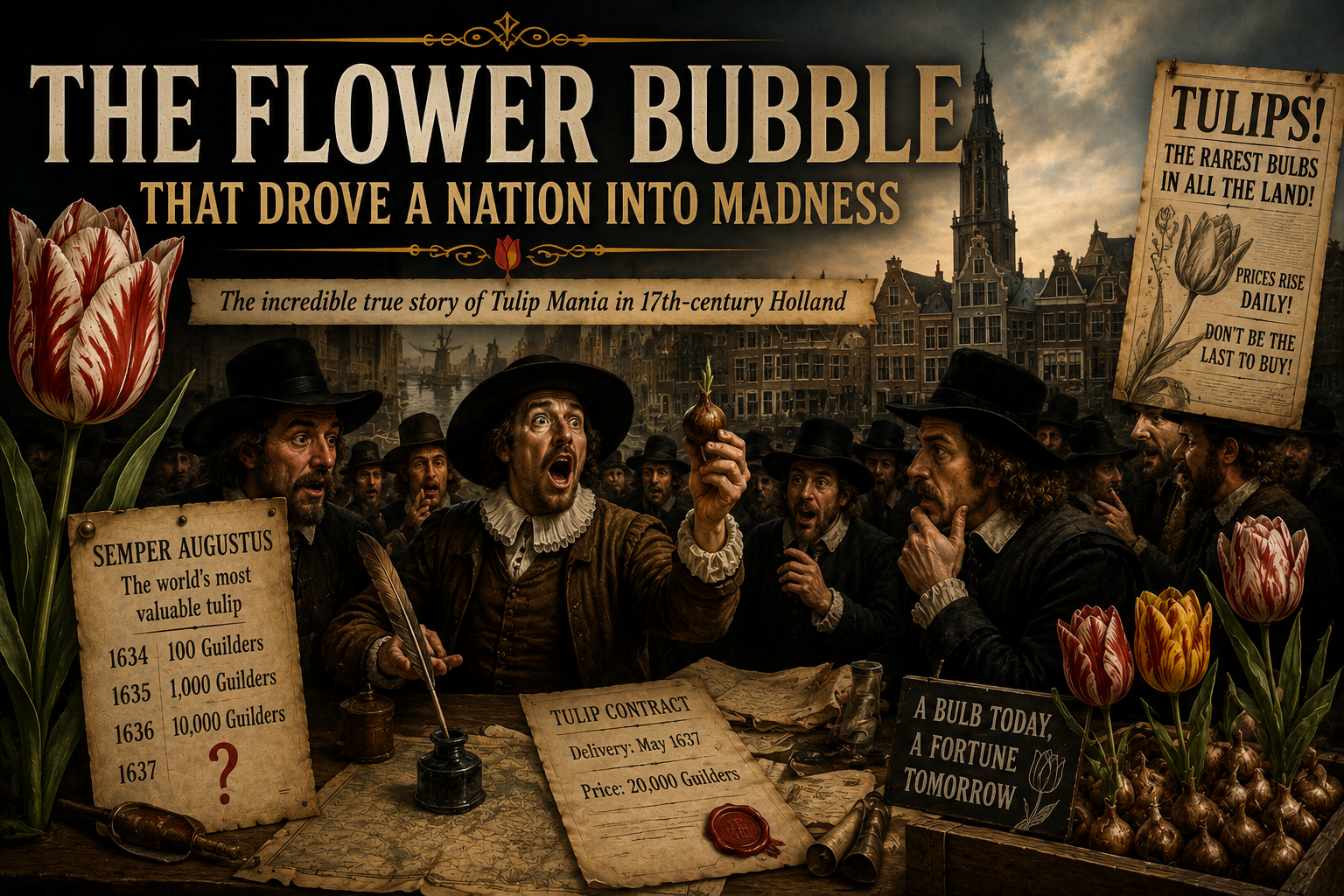
 In the winter of 1637, perfectly sane adults in the Dutch Republic began spending staggering fortunes on tulip bulbs.
Merchants traded flowers they had never physically seen.
Contracts changed hands inside crowded taverns filled with shouting speculators.
Some bulbs supposedly sold for the price of luxury homes.
Others were exchanged for livestock, land, furniture, wine, silver, or entire business inventories.
Then, almost overnight, the market collapsed.
Fortunes evaporated.
Contracts became worthless scraps of paper.
And one of the most famous financial disasters in history was born.
The event became known as Tulip Mania — the extraordinary economic frenzy that turned flowers into one of the most valuable commodities in Europe. For centuries, the story has been retold as a warning about greed, speculation, and the irrational behavior of crowds.
But the truth behind Tulip Mania is more complicated than many people realize.
It was not simply about flowers.
It was about status, wealth, fear, ambition, and the dangerous psychology of markets.
The Dutch Golden Age
To understand Tulip Mania, you first have to understand the Netherlands during the early 1600s.
At the time, the Dutch Republic was one of the richest and most powerful societies on Earth. Amsterdam had become a global center of trade and finance. Dutch ships crossed oceans carrying spices, textiles, sugar, and luxury goods from around the world.
Money flowed constantly through the republic.
The Dutch East India Company dominated international commerce. Wealthy merchants built elegant homes beside canals while artists like Rembrandt and Vermeer transformed Dutch culture into one of Europe’s great creative eras.
This prosperity created something relatively new in European history: a massive middle class with disposable income.
And wealthy societies often become obsessed with luxury.
The Arrival of the Tulip
Tulips were not originally Dutch flowers.
The plants arrived in Europe from the Ottoman Empire during the 1500s. European botanists and wealthy collectors immediately became fascinated by them. Tulips looked exotic, colorful, and unlike most flowers commonly grown in northern Europe.
Certain varieties were especially prized.
Some tulips developed dramatic streaks and flame-like patterns on their petals. Unknown to growers at the time, these beautiful color patterns were caused by a virus affecting the flowers. Ironically, diseased tulips became the most valuable of all.
Rare tulips turned into status symbols.
Owning unusual varieties demonstrated wealth, sophistication, and access to international trade networks. Aristocrats and merchants competed to display the most beautiful flowers in carefully maintained gardens.
Soon, collectors began paying extraordinary prices for rare bulbs.
That was when speculation entered the picture.
When Flowers Became Investments
At first, tulips were simply luxury items for wealthy enthusiasts.
But by the 1630s, more people realized tulips could function as speculative investments. Prices kept rising, and buyers believed they could always sell bulbs later for even greater profits.
This mentality spread rapidly.
People who knew nothing about botany entered the market hoping to get rich quickly.
Trades became increasingly detached from reality. Buyers and sellers often exchanged contracts for bulbs that were still underground and months away from blooming. Speculators rarely handled actual flowers. They traded promises, futures, and paper agreements.
In effect, the Dutch accidentally created an early futures market.
And it quickly spiraled into something irrational.
The Taverns of Speculation
Many tulip deals took place in taverns.
Groups of traders gathered around tables drinking wine and negotiating bulb contracts late into the night. The atmosphere often resembled gambling more than commerce.
Prices climbed constantly.
Every successful sale encouraged more speculation.
A bulb purchased one month might double or triple in value shortly afterward. Stories spread of ordinary people becoming wealthy almost instantly through tulip trading.
The fear of missing out became overwhelming.
Artisans, shopkeepers, brewers, and laborers all entered the market hoping for easy profits. Some mortgaged property or borrowed heavily to buy rare bulbs before prices climbed even higher.
Tulips transformed from flowers into symbols of financial fantasy.
The Most Valuable Bulbs in Europe
Certain tulip varieties became legendary.
One of the most famous was the Semper Augustus, a white tulip with dramatic crimson streaks. It was exceptionally rare and enormously desirable among wealthy collectors.
According to historical accounts, individual bulbs sometimes sold for astonishing sums.
Stories circulated claiming rare bulbs were worth more than elegant Amsterdam houses. Other reports described trades involving horses, wagons, grain, silver cups, livestock, wine casks, furniture, and years of wages.
Some historians debate whether the most extreme prices were exaggerated later, but there is no doubt that the market became detached from normal economic logic.
People were no longer buying flowers.
They were buying the dream of future wealth.
Why Tulips Became So Dangerous
The tulip market contained a psychological trap that appears repeatedly throughout financial history.
As prices rose, people convinced themselves the increases made sense because prices had already been rising.
Speculators looked around and saw neighbors making money.
Merchants saw contracts selling instantly.
Buyers believed demand would continue forever.
That belief fed the bubble.
Tulips also possessed an aura of exclusivity. Since many rare bulbs were difficult to cultivate and reproduced slowly, scarcity made them feel even more valuable.
The market became driven less by practical value and more by emotion.
Greed mixed with fear.
Nobody wanted to miss the opportunity.
And nobody wanted to be the last person holding overpriced bulbs when reality finally returned.
The Collapse of 1637
Then came the panic.
In February 1637, buyers suddenly stopped appearing at auctions.
One failed sale triggered anxiety.
Anxiety triggered hesitation.
Hesitation triggered fear.
Almost instantly, confidence evaporated.
Speculators who had spent enormous sums on tulip contracts discovered there were no buyers willing to pay the inflated prices anymore. Contracts that once seemed incredibly valuable became nearly worthless.
Prices collapsed across the Dutch Republic.
Some bulbs lost most of their value within days.
The psychological shift was devastating. A market built entirely on confidence disintegrated once people realized prices could fall just as quickly as they had risen.
The mania was over.
Financial Ruin and Public Humiliation
For many participants, the collapse was financially painful and socially humiliating.
Some traders had committed themselves to enormous contracts they could no longer afford. Others desperately tried to escape deals before payments became due.
Lawsuits and disputes spread rapidly.
The Dutch government attempted to calm the chaos by modifying certain contract rules, but confidence in the tulip market had already shattered.
Importantly, modern historians believe Tulip Mania did not completely destroy the Dutch economy the way later legends sometimes suggest. The broader Dutch financial system remained remarkably strong.
But individual losses could still be severe.
Families lost savings.
Speculators went bankrupt.
And countless people learned brutal lessons about speculative bubbles.
How the Mania Became a Legend
Tulip Mania fascinated later generations because it seemed almost absurd.
The idea of people destroying themselves financially over flowers felt like a perfect metaphor for human irrationality. Writers, economists, and historians repeatedly used the story to illustrate the dangers of speculation.
In the centuries that followed, Tulip Mania became shorthand for any irrational economic frenzy.
Whenever markets spiral out of control, someone eventually compares the situation to Dutch tulips.
Stock market bubbles.
Cryptocurrency surges.
Housing booms.
Speculative crazes of every kind.
Tulip Mania remains the historical reference point for collective financial madness.
The Reality Behind the Myth
Modern historians have complicated some of the older myths surrounding Tulip Mania.
For years, many writers claimed the bubble ruined huge portions of Dutch society. More recent research suggests the most extreme financial damage may have been somewhat limited to particular trading circles rather than the entire population.
Some dramatic stories about people selling everything they owned for tulips were likely exaggerated over time.
Yet the essential truth remains.
A speculative frenzy absolutely occurred.
People absolutely paid extraordinary sums for bulbs.
And the market absolutely collapsed in spectacular fashion.
Even if later storytellers embellished certain details, the core event remains astonishing.
The Strange Beauty of the Tulip
Part of what makes Tulip Mania so compelling is the contrast between beauty and greed.
Tulips are delicate flowers.
Their blooms last only briefly.
Yet for a short moment in the 1630s, these fragile plants became objects of obsession powerful enough to distort human behavior on a national scale.
Merchants argued over petals.
Fortunes rose and fell over bulbs hidden underground.
Elegant flowers became financial weapons.
There is something strangely poetic about the entire episode.
The First Modern Bubble
Many economists consider Tulip Mania one of the first recorded speculative bubbles in modern capitalist history.
The Dutch Republic had developed sophisticated financial systems unusually early for its time. Stock exchanges, futures trading, international commerce, and advanced banking all existed in forms that resembled modern markets.
Tulip Mania exposed both the power and danger of speculation.
Markets are not driven purely by logic.
They are driven by emotion, storytelling, momentum, fear, and collective psychology. When enough people believe prices will rise forever, almost anything can become a bubble.
Even flowers.
The Legacy of Tulip Mania
Nearly four centuries later, Tulip Mania still captures the imagination because it feels simultaneously ridiculous and deeply familiar.
Modern societies often assume people in the past were irrational in uniquely foolish ways.
But the tulip traders of the 1630s behaved much like modern speculators chasing internet stocks, real estate booms, meme coins, or luxury collectibles.
Human psychology has not changed much.
People still chase fast wealth.
Crowds still convince themselves impossible prices are normal.
And bubbles still burst when confidence disappears.
The Dutch Republic survived Tulip Mania, but the story endured because it revealed something uncomfortable about human nature.
Sometimes people become so intoxicated by the possibility of profit that they stop asking simple questions.
Like why a flower bulb suddenly costs as much as a house.
For one brief period in the 1630s, tulips became more than flowers. They became symbols of wealth, dreams, vanity, fear, and financial illusion — delicate petals wrapped around one of history’s earliest economic manias.